


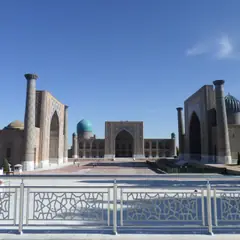
Three madrasas face to face
Registan Square
What to see at the Registan in Samarkand: the esplanade of proclamations, Ulugh Beg's portal of stars, the straightened minarets, the gold of Tilla-Kari and the sun tigers of Sher-Dor.
Samarkand, Uzbekistan
Explore Samarkand with 31 audio stops and documented, fact-checked narration. From Tamerlane's nephrite slab to Ulugh Beg's marble arc, every place explains how the Silk Road city rose, fell and rose again.
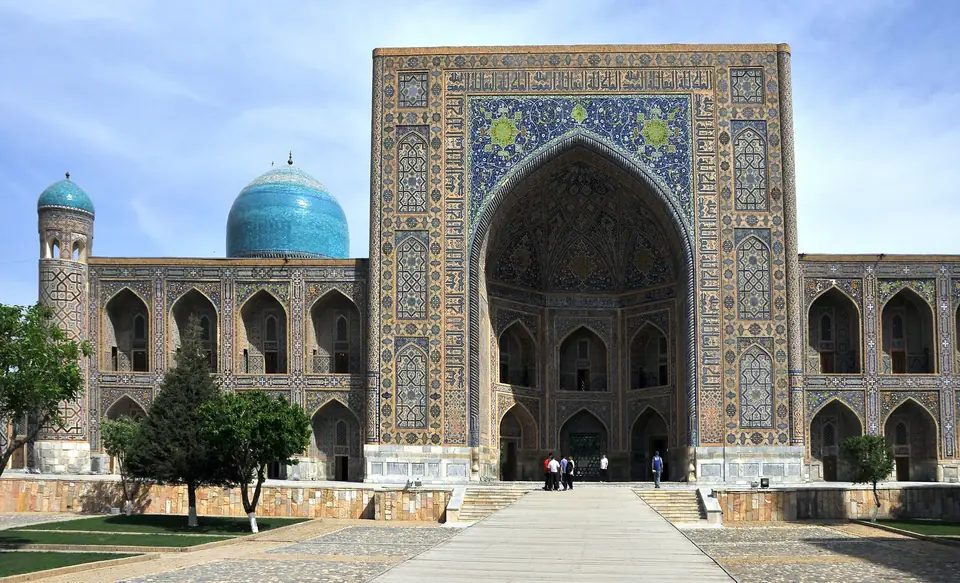
Three madrasas face to face
What to see at the Registan in Samarkand: the esplanade of proclamations, Ulugh Beg's portal of stars, the straightened minarets, the gold of Tilla-Kari and the sun tigers of Sher-Dor.
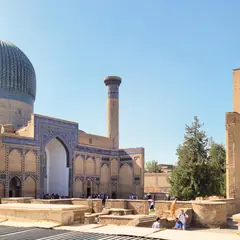
Tamerlane's mausoleum
What to see at Gur-e-Amir: Muhammad Sultan's portal, the 64-ribbed dome, the Kök Tash stone, the golden hall and Tamerlane's nephrite slab.
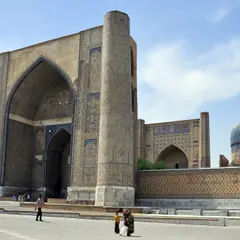
Tamerlane's grand mosque
What to see at the Bibi-Khanym Mosque: the portal Tamerlane had rebuilt, the courtyard without galleries, Ulugh Beg's marble lectern and the great turquoise dome.
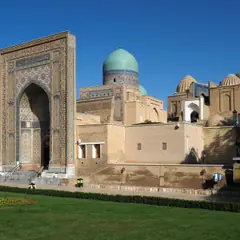
Street of Timurid mausoleums
What to see at Shah-i-Zinda: Abdulaziz's portal, the staircase of 40 steps, the double-domed mausoleum, the ceramics of Shadi Mulk Aqa and the carved door of the Living King.

Samarkand's great market
What to see at the Siab Bazaar in Samarkand: the triple-arched gate, the tandoor bread row, wedding halva, dried fruit and the pavilions of the dehkan market.

7th-century Sogdian murals
What to see at the Afrasiab Museum: the hills of pre-Islamic Samarkand, the wall of the ambassadors, the Sogdian inscription, the Chinese boat and King Varkhuman's procession.
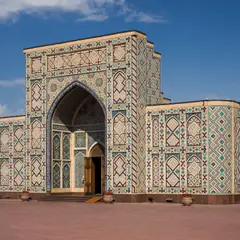
Timurid astronomy
What to see at the Ulugh Beg Observatory: the foundations of the three-storey cylinder, Vyatkin's tomb, the marble arc of the Fakhri sextant and the museum of the star tables.
Samarkand Audio Guide
Samarkand reads like a succession of capitals. To the north, under the hills of Afrasiab, sleeps the city inhabited from around 500 BC until the Mongols arrived in 1220, and its museum keeps the 7th-century Sogdian murals where Chinese envoys with silk cocoons file before King Varkhuman. On its slope climbs Shah-i-Zinda, a street of Timurid ceramic mausoleums rising towards the tomb of the Living King. Further down begins Tamerlane's Samarkand: the Bibi-Khanym Mosque, with a 167-by-109-metre courtyard and a portal the conqueror had torn down for being too low, and wall to wall with it the Siab Bazaar, with more than 17 kinds of tandoor bread. On the Registan, the Ulugh Beg Madrasa faces Sher-Dor and its sun tigers head on, and at Gur-e-Amir Tamerlane lies at the feet of his master under a nephrite slab. On the outskirts, a trench cut into the rock preserves the marble arc of Ulugh Beg's observatory, from which came a catalogue of 1,018 stars.
With the EarGuide Samarkand audio guide, every place reveals its history through documented narration checked against historical sources. Unlike a free walking tour or a conventional guided visit, you set the pace, the order and the stops. No groups, no timetables, no internet connection.
No internet needed
Download the routes before you head out and explore without using data.
Smart geolocation
The narration starts by itself when you reach the point of interest.
Frequently asked questions
The EarGuide app is free. The Samarkand audio guide includes 7 independent routes with about six and a half hours of narration spread across 7 sites and 31 audio stops, and it is found inside the app itself.
No. EarGuide works entirely offline. Download the routes over WiFi before you set out and you can use the audio guide with no connection and no data use throughout your visit. The map shows your GPS position in real time even without coverage.
The Samarkand audio guide is available in Spanish and English, with documented, fact-checked narration on Tamerlane's capital, Ulugh Beg's science and the Sogdian city of Afrasiab.
The audio guide brings together 7 independent routes with about six and a half hours of narration in total, from 40 minutes to an hour and a half per route. The most comfortable way is to split them over two days: the Registan, Gur-e-Amir, Bibi-Khanym and the Siab Bazaar on one, and Shah-i-Zinda, the Afrasiab Museum and the Ulugh Beg Observatory, to the northeast, on another.
They are different experiences. The EarGuide audio guide lets you explore Samarkand without timetables or groups, pause and resume whenever you like, and replay any explanation as often as you need. It suits independent travellers, families and anyone who prefers to understand the city at their own pace, with no prior knowledge of Central Asia.
The Samarkand audio guide covers 7 main sites: Registan Square, the Gur-e-Amir Mausoleum, the Bibi-Khanym Mosque, the Shah-i-Zinda Necropolis, the Siab Bazaar, the Afrasiab Museum and the Ulugh Beg Observatory.
Yes, in good shoes. Five of the seven sites, from the Gur-e-Amir Mausoleum to Shah-i-Zinda, lie a little over two kilometres apart in a straight line from one end to the other, and the Bibi-Khanym Mosque and the Siab Bazaar are wall to wall. The Afrasiab Museum is a kilometre from Shah-i-Zinda and the Ulugh Beg Observatory, the farthest, is about 3.5 kilometres from the Registan; for those two stretches, a taxi saves time.
Yes. Purchases belong to your EarGuide account, not to one app or one phone. A city unlocked in the EarGuide app is also unlocked in that city's own app, and the other way round, on both iPhone and Android. Just sign in with the same account on the other device. The store's “restore purchases” button only covers the app the purchase was made in, so signing in is what carries it across.
The Samarkand audio guide is inside the EarGuide app, free and ready to use offline. Carry it in your pocket and explore the city at your own pace.
More destinations
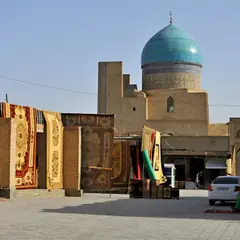
The Silk Road city: a minaret that survived Genghis Khan, the emirs' citadel, a thousand-year-old mausoleum and the last great pool. Explore Bukhara with audio guides.
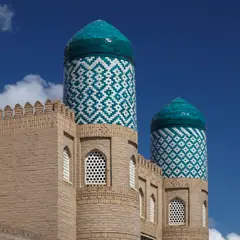
The walled city of Itchan Kala: a turquoise minaret left unfinished, a mosque of 212 wooden columns and the khans' citadel. Explore Khiva with audio guides.

From Chorsu Bazaar under its blue dome to the Hazrati Imam Complex and the opera house finished by Japanese prisoners: the Uzbek capital between madrasas and Soviet modernism, with audio guides.

3 cities
7 routes · ~6.5h of audio

7 routes · ~6.5h of audio

14 cities

3 cities

7 routes · ~7h of audio

7 routes · ~7.5h of audio
3 cities
3 cities

7 routes · ~5h of audio

4 cities
5 cities
9 cities

7 routes · ~5.9h of audio
3 cities
5 cities
4 cities

7 routes · 8h of audio

3 cities

4 cities

6 cities
3 cities
7 routes · ~5.5h of audio
7 routes · ~7.5h of audio

7 routes · ~5h of audio

7 routes · ~8.5h of audio

6 routes · 6h of audio

7 routes · ~6h of audio

7 routes · ~5h of audio
3 cities

7 routes · ~8.5h of audio

7 routes · ~7h of audio

3 cities
10 cities
3 cities

7 routes · ~9h of audio

7 routes · ~5h of audio

7 routes · ~9h of audio

7 routes · ~6.5h of audio

8 cities

7 routes · ~9.5h of audio
7 cities

7 routes · ~6h of audio