Natural monument
Elephant Rock Audio Guide (Jabal AlFil)
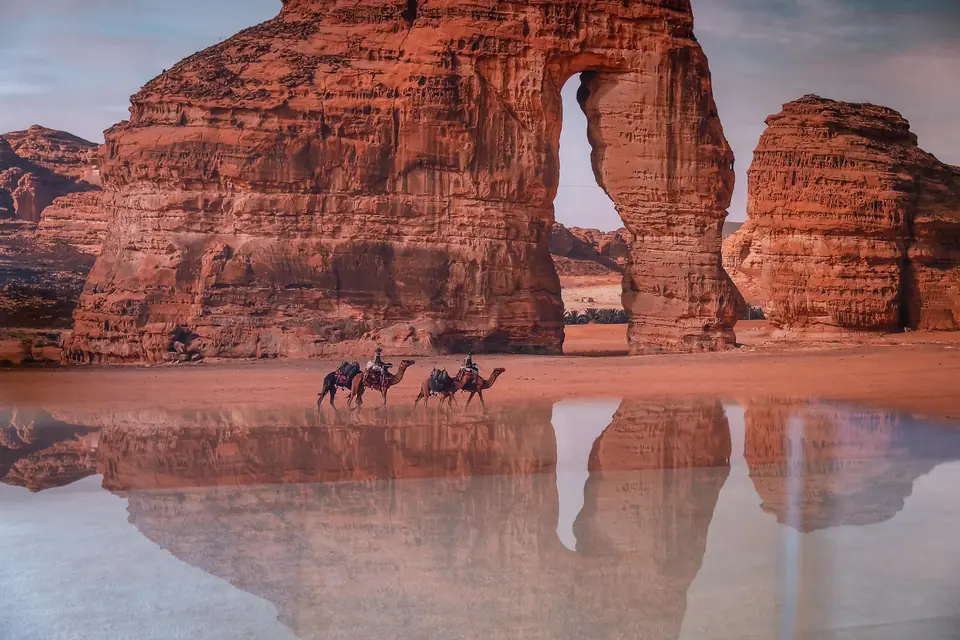
A 52-metre elephant with its trunk planted in the sand that no sculptor touched: wind and water drew it on sandstone born when there was still no animal life on dry land.
- 45 min of audio
- Geological formation
Jabal AlFil, the “elephant mountain”, rises isolated above the sand northeast of AlUla Old Town. Its red sandstone formed between 540 and 485 million years ago from sand carried by immense rivers at the edge of Gondwana; buried for hundreds of millions of years, it returned to the surface with the opening of the Red Sea, and erosion dismantled that plateau until it left this silhouette.
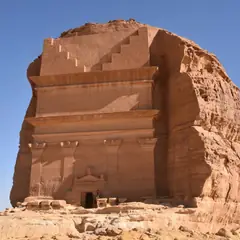
A few kilometres away, the Nabataeans carved Hegra's funerary facades by hand; here no hand intervened, although the profile is so sharp that it looks like the work of an ancient civilisation. And the rock is not only geology: at nightfall it lights up with floodlights and the esplanade around it becomes AlUla's open-air living room, with seats sunk into the sand and bonfires.
Highlights
- Trunk and central gap — an opening carved by erosion in a 52 m mass
- Sandstone from 540–485 million years ago, from a world without animals on land
- Night esplanade — seats sunk into the sand, bonfires and a lit rock
- Neighbouring formations — the game of spotting figures, like a faceless sphinx
The story of Elephant Rock begins long before that of any civilisation. The red sandstone it is made of was deposited about 500 million years ago, when AlUla lay on the edge of the supercontinent Gondwana and braided rivers more than 100 kilometres wide carried and buried sand, with no animals or forests yet on dry land. Compressed and heated, that sand turned to stone, spent hundreds of millions of years underground and, as the Red Sea opened, was pushed to the surface as a great plateau. Wind and rain did the rest: what remains of that mass today is Jabal AlFil, a 52-metre elephant with its trunk resting on the sand.
That is the official figure, although some sources speak of about 50 metres and some simply describe it as a rock “three storeys” tall; the date of the uplift also varies, with some pages placing it about 30 million years ago and others about 40. What allows no argument is the effect of the silhouette on arrival. The Royal Commission for AlUla has developed the surroundings with car parks, walkways and seating areas, and the site opens every afternoon until midnight. The audio guide tours the rock in three stops, from the wooden walkway to the central gap and from there to the bonfires, with a narration documented and checked against geological and historical sources.
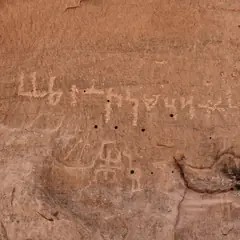
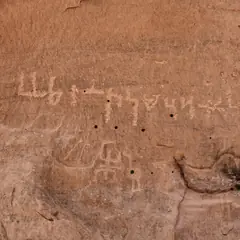
The other half of the valley’s geological story, the black lava that covered the sandstone, can be read from the Harrat Viewpoint; in the gorge of Jabal Ikmah, by contrast, sandstone served as the page for hundreds of inscriptions.
A sculpture nobody carved, seen from the walkway
Wooden walkway
Summary of this stop
The rock is about 20 minutes by car northeast of AlUla Old Town along Highway 70. From the free car park, a plank walkway leads to the entrance of the site, and at the end of that path the first view appears: a mass of red sandstone that rises suddenly from flat ground and reaches 52 metres at its highest point.
What is disconcerting is the sharpness of the figure. A few kilometres away, at Hegra, the Nabataeans carved their funerary facades by hand; here there was no chisel, only wind and water, and yet the profile looks like the work of an ancient sculptor. Climbing it is forbidden to protect it, but photographing it is allowed, and that photo has travelled far: on 18 March 2024 the rock was Bing’s image of the day in several national editions, under the title “Gentle giant of the dunes”. How that elephant ended up turned into a mammoth is one of the anecdotes the narration keeps for this point.
The trunk and the five-hundred-million-year gap
Elephant Rock
Summary of this stop
Facing the rock, the detail that gives the place its name is understood at once. Erosion has opened a large gap in the centre of the mass: on one side lies the body, with a rounded profile and pitted surface; on the other, the head, with a trunk that descends until it touches the sand. Against the light, the sky shows through the gap, and that gap is in itself a lesson in geology.
That gap sums up the stone’s whole journey, from the rivers at the edge of Gondwana to the opening of the Red Sea and the slow dismantling of the plateau. Most sources speak of millions of years of erosion, although one recent account mentions only thousands. In front of the rock there is also a game of spotting figures: according to popular belief, the elephant is missing its tusks, and among the neighbouring sandstone masses some people recognise a faceless sphinx. Where exactly it hides is something to discover with the audio guide on, looking around.
Bonfires at the foot of the lit elephant
Sunken seats and bonfires
Summary of this stop
As evening falls, the esplanade changes function. The seats sunk into the sand, facing the rock, group around bonfires; floodlights light up the sandstone and cut it against the starry sky, with ambient music in the background, and the nearby restaurants and cafés complete the scene until midnight. During Ramadan 2026, many residents and visitors came to break the fast at the foot of the elephant, timing the iftar with the sunset over the stone.
The rock has also become a stage. On 13 and 14 November 2026, as part of the AlUla Skies festival, it hosted the Hot Air Balloon Glow Show, with up to 12 illuminated hot-air balloons, fire, projections and acrobats. Around 2019, the area received at least 30,000 tourists a year; the story of a Colombian family who in 2021 crossed half the world to see Jabal AlFil, and of the woman who at first did not want to make the trip, tells at this last stop how quickly the elephant’s fortunes changed.