


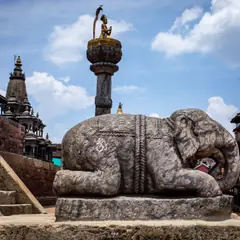
Malla royal square
Patan Durbar Square
What to see at Patan Durbar Square: the row of temples facing the Malla palace, the rebuilt Harishankar, the column of the gilded king and the Tusha Hiti well.
Patan, Nepal
Explore Patan with 31 audio stops and documented, fact-checked narration. From the royal square of the Malla kings, partly brought down by the 2015 earthquake and raised again piece by piece, to the Newar Buddhist courtyards where rituals are still held every day, every place tells how this city of craftsmen in the Kathmandu Valley turned brick, wood, stone and metal into temples.
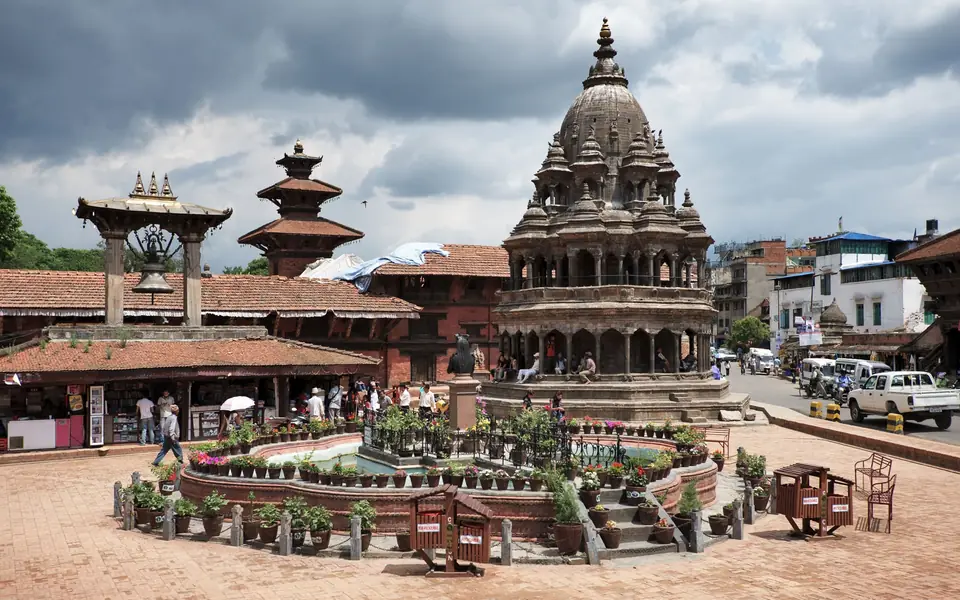
Malla royal square
What to see at Patan Durbar Square: the row of temples facing the Malla palace, the rebuilt Harishankar, the column of the gilded king and the Tusha Hiti well.
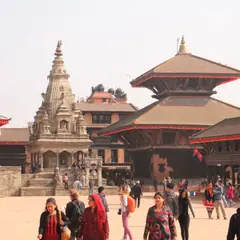
Stone temple
What to see at the Krishna Mandir in Patan: the stone temple with 21 golden pinnacles, its Mahabharata and Ramayana friezes, the avatars of Vishnu and the dabali in front of the façade.
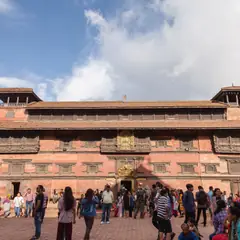
Malla palace and museum
What to see at the Patan Museum: the Golden Door and Window, the courtyard of the Vishnu shrine, the throne of 1666 and the Uma-Maheshwar relief returned from Berlin.
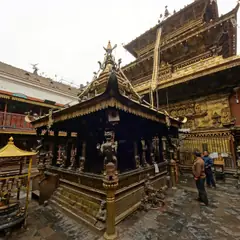
Newar Buddhist monastery
What to see at the Golden Temple in Patan: the pagoda with the golden façade, the Swayambhu chaitya, the child priest's shrine and the manuscript written in gold.
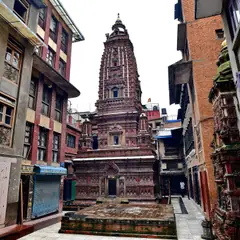
Newar Buddhist temple
What to see at the Mahabuddha Temple: the terracotta tower covered in buddhas, the balcony line of the 1934 earthquake, the Maya Devi shrine and the view from the rooftop.
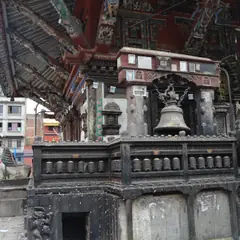
Newar temple
What to see at the Rato Machindranath Temple: the three-roof pagoda of 1673, Śrīnivāsa Malla's stele, the caged metal animals and the red image of the god.
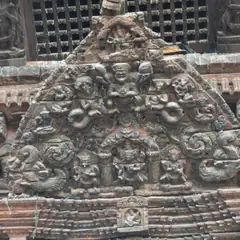
Shiva pagoda
What to see at the Kumbheshwar temple: the five-roof pagoda, the sacred pond of Gosainkunda, the Bagalamukhi shrine and the stone spouts of Konti Hiti.
Patan Audio Guide
Patan is explored from its royal square. On Patan Durbar Square, a row of brick-and-timber temples faces the palace of the Malla kings head-on, whose present architecture is mostly 17th-century; on it rises the Krishna Mandir, a grey stone temple with 21 pinnacles that the whole city queues to see at Janmashtami, and the old palace now houses the Patan Museum, with bronzes that have never stopped being sacred and stolen gods that have come home. A few steps to the north, behind a stone gateway with lions, the Golden Temple keeps a gilded metal façade, a silver Buddha tended by a child priest and a book written in gold that is still read almost every day. Further north, the five-roof pagoda of Kumbheshwar watches over a pond that, according to tradition, flows down from the sacred lake of Gosainkunda. To the south, the Mahabuddha Temple copies the Mahabodhi of Bodh Gaya in terracotta, with a Buddha on every brick, and in the square of Ta Baha Rato Machindranath, the rain god who travels the city on the chariot of Nepal's longest jatra, lives for half the year.
With the EarGuide Patan audio guide, every place reveals its history through documented narration checked against historical sources. Unlike a free walking tour or a conventional guided visit, you set the pace, the order and the stops. No groups, no timetables, no internet connection.
No internet needed
Download the routes before you head out and explore without using data.
Smart geolocation
The narration starts by itself when you reach the point of interest.
Frequently asked questions
The EarGuide app is free. The Patan audio guide includes 7 independent routes with about five hours of narration spread across 7 sites and 31 audio stops, and it is found inside the app itself.
No. EarGuide works entirely offline. Download the routes over WiFi before you set out and you can use the audio guide with no connection and no data use throughout your visit. The map shows your GPS position in real time even without coverage.
The Patan audio guide is available in Spanish and English, with documented, fact-checked narration on its royal square, its Hindu temples, its Newar Buddhist monasteries and its festivals.
The audio guide brings together 7 independent routes with about five hours of narration in total, from twenty-five minutes to an hour and a half per route. It can be done in one long day, although the most comfortable way is to give one day to Durbar Square, the Krishna Mandir and the Patan Museum, which alone calls for an hour and a half, and another to the neighbourhood temples: the Golden Temple, Kumbheshwar, Mahabuddha and Rato Machindranath.
They are different experiences. The EarGuide audio guide lets you explore Patan without timetables or groups, pause and resume whenever you like, and replay any explanation as often as you need. It suits independent travellers, families and anyone who prefers to understand the city at their own pace, with no prior knowledge of its history.
The Patan audio guide covers 7 main sites: Patan Durbar Square, the Krishna Mandir, the Patan Museum, the Golden Temple (Hiranya Varna Mahavihar), the Mahabuddha Temple, the Rato Machindranath Temple and the Kumbheshwar Temple.
Yes. The Krishna Mandir and the Patan Museum are on Durbar Square itself, and the other sites are less than ten minutes' walk from it: the Golden Temple and Kumbheshwar to the north, Rato Machindranath to the southwest and Mahabuddha, the farthest, a little over half a kilometre to the southeast, through the alleys of Okubahal.
Yes. Purchases belong to your EarGuide account, not to one app or one phone. A city unlocked in the EarGuide app is also unlocked in that city's own app, and the other way round, on both iPhone and Android. Just sign in with the same account on the other device. The store's “restore purchases” button only covers the app the purchase was made in, so signing in is what carries it across.
The Patan audio guide is inside the EarGuide app, free and ready to use offline. Carry it in your pocket and explore the city at your own pace.
More destinations
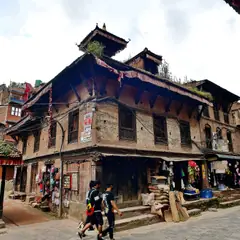
From the tallest pagoda in Nepal, raised in six months in 1702, to the Peacock Window and the oldest dated inscription in the country at Changu Narayan. Explore Bhaktapur with audio guides.
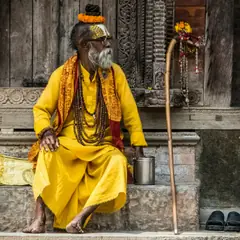
From the wooden pavilion that named the city to the pyres of the Bagmati and the painted-eyed dome of Boudhanath, by way of the palace of the 2001 royal massacre. Kathmandu with audio guides.
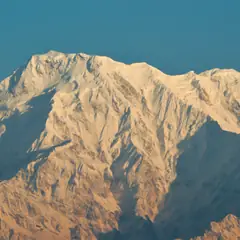
From the forest drowned beneath Phewa Lake to the waterfall that sinks into the Himalaya's largest cave and the pagoda the state tore down in 1974, with audio guides.

3 cities
7 routes · ~6.5h of audio

7 routes · ~6.5h of audio
14 cities

3 cities

7 routes · ~7h of audio

7 routes · ~7.5h of audio
3 cities

3 cities

7 routes · ~5h of audio
4 cities
5 cities
9 cities
7 routes · ~5.9h of audio
3 cities
5 cities
4 cities

7 routes · 8h of audio

3 cities

6 cities
3 cities
7 routes · ~5.5h of audio
7 routes · ~7.5h of audio

7 routes · ~5h of audio

7 routes · ~8.5h of audio

6 routes · 6h of audio

7 routes · ~6h of audio

7 routes · ~5h of audio

3 cities

7 routes · ~8.5h of audio
7 routes · ~7h of audio
3 cities
10 cities
3 cities

7 routes · ~9h of audio

7 routes · ~5h of audio

7 routes · ~9h of audio

7 routes · ~6.5h of audio
8 cities

7 routes · ~9.5h of audio
4 cities
7 cities

7 routes · ~6h of audio