



UNESCO World Heritage
Taj Mahal
What to see at the Taj Mahal in Agra: the calligraphed great gate, the paradise garden with its pool, the leaning minarets, the cenotaph chamber and the terrace over the Yamuna.
Agra, India
Explore Agra with 33 audio stops and a narration that is documented and checked against sources. From the marble mausoleum Shah Jahan raised for Mumtaz Mahal to the red sandstone citadel where he ended his days confined by his son, and to the capital Akbar built on a ridge beside a Sufi saint's cave, each place tells how three generations of Mughal emperors shaped the city.

UNESCO World Heritage
What to see at the Taj Mahal in Agra: the calligraphed great gate, the paradise garden with its pool, the leaning minarets, the cenotaph chamber and the terrace over the Yamuna.
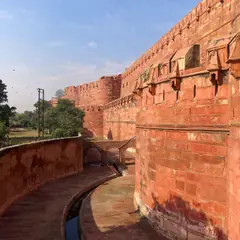
Mughal citadel
What to see at Agra Fort: red sandstone walls, Akbar's Jahangiri Mahal, Shah Jahan's marble pavilions, the black throne and the tower that looks onto the Taj Mahal.
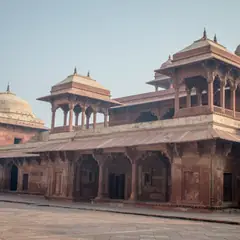
Akbar's Mughal capital
What to see at Fatehpur Sikri, Akbar's red sandstone capital near Agra: the Diwan-i-Khas, the Panch Mahal, the tomb of Salim Chishti and the Buland Darwaza.
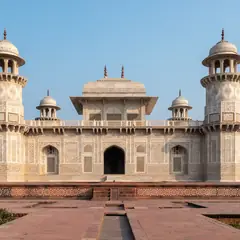
Mughal mausoleum
What to see at the Tomb of Itimad-ud-Daulah, Agra's Baby Taj: marble inlaid with hard stones, the charbagh garden and the pavilion over the Yamuna.
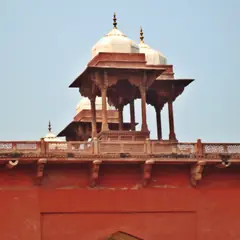
Mughal mausoleum
Emperor Akbar's mausoleum in Sikandra: gate with white minarets, a garden with antelopes, a red pyramid without a dome and a crypt plundered in 1688.

Mughal garden
What to see at Mehtab Bagh: the Mughal garden facing the Taj Mahal, its octagonal pool, the southeast tower and the story of the black Taj myth.

Great Mughal mosque
What to see at the Jama Masjid in Agra: the great mosque paid for by Princess Jahanara in 1648, with red-and-white zigzag domes, a Persian inscription and a unique pulpit.
Agra Audio Guide
Agra is best understood from the banks of the Yamuna, where the Mughal emperors raised palaces, gardens and tombs in barely a century. The Taj Mahal is the Makrana marble mausoleum that Shah Jahan commissioned in 1631 for Mumtaz Mahal, a garden of paradise laid out with obsessive symmetry and signed by its calligrapher. Upriver, Agra Fort shows in its walls the shift from Akbar's red sandstone ashlar to Shah Jahan's marble, the same emperor who spent his last years there confined by his son, with the Taj in sight. Opposite, on the other bank, Mehtab Bagh, the moonlight garden, lines up with the mausoleum and was rescued from the floods in 1994, and a little further north the tomb of Itimad-ud-Daulah, which Empress Nur Jahan dedicated to her parents, pioneered white marble inlaid with hard stones before the Taj itself. Completing the city are the Jama Masjid paid for by Princess Jahanara in 1648, with its red-and-white zigzag domes; Akbar's Tomb in Sikandra, a truncated red sandstone pyramid with the upper terrace open to the sky; and Fatehpur Sikri, the capital Akbar raised beside a Sufi saint's cave and which governed the empire between 1571 and 1585.
With the EarGuide Agra audio guide, each place reveals its history through a narration that is documented and checked against historical sources. Unlike a free tour or a conventional guided visit, you decide the pace, the order and the stops. No groups, no schedules, no internet connection.
No internet connection
Download the routes before you leave and explore without using data.
Smart geolocation
The narration starts on its own when you reach the point of interest.
Frequently asked questions
The EarGuide app is free. The Agra audio guide includes 7 independent routes with more than eight hours of narration spread across 7 places and 33 audio stops, and it is found inside the app itself.
No. EarGuide works completely in offline mode. Download the routes over WiFi before you leave and you can use the audio guide without a connection or data use throughout the whole route. The map shows your GPS position in real time even without coverage.
The Agra audio guide is available in Spanish and English, with a narration about the Taj Mahal, the palaces of Agra Fort, the Mughal tombs and Akbar's capital at Fatehpur Sikri, documented and checked against sources.
The audio guide brings together 7 independent routes with more than eight hours of narration in total, from forty minutes to two hours per route. It can be spread over two or three days: one for the Taj Mahal and Mehtab Bagh, another for Agra Fort, the Jama Masjid, the tomb of Itimad-ud-Daulah and Akbar's Tomb, and an excursion to Fatehpur Sikri, whose route lasts two hours.
They are different experiences. The EarGuide audio guide lets you explore Agra without schedules or groups, pause and resume whenever you want, and listen again to any explanation as many times as you need. It is ideal for independent travellers, families and those who prefer to understand the city at their own pace, with no prior knowledge of the history of the Mughal empire.
The Agra audio guide covers 7 main places: the Taj Mahal, Agra Fort, Fatehpur Sikri, the tomb of Itimad-ud-Daulah, Akbar's Tomb, Mehtab Bagh and the Jama Masjid.
Only in part. Agra Fort and the Jama Masjid are less than a kilometre from each other, and the Taj Mahal is about two kilometres from the Fort. Mehtab Bagh and the tomb of Itimad-ud-Daulah are on the other bank of the Yamuna, so it is best to go by car or rickshaw. Akbar's Tomb, in Sikandra, is about ten kilometres from the centre, and Fatehpur Sikri, almost forty, calls for a half-day excursion.
Yes. Purchases are tied to your EarGuide account, not to a specific app or phone. A city unlocked in the EarGuide app is also unlocked in that city's own app, and the other way round, on both iPhone and Android. You just need to sign in with the same account on the other device. The store's “restore purchases” button only covers the app in which the purchase was made, so what carries it over is signing in.
The Agra audio guide is inside the EarGuide app, free and ready to use offline. Carry it in your pocket and explore the city at your own pace.
More destinations

From Amber Fort, with its goddess brought from Bengal, to the 953 lattice windows of the Hawa Mahal and the 27-metre sundial of the Jantar Mantar. Explore Jaipur with audio guides.

From Shah Jahan's red wall to the Jama Masjid courtyard, the Sikh kitchen that feeds thousands for free every day and the Qutub Minar victory tower. New Delhi, with audio guides.

From Shiva's temple plated with a tonne of Sikh gold to the pyres burning day and night at Manikarnika and the Sarnath stupa that marks the Buddha's first sermon. Varanasi, with audio guides.

3 cities
7 routes · ~6.5h of audio

7 routes · ~6.5h of audio

14 cities

3 cities

7 routes · ~7h of audio

7 routes · ~7.5h of audio
3 cities

3 cities

7 routes · ~5h of audio

5 cities

9 cities

7 routes · ~5.9h of audio

3 cities

5 cities

4 cities

7 routes · 8h of audio

3 cities

4 cities

6 cities

3 cities
7 routes · ~5.5h of audio

7 routes · ~7.5h of audio

7 routes · ~5h of audio

7 routes · ~8.5h of audio

6 routes · 6h of audio

7 routes · ~6h of audio

7 routes · ~5h of audio

3 cities

7 routes · ~8.5h of audio

7 routes · ~7h of audio

3 cities

10 cities

3 cities

7 routes · ~9h of audio

7 routes · ~5h of audio

7 routes · ~9h of audio

7 routes · ~6.5h of audio

8 cities

7 routes · ~9.5h of audio
4 cities

7 cities

7 routes · ~6h of audio