Catalan Gothic
Barcelona Cathedral Audio Guide (Catedral de Barcelona)
The Seu of the Gothic Quarter took a century and a half to build without ever closing its doors to worship, and waited five more centuries for a façade. Santa Eulàlia sleeps beneath its altar, the coats of arms of Europe's kings were painted in its choir and thirteen white geese swim in its cloister.
- 30 min of audio
- Gothic of the Gothic Quarter
Barcelona Cathedral grew in layers. As early as the year 599 a church in the city was recorded as dedicated to the Holy Cross; in 1058 a Romanesque cathedral promoted by Count Ramon Berenguer the Elder and Countess Almodis was consecrated; and on 1 May 1298, under James II and Bishop Bernat Pelegrí, the Gothic work began, replacing the Romanesque church in stages while it remained in use. That is why the present temple keeps the axis of the earlier one, and why its main façade was not finished until 1913.
Behind the stone lie unexpected episodes: a king who in 1384 complained by letter that the works had broken the pipes of his palace, a Turk's head that threw sweets from the organ on Holy Innocents' Day, an egg that dances every Corpus Christi on the cloister fountain and a bell that, according to tradition, ended up melted into cannons after the siege of 1714.
Highlights
- Portal of Sant Iu — The oldest door, from 1298, the main entrance for five hundred years
- Neo-Gothic façade — 40 metres wide on a design of 1408, crowned in 1913 by Saint Helena
- Christ of Lepanto — Barcelona's most venerated image, possibly a 13th-century Gothic carving
- Golden Fleece choir stalls — The arms of the knights Charles V gathered in the choir in 1519
- Crypt and cloister — Santa Eulàlia's alabaster sarcophagus and the thirteen white geese
Barcelona Cathedral, the Seu, is a building that never stopped praying while it was being built. Its history begins long before the Gothic: at the second Council of Barcelona, in the year 599, the early cathedral was already recorded as dedicated to the Holy Cross, and in 877 it received in one of its chapels the relics of Santa Eulàlia, found at Santa María de las Arenas, the present Santa Maria del Mar. After the damage caused by Almanzor, Count Ramon Berenguer the Elder, Countess Almodis and Bishop Guislabert began a Romanesque cathedral in 1046, which Archbishop Wifred of Narbonne consecrated on 18 November 1058.
The history of Barcelona Cathedral as a Gothic temple begins on 1 May 1298, under King James II and Bishop Bernat Pelegrí. The work began at the east end and advanced as a renovation in stages: the Romanesque church was never entirely torn down and stayed in use, so the new building inherited its axis. The layers follow one another from there: the crypt of Santa Eulàlia, finished in 1326; Arnau Bargués’ former chapter house, from 1407; a plain wall that closed the façade in 1417; the chapter of the Golden Fleece that Charles V held in the choir in 1519; and, in the 19th century, the Neo-Gothic façade paid for by the industrialist Manuel Girona, whose crossing tower his children completed in 1913. Beside the sacristy are also preserved the tombs attributed to the founding count and countess, an identification that goes back only to the 16th century; according to documented tradition, Almodis was murdered in 1071 by her stepson Pere Ramon.
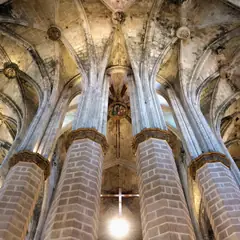
The architecture of Barcelona Cathedral also reads upwards: 215 vault keystones, those of the central nave two metres across and weighing about five tonnes, which the restoration of 1970 found to be polychrome. As for its measurements, sources do not fully agree on the length of the nave or the height of the towers and the crossing tower. What to see at Barcelona Cathedral is arranged in six stops, from the oldest door to the cloister of the geese, on a visit researched and checked against historical sources; what links each layer to the next is easier to grasp by walking it with the audio guide.
A few minutes’ walk away, in the Ribera district, the city’s other great Gothic church is Santa Maria del Mar, and to the west the Gothic Quarter flows out into La Rambla.
Sant Iu, the door that was the main one
Plaça de Sant Iu
Summary of this stop
On Carrer dels Comtes opens the Portal of Sant Iu, from 1298, in marble and Montjuïc stone: it is the cathedral’s oldest door and for five hundred years it was its main entrance. Angel musicians peer out along the arch, Santa Eulàlia fills the tympanum and the imposts reuse marble from the Romanesque cathedral. Its name comes from the building opposite, seat of the lawyers, whose patron is Saint Ivo. Very close by, on the apse, early 14th-century gargoyles show a unicorn, a knight and an elephant with a structure on its back.
The Gothic began here, while the old Romanesque church was still standing on the other side. Tearing it down piece by piece had consequences: in 1384 King Peter the Ceremonious wrote to the master builder Bernat Roca to complain that his workmen had broken the pipes that brought water to the royal palace, and it was Roca who took charge of the repair.
Above the door rises the clock tower, and with it the memory of the bell Honorata, the one that struck the quarters. According to documented tradition, it rang the alarm throughout the fourteen months of the siege that ended in 1714; afterwards the Bourbon authorities destroyed it and melted its metal for the cannons of the Citadel. The one that rings today is a recasting of 1865. What remains of that punished bell in the quarters you hear now is revealed by listening to the narration in front of the portal.
A façade that waited five centuries
Pla de la Seu
Summary of this stop
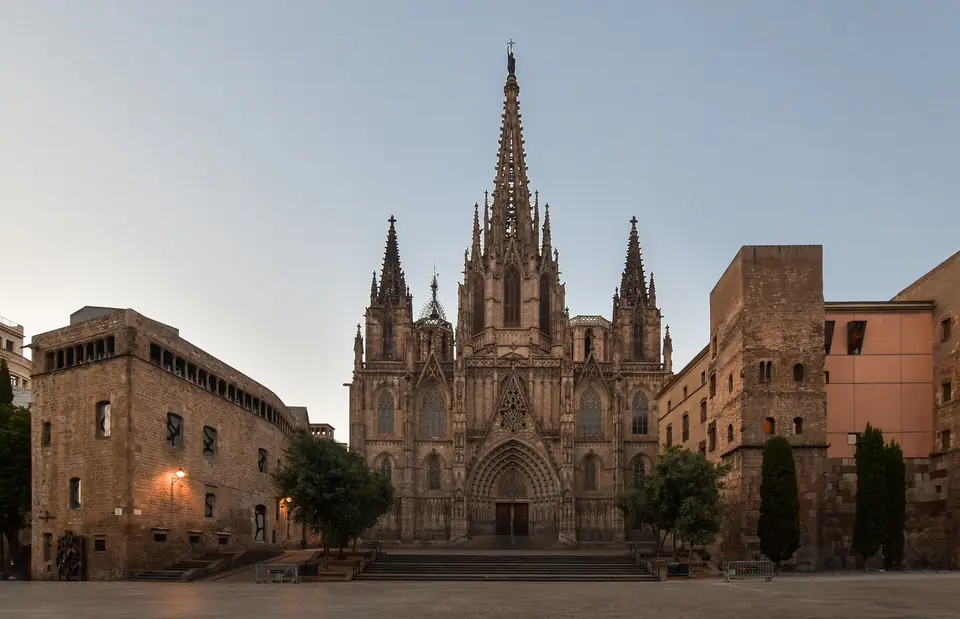
The façade that presides over the Pla de la Seu looks medieval and is not. In 1417 the main entrance was closed with a plain wall, and so it remained for centuries. The present one, Neo-Gothic and 40 metres wide, was paid for by the industrialist Manuel Girona on plans by Josep Oriol Mestres, who drew on the design made in 1408 by Carles Galtés de Ruan, known as Carlí. Two towers with tall pinnacles flank the portal, with a Christ by Agapit Vallmitjana on the central pier and 76 figures in the archivolts.
Above, the openwork spire of the crossing tower, which Girona’s children completed in 1913, culminates in a bronze Saint Helena by Eduard Alentorn holding the Holy Cross, the same one that gives the cathedral its name. That cross has its feast: every 3 May the municipality of Barcelona is blessed from the temple’s roof terraces. In 2024 the renovation of those terraces was opened, 2,002 m² of tiled floor with a new lift, open as a viewpoint over the towers, the pinnacles and the cloister.
How a design of 1408 ended up being built five centuries later, and what the cathedral lost or gained along the way, is told by the narration in front of the façade.
The Christ of Lepanto, older than its legend
Blessed Sacrament Chapel and Christ of Lepanto
Summary of this stop
The Blessed Sacrament Chapel is the former chapter house that Arnau Bargués built in 1407, with a star vault and a Pentecost keystone. There, above the Baroque tomb of Saint Olegarius, the Christ of Lepanto is venerated, Barcelona’s most venerated image: a crucifix with a leaning body before which devotion can be felt in the silence. Photos are not allowed during worship.
According to tradition, it travelled on the flagship of John of Austria at the battle of 1571 and bent to dodge a cannonball or to cover a leak. The restoration, however, told another story: removing the blackening of smoke, wax and 19th-century varnishes brought to light its original polychromy, and the study considers it a Gothic wooden carving, possibly from the 13th century. Visitor sheets still date it to the 16th century, so the discussion remains open.
Lepanto left another mark on the cathedral. Under the organ there hung, from shortly after the battle, the “carassa”, a Turk’s head with a turban that on Holy Innocents’ Day opened its mouth and threw sweets. In 1970 it was removed as offensive to Muslims and it is now in the triforium. How old the Christ really is and how a legend wins over a carving older than the battle is revealed by listening to the narration in the chapel.
Kings of Europe in the choir stalls
Bartolomé Ordóñez's retrochoir
Summary of this stop
In March 1519 Emperor Charles V gathered the chapter of the Order of the Golden Fleece in the cathedral choir. Juan de Borgoña painted on the backs of the upper choir stalls the coats of arms of the knights summoned, among them the kings of France and England. The Gothic choir stalls, in oak, raise tall canopies of pinnacles, and to their right is the pulpit of 1403.
Towards the nave, Bartolomé Ordóñez’s retrochoir presents a Renaissance marble screen in the form of a Doric colonnade, with four reliefs of the life of Santa Eulàlia, begun in 1519. Its marble has a curious story: after Ordóñez’s death it lay underground for 42 years, until Pere Villar resumed the work. Centuries later, during the works on the façade, people came to watch as some Gothic sculptures believed hidden beneath the steps were dug up, and none appeared; the episode is told with variations depending on the source.
Above, on the axis of the nave, hang the great keystones some two metres across, among them the Virgin of Mercy of 1379, which were once coloured. And among those vaults a legend lives too: it is said that three blows of a mallet told a canon that he had three days left to live. Which coats of arms fill the choir stalls and how a marble that spent four decades buried came safely to port is revealed by listening to the narration in front of the retrochoir.
Santa Eulàlia, beneath the altar
Crypt of Santa Eulàlia
Summary of this stop
Beneath the raised high altar, a staircase descends to the crypt of Santa Eulàlia, the work of Jaume Fabre, covered by a flat vault with a large central keystone. There rests the young martyr whom Barcelona took as its patron, in an alabaster sarcophagus held up by eight columns and carved with scenes of her martyrdom by the Pisan sculptor Lupo di Francesco.
Her relics travelled a long way. Found at Santa María de las Arenas, the present Santa Maria del Mar, they arrived in 877 at a chapel of the early cathedral, the one already recorded in 599 as dedicated to the Holy Cross. The crypt was finished in 1326, but the saint’s remains were not moved to it until 1339: thirteen years of waiting before a finished work.
What the alabaster scenes tell and why the transfer was so long in coming is revealed by listening to the narration on the crypt staircase.
Thirteen geese and a dancing egg
Cloister of Barcelona Cathedral
Summary of this stop
The cloister closes the visit with life. In its garden, among palm trees, magnolias and an orange tree, a pond holds thirteen white geese, as many as the years of Santa Eulàlia at her martyrdom according to tradition. There have been geese in the cloister since at least the 16th century, and today a veterinary service looks after them.
In one corner, beside the Pietat door, stands the little shrine with the keystone of Saint George and the dragon of the Claperós, from 1448, and its fountain, crowned by a Saint George on horseback from 1970. It is the fountain of “l’ou com balla”: every Corpus Christi an empty egg is made to dance on the jet, decorated with flowers and cherries. The cathedral was the first in Barcelona to present this custom, from at least 1636.
The cloister’s calendar holds another ritual: every Christmas Eve, between matins and midnight mass, the Cant de la Sibil·la is sung in the cathedral, a medieval drama in which a sibyl announces the Apocalypse, which was performed until 1575, when the guidelines of the Council of Trent discouraged it, and which the Francesc Valls Chamber Choir revived on the basis of the research of Dr Josep Baucells. Why a whole city comes to watch an egg dance, and what the geese have to do with a martyr, is revealed by listening to the narration beside the pond.