Catalan Gothic
Santa Maria del Mar Audio Guide
The church that was built not by a bishop but by a port neighbourhood: the dockers of the Ribera carried Montjuïc stone on their backs and the temple stood complete in just 54 years. Inside waits a single open space of octagonal columns that the fire of 1936 left even barer.
- 25 min of audio
- 14th-century Gothic basilica
Santa Maria del Mar is the great Gothic basilica of Barcelona's Ribera district. On 25 March 1329 King Alfonso the Benign laid its first stone, and on 3 November 1383 the last vault keystone was closed: 54 years, when a temple of this kind usually took more than a century. Donations from King Peter the Ceremonious and the neighbourhood's leading men were added to the labour of guilds such as the bastaixos, the carpenters and the glaziers, and the result is regarded as one of the purest expressions of Catalan Gothic.
Its present bareness is both a wound and a source of pride. The fire of July 1936, at the start of the Civil War, took away the Baroque altarpiece, the great organ, much of the stained glass and a good part of the archive. What was left was the pure structure: three aisles calculated in medieval feet and a total width of 100 feet, the same as the building's maximum height.
Highlights
- Main door — Bronze reliefs of the bastaixos carrying the stones for the building
- Fossar de les Moreres — The cemetery of the defenders of 1714 and its flame leaning towards the church
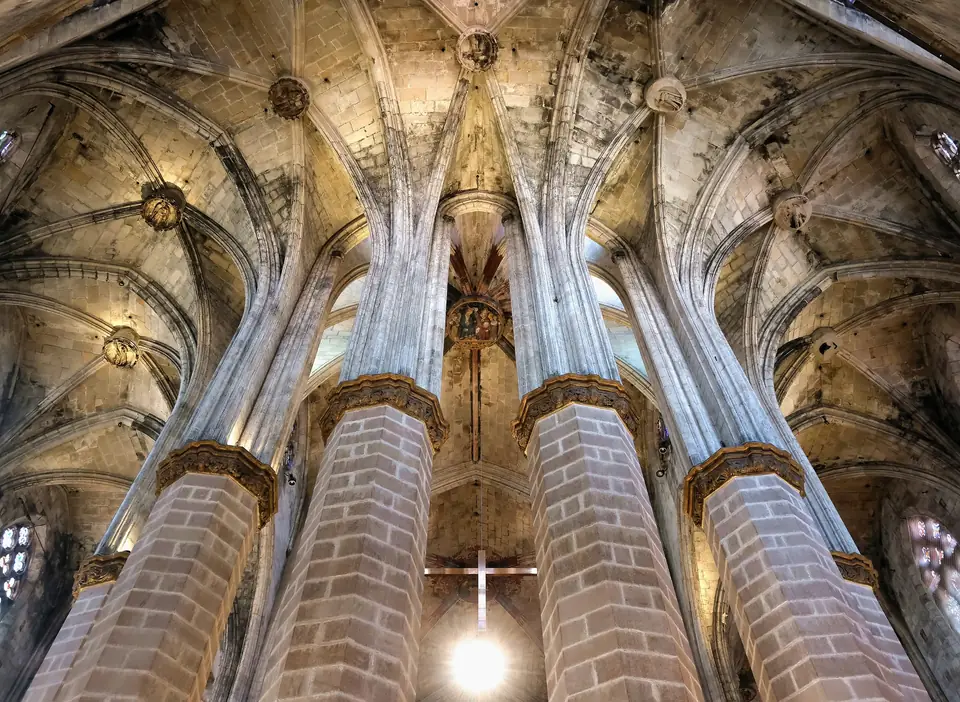
- Central nave — Octagonal columns about 15 metres apart in a temple 100 feet wide and high
- Presbytery and galleries — Remains of the Baroque altarpiece and the outline of the great organ that burned in 1936
- Flamboyant rose window — Rebuilt after the earthquake of 1428 and dedicated to the Coronation of Mary
Santa Maria del Mar stands on ground that was already sacred long before the Gothic. Beneath the church, the 102 burials of an early Christian necropolis of the 4th to 6th centuries were excavated in 1966; the idea that there was also a Roman amphitheatre underneath is only a hypothesis of the historian Jordina Sales i Carbonell. In 998 the church of Santa Maria de les Arenes stood here, in 1005 the name Santa Maria del Mar appears for the first time and in 1009 it is recorded as the parish of the Vilanova de la Mar, the suburb of shipowners, merchants and dockers that lived off the port.
The history of Santa Maria del Mar as a Gothic temple begins on 2 March 1329, when Ramon Despuig and Berenguer de Montagut signed the building contract; on 25 March King Alfonso the Benign laid the first stone. In 1379 the scaffolding burned when the fourth bay of vaults was nearly closed, on 3 November 1383 the last keystone was placed and on 15 August 1384 the first mass was celebrated (another chronology moves those dates back to 1330, 1345 and 1346, but 1383 is the one that fits the 54 years of work). Then came the blows: the earthquake of 1428, the wedding of a pretender to the throne in 1708, the siege of 1714 a few steps away and the fire of 1936.
The architecture of Santa Maria del Mar is that of a proud neighbourhood: Barcelonans called it “Seu de la pescateria” (the fishmongers’ cathedral), “Seu del Born” or “Catedral sense claustre” (the cathedral without a cloister), as if measuring their church against the official cathedral. What to see at Santa Maria del Mar is arranged in five stops, from the bronze door of the bastaixos and the Fossar de les Moreres to the nave, the presbytery and the rose window. Each one holds an absence or a scar that is easier to grasp by walking it with the audio guide.
The neighbourhood church has always measured itself against Barcelona Cathedral, a few minutes’ walk away, and across Via Laietana the Sant Pere district holds the Palau de la Música Catalana.
The dockers who signed the door
Plaça de Santa Maria
Summary of this stop
The façade on Plaça de Santa Maria is massive, almost severe, flanked by two octagonal towers that end in terraces instead of spires. They are not twins in time: the western one, the work of Pere Oliva, was finished in 1496; the eastern one, which served as the clock tower from 1674, was not crowned until 1902. More than four centuries separate two finials that look identical at first glance.
Seen up close, the main door tells another story. Between Saint Peter and Saint Paul, in their niches, the bronze reliefs on the leaves show the bastaixos, the guild of dockers of the Ribera port, carrying stones on their backs. They were the ones who transported, one by one, the stones for the building from the royal quarry on Montjuïc and from the beach to the Born, and the church returned the favour by building them into the edifice itself. Ildefonso Falcones’ 2006 novel and its series have magnified that epic; alongside the guild’s sweat there were also large donations from the king and the neighbourhood’s leading men.
From this come the nicknames with which the port district, which never had a bishop, christened its church. Why a “fishmongers’ cathedral” could look the official Seu in the eye is revealed by listening to the narration in front of the bronze door.
A flame leaning towards the church
Fossar de les Moreres
Summary of this stop
On the side of the basilica opens the Moreres door. On either side, two plaques, in Latin on the left and in Catalan on the right, date the start of the work to 1329: the contract of 2 March and the first stone of 25 March, laid by Alfonso the Benign. It is the temple’s birth certificate, carved in its own stone.
Opposite stretches the Fossar de les Moreres, the former parish cemetery. During the siege of Barcelona in 1714 the defenders of the Ribera were buried there. The square, redesigned in 1989 by Carme Fiol, has a red granite bench inscribed to the martyrs of 1714 and a brazier by Albert Viaplana whose flame leans towards the church. Around 1870 the Onze de Setembre began to be celebrated here, and every 11 September the place still fills up; since April 2002, moreover, every Sunday at noon a bouquet of flowers with the Catalan flag appears beside the flame.
On the bench a verse is carved in letters about 25 centimetres high: “Al fossar de les Moreres no s’hi enterra cap traïdor” (no traitor is buried in the Fossar de les Moreres). It comes from a poem by Frederic Soler, Pitarra, written during the Renaixença, a literary fiction that has had a plaque in the square since 1915. What family story that poem tells, and why its harshest line ended up as a motto, is told by the narration beside the brazier.
A hundred feet wide, a hundred high
Octagonal columns of the nave
Summary of this stop
On entering, the space opens up all at once. Santa Maria del Mar is a single open volume, held up by slender octagonal pillars about 15 metres apart, in which the vault ribs die directly into the capitals. Some of those capitals again depict the bastaixos.
The measure that orders everything is the medieval foot of 33 centimetres: side chapels 10 feet deep, side aisles of 20 and a central nave of 40, adding up to 100 feet of total width, the same figure as the building’s maximum height. That such a proportion was completed in 54 years, with the money of King Peter the Ceremonious and the neighbourhood’s leading men and the work of the guilds, explains much of its unity of style.
The ground, by contrast, is far older. According to a documented tradition, Bishop Frodoí found, at the end of the 9th century at Santa Maria de les Arenes, the remains of Santa Eulàlia, Barcelona’s patron, and carried them in procession towards the cathedral. What happened halfway, and why a city square changed its name because of a finger, is revealed by listening to the narration in the centre of the nave.
The altar that lost its altarpiece
Presbytery and apse galleries
Summary of this stop
The east end of Santa Maria del Mar has seen court ceremonies. On 1 August 1708, in the middle of the War of the Spanish Succession, Archduke Charles of Austria, pretender to the throne, and Elisabeth Christine of Brunswick-Wolfenbüttel were married here. Today, however, what speaks loudest in front of the high altar are the absences.
The fire of July 1936 destroyed the Baroque altarpiece by Deodat Casanovas and Salvador Gurri, the furnishings, much of the stained glass and a good part of the archive; sources do not agree on its exact date or duration, and some describe it as an eleven-day fire. From that altarpiece survive estípite columns displayed in the raised galleries behind the presbytery, along with painted remains and the windows of the Ascension and the Washing of the Feet.
On the wall, opposite today’s smaller organ, you can still make out the outline of the great organ by Jean-Pierre and Dominique Cavaillé, which occupied that spot from 1797 to 1936 and vanished completely in the flames. How a temple that lost its main voice sounds today, and what the galleries say about the altar that once stood, can be heard with the narration in front of the presbytery.
The rose window that fell in the earthquake
Façade rose window
Summary of this stop
At the foot of the temple, the great flamboyant rose window dominates the façade from inside, with blue as its dominant colour. It is not the original. The earthquake of 1428 brought down the first one and the falling stones caused some thirty deaths; the new one, dedicated to the Coronation of Mary, was finished in 1459 and its glass installed a year later. From the roofs, more than 33 metres up, the cracks from that quake can still be seen, and the polychrome keystones of the central nave, repainted after 1936, complete its account of the life of the Virgin.
The stained glass lost in 1936 was not replaced until the 1960s, thanks to a collection in which the whole city took part. One of the donors set a condition: FC Barcelona contributed in exchange for its crest appearing in one of the windows. Among the pieces that did survive the fire is the Gothic window of the Last Judgement, with four lancets of intense colours, dated 1474 or 1494 depending on the version.
Few churches sum up so well the idea that a building is still standing because it has been raised again. Where the club’s crest hides among the glass, and what the cracks in the roof say, is revealed by listening to the narration beneath the rose window.