UNESCO World Heritage
Palau de la Música Catalana Audio Guide
A neighbourhood choir paid for itself a box of iron, glass and mosaic wedged between the narrow streets of Sant Pere. Beneath a stained-glass sun that lets the daylight in, Catalan music celebrated, was forcibly silenced and sang again.
- 30 min of audio
- Catalan Modernisme
The Palau de la Música Catalana was born as the home of the Orfeó Català, the choir founded in 1891 by Lluís Millet and Amadeu Vives. Its assembly approved the project on 31 May 1904, the first stone was laid on 23 April 1905 and Lluís Domènech i Montaner's building opened on 9 February 1908, financed in large part with 6,000 bonds of one hundred pesetas. On 4 December 1997 it was inscribed as a World Heritage Site together with the Hospital de Sant Pau, and it is the only concert hall with that status.
Its rear façade was doomed to shadow: the church of Sant Francesc de Paula covered it completely. Even so, Domènech opened a courtyard of about three metres so the hall would receive light from both sides and decorated that invisible wall with brick, ironwork and stained glass, an effort that helped the initial budget of 450,000 pesetas to double. Almost a century later, the demolition of the church brought to light the façade nobody was meant to see.
Highlights
- Central skylight — Antoni Rigalt's stained-glass sun that lets daylight in by day and serves as a lamp by night
- Stage of the muses — Eighteen muses in relief and trencadís beneath the 1908 Walcker organ
- La cançó popular catalana — Saint George as a figurehead on the corner, by Miquel Blay
- Hidden façade — The wall decorated for the shade that the demolition of Sant Francesc de Paula revealed
- Fets del Palau — The Cant de la Senyera, banned in 1960 and sung by the audience on their feet
The Palau de la Música Catalana was not commissioned by a king, a banker or a city council: a choir bought it and built it. The Orfeó Català, founded in 1891 by Lluís Millet and Amadeu Vives, approved the project in assembly on 31 May 1904 and that same year acquired the cloister of the former convent of Saint Francis, a plot of 1,350.75 m², for 240,322.60 pesetas. The first stone was laid on 23 April 1905 and the hall opened on 9 February 1908, paid for in large part by issuing 6,000 bonds of one hundred pesetas. That first stone is still kept in the Orfeó’s Rehearsal Hall, beneath the half-moon of the stage.
The history of the Palau de la Música Catalana began in grand style. On 15 May 1908 the Berlin Philharmonic made its debut here with Richard Strauss, and on 10 October that year Pau Casals did, whose orchestra was based at the Palau from 1920 to 1936. In this hall were premiered Alban Berg’s Violin Concerto “to the memory of an angel”, on 19 April 1936, and Joaquín Rodrigo’s Concierto de Aranjuez, on 9 November 1940. It also knew dark years: after the war the Franco regime renamed it “Palacio de la Música”, and in 1960 a banned hymn turned a concert into a protest. In 2009 a nine-hour police search uncovered the diversion of funds by its own managers.
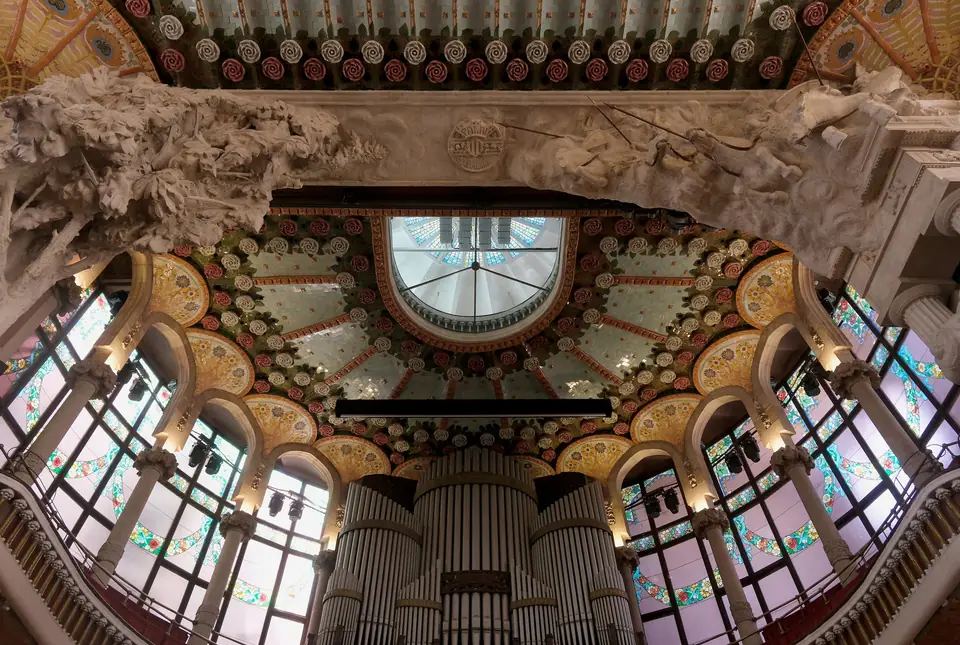
The architecture of the Palau de la Música Catalana is that of an iron-and-glass box dressed in mosaic, ceramics and sculpture, which Lluís Domènech i Montaner wedged into the narrow street plan of Sant Pere. The side walls are pink stained glass from floor to ceiling, the ceiling is strewn with ceramic roses and peacock tails, and in the centre hangs the great skylight by Antoni Rigalt i Blanch. On 4 December 1997 it was inscribed as a World Heritage Site together with the Hospital de Sant Pau, by the same architect: it is the only concert hall with that status. Between 1982 and 1989 Òscar Tusquets and Carles Díaz restored and extended it, and in October 2026 the Nova Porta del Palau opened, a welcome space of more than 350 m² on the corner of Via Laietana and Ramon Mas. What to see at the Palau de la Música Catalana is arranged in five stops, from the sculpted street corner to the stage of the muses, and the full story of each one is easier to grasp by walking them with the audio guide.
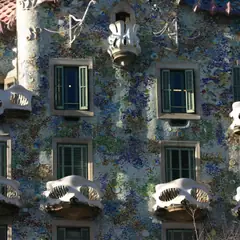
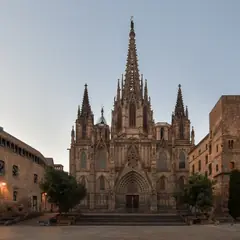
Its Modernisme converses with Gaudí’s in Casa Batlló; very close by, across Via Laietana, rises the Gothic of Santa Maria del Mar, and La Rambla is about ten minutes’ walk away.
Saint George on the prow of a corner
La cançó popular catalana
Summary of this stop
At the junction of Sant Pere Més Alt with Amadeu Vives, the building pushes out over the street like a ship. The corner is crowned by “La cançó popular catalana”, Miquel Blay’s sculptural group: Saint George at the top, a female figure as a figurehead and, around her, a sailor, peasants, an old man and children. It was paid for by the Marquis of Castellbell and was unveiled on 8 September 1909, a year and a half after the hall.
The corner sums up the building’s origin. Behind that prow there is no patron, but a choral society born in 1891 that bought a plot in the cloister of a former convent and commissioned its home from Domènech i Montaner. On top of the old façade, the busts of Palestrina, Bach and Beethoven by Eusebi Arnau, with Wagner already on Amadeu Vives, and Lluís Bru’s mosaic pediment with the Orfeó’s senyera and the scene of La Balanguera complete the message. Which popular song exactly this corner sings, and why a choir wanted to announce itself to the city this way, is revealed by listening to the narration right there.
The façade nobody was meant to see
Statue of Lluís Millet
Summary of this stop
For almost a century, the back of the Palau was hidden by the church of Sant Francesc de Paula. Domènech i Montaner opened a courtyard of about three metres between the two buildings so the hall would receive light from both sides, and decorated that invisible façade with the same care as the main one: brick, ironwork and stained glass. The whim had a price, because it helped the initial budget of 450,000 pesetas to double.
The second phase of Tusquets’ renovation, begun in 2000, demolished the church, burned in the Civil War, to open a square and build an annexe of six floors with a tower whose base is sculpted in the form of a palm tree. From that square today appear the formerly hidden façade, Naxo Farreras’ great Tree of Life in brick relief and, on a flight of steps, the statue of Lluís Millet, by Josep Salvadó Jassans, from 1991.
The square also holds the building’s least noble chapter. On 23 July 2009 the police searched the Palau for nine hours over the diversion of funds from the Orfeó Català; audits put the embezzlement by its managers, Fèlix Millet and Jordi Montull, at more than 34 million euros, and the ruling of 15 January 2018 sentenced Millet to nine years and eight months in prison. How that episode coexists with the statue of the founder is told in the narration in front of the façade.
Glass balusters to welcome Strauss
Double staircase with glass balusters
Summary of this stop
The old entrance on Sant Pere Més Alt was the usual door until 1989. Two of its thick columns housed the original ticket offices, beneath arches decorated with floral mosaic, and from there starts the double staircase that climbs to the first floor between large lamps, with a stone handrail and yellow glass balusters. On the first-floor balcony, fourteen columns in pairs each show off a different mosaic.
Up this gala staircase, in the building’s first year of life, climbed much of musical Europe. On 15 May 1908 the Berlin Philharmonic made its debut at the Palau with Richard Strauss, and on 10 October Pau Casals did. That same year the Barcelona City Council awarded the building the prize for the best of those completed in 1908, with a jury that called it “el superb edifici de l’Orfeó Català”. Later would come the premieres of Alban Berg in 1936 and of the Concierto de Aranjuez in 1940. What a neighbourhood choir felt on seeing its home become a European stage is revealed by the narration at the foot of the staircase.
A glass sun that serves as a lamp
Central skylight of the hall
Summary of this stop
In the centre of the hall’s ceiling hangs Antoni Rigalt i Blanch’s great stained-glass skylight: a sun in the form of an inverted sphere, with golden glass in the centre and surrounded by female busts in blues and whites. It is open to the outside, so by day it lets in natural light and by night it works as a lamp. At the sides, the pink floor-to-ceiling windows, with the arms of Catalonia and Saint George, complete a hall designed for daylight; it has even been said that there is no other auditorium in Europe lit this way, though that primacy is not established.
Above the stage is the organ that the Orfeó bought in 1908 from the German firm Walcker of Ludwigsburg. Its first concert, by Alfred Sittard, organist of Dresden Cathedral, was the first organ concert heard in Barcelona outside a church. In 2003 it was restored by Gerhard Grenzing, with donors sponsoring pipes.
The hall is still the city’s. Every 26 December, Sant Esteve, the Orfeó’s choirs give their carol concert here, a tradition documented since 1913 that was moved only by the death of President Macià in 1933, a great snowfall in 1962 and the war and postwar years. How this hall sounds beneath its glass sun is best appreciated by listening to the narration in the centre of the stalls.
Beethoven, Clavé and the banned hymn
Stage of the muses
Summary of this stop
The stage opening, eleven metres wide, faces two worlds. On the right, a bust of Beethoven beneath Wagner’s ride of the Valkyries; on the left, Josep Anselm Clavé beneath a tree with a group of singers, alluding to Catalan popular music. The ensemble was begun by Dídac Massana and continued by the young Pau Gargallo, and the two masses almost touch at the top. At the back, eighteen muses emerge from the wall, with busts in relief by Eusebi Arnau and skirts in trencadís by Mario Maragliano and Lluís Bru, each with a different instrument. According to local tradition, only one of them, the one to the right of the arms of Catalonia, has the Habsburgs’ double-headed eagle embroidered on her.
This same hall lived through its bitterest hours after the war. On 2 April 1940 the Falange organised a festival here in which the choir, announced only as Maestro Millet’s orfeón, had to open with the “Cara al sol”; it is said that Lluís Millet conducted it with his arms motionless, pressed to his body. In those years Russian soldiers of the former tsarist army sang here and, in 1943, the Hitler Youth choir. The Orfeó did not reappear until 1946.
In 1960, during a visit by Franco to Catalonia, the authorities banned the Cant de la Senyera at the last minute at the concert for the Joan Maragall centenary. The audience rose to sing it and threw leaflets against the dictator. There were arrests, and the young Jordi Pujol ended up tried in a court martial, though accounts differ on whether he was in the hall. The hymn did not sound legally again at the Palau until 18 April 1967. What exactly happened that night, in front of the same muses, is told by the narration before the stage.