Historic promenade
La Rambla Audio Guide
A stream ran beneath Barcelona's most famous promenade, and on its bank stood a 13th-century wall that now reappears among the roadworks. In 1.2 km you will find a fountain that promises your return, a market born from a burned convent, a Miró underfoot and a theatre that came back to life twice.
- 30 min of audio
- From Canaletes to Colom
The name says it all: ramla, in Arabic, means sandy ground, and the word appears in Catalan from 1249. The stream of the riera d'en Malla ran down here until in 1440 it was diverted outside the new walls and the dry bed began to turn into a street. Earlier, in 1260, under James I, a wall of 5,100 metres in perimeter and 8 gates had begun to rise along La Rambla. After the riots of the night of Sant Jaume in 1835, the sites of the burned convents were sold off and on them arose the Boqueria (1836), the Liceu (1847) and Plaça Reial (1848).
La Rambla has never stopped remaking itself, and now it is doing so from end to end. The complete renovation arising from the international competition of 2017, won by the Km-ZERO team, covers 1,200 metres of promenade at an estimated cost of 55.6 million euros. As the ground has been lifted, stretches of the medieval wall have appeared, remains of towers of the Portal de la Ferrissa and pillars of the old Foneria de canons: the street being built for the future is unearthing its own past.
Highlights
- Font de Canaletes — The 1890 lamp-post fountain whose water, according to legend, decides whether you return to Barcelona
- Poliorama clock — The clock by which the city set its own and beneath which Orwell stood guard in 1937
- Mercat de la Boqueria — The market built in 1836 on the site of a burned convent
- Miró mosaic in the Pla de l'Os — More than six thousand pieces welcoming those who arrive by sea, from 1976
- Gran Teatre del Liceu — The 1847 opera house that survived a bomb and two fires
La Rambla runs 1.2 km down from Plaça de Catalunya towards the sea, following a line that no planner drew: water marked it. The riera d’en Malla ran here, and the name comes from the Arabic ramla, “sandy ground”, documented in Catalan from 1249. In 1260, under James I, a new wall of 5,100 metres in perimeter with 8 gates began to be built alongside that watercourse, among them the Boqueria gate and the Porta Ferrissa. In 1440 the stream was diverted outside the new walls and, without water, the sandy ground began to turn into a street.
The history of La Rambla is a succession of layers. The convents that occupied its margins burned in the riots of the night of Sant Jaume in 1835; their sites were sold off and on them were born the Boqueria in 1836, the Liceu in 1847 and Plaça Reial in 1848. Shade came earlier: in 1702 280 poplars were planted, later elms, in 1832 acacias and from 1859 plane trees brought from the Devesa de Girona. Today the promenade has 375 trees, mostly listed plane trees, and each stretch keeps its own name: Rambla dels Estudis, de Sant Josep, dels Caputxins. Along the way you also come across the Palau de la Virreina, the Baroque palace at number 99, and the Església de Betlem, the only remnant of the Jesuit college founded in 1553.
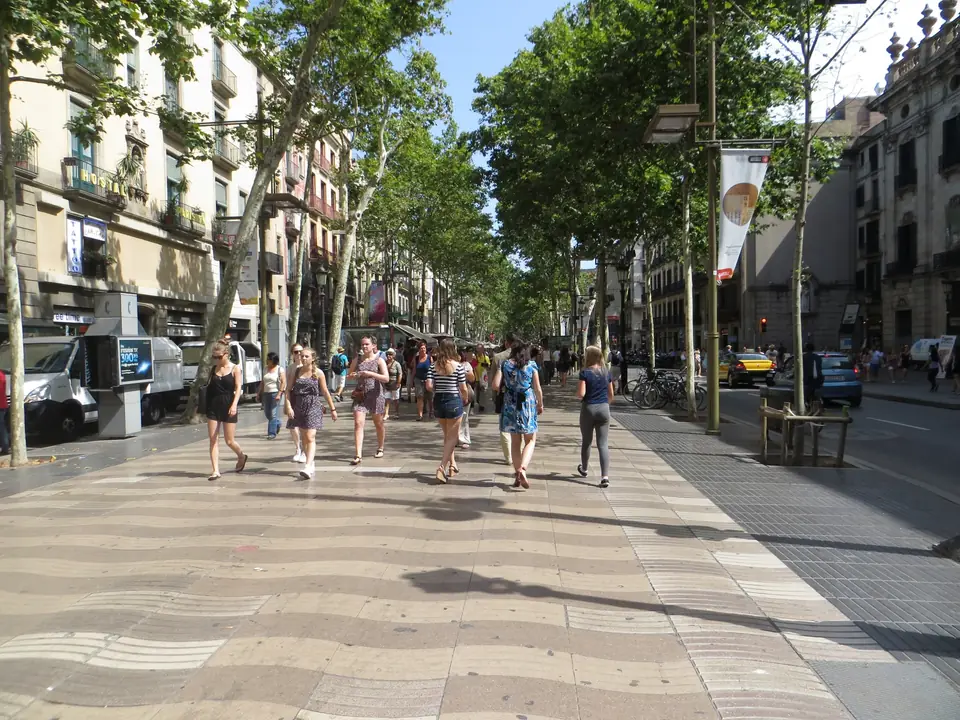
The architecture of La Rambla reads as much in its façades as on the ground: the iron lamp-post fountain of Canaletes, the dragon and umbrellas of Casa Bruno Cuadros, the façade of the Gran Teatre del Liceu and the undulating pavement by Adolf Florensa and Jordi Ros, laid between 1969 and 1978 after the Portuguese calçada of Lisbon’s Rossio. What to see on La Rambla is arranged in six stops, from the fountain that promises your return to the already renovated stretch facing Colom, while the whole promenade is being remade and brings its walls to light. What each stretch hides underfoot is easier to grasp by walking it with the audio guide.
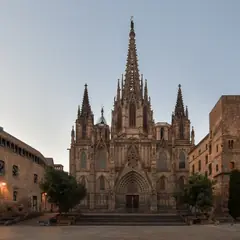
From the promenade, the streets of the Gothic Quarter lead to Barcelona Cathedral, and a little further on, in Sant Pere, the Palau de la Música Catalana awaits.
Canaletes, the fountain over a lost river
Font de Canaletes
Summary of this stop
At the top of the promenade stands the Font de Canaletes, an iron lamp-post fountain with four spouts and a four-light lantern crowning it. The present one dates from 1890 and follows a 1889 model by the municipal architect Pere Falqués, but the fountain reached La Rambla earlier, in 1860, from the courtyard of the old Estudi General.
The gentle slope that starts here is no accident: it is the trace of the riera d’en Malla, the watercourse that ran down this route until in 1440 it was diverted outside the walls. On that dry sandy ground, ramla in Arabic, the street was born.
Legend has it that whoever drinks from Canaletes returns to Barcelona, “qui beu de Canaletes, torna a la ciutat”, and that the water awakens in whoever tastes it a lasting passion for the city. That is why many visitors go up to the spouts before leaving. Where the fountain comes from and what its water holds is revealed by listening to the narration beside it.
A clock, the birds and Orwell’s guard
Teatre Poliorama
Summary of this stop
A few steps further down, on the façade of the Teatre Poliorama building, a clock from the Reial Acadèmia de Ciències i Arts marked the street’s official time for generations: Barcelonans set their own watches by it. This is the shady Rambla, with the double row of plane trees, and also the Rambla of the birds. From 1855 bird sellers sold animals along the central stretch, to the point that the promenade was called Rambla dels Ocells; the last stall closed on Sunday 15 November 2013, after years of campaigns by FAADA and Libera!.
On that roof a notable episode took place. During the May Days of 1937, from 3 to 7 May, George Orwell, a POUM militiaman, spent three nights on guard at the top of the building to protect his party’s headquarters across La Rambla, while government forces dug in at the Café Moka, a few metres away. He told it in Homage to Catalonia, and in May 2024 a plaque in his memory was unveiled on the building, in the presence of his son, Richard Blair.
What Orwell saw from that roof and how a promenade became a battle front is told by the narration in front of the clock.
Flowers and a market over a burned convent
Mercat de Sant Josep de la Boqueria
Summary of this stop
On the Rambla de Sant Josep the central promenade fills with colour from the row of 16 florists’ kiosks. The first flower stalls date from 1853: the florists set up wooden trestles every day and took them down at closing time, and permanent kiosks did not arrive until the 1960s.
Opposite opens the great portico of the Mercat de la Boqueria. The market, from 1836, occupies the site of a former Carmelite convent sold off after the night of Sant Jaume in 1835, when convents burned and friars died. Its name is even older: the Boqueria was one of the 8 gates of the wall that began to be built in 1260 under James I, like the Porta Ferrissa, where an iron bar served to check the cana, a unit of length.
How a medieval gate and a night of fire ended up giving name and place to the city’s most famous market is revealed by listening to the narration at its entrance.
The Miró mosaic everyone walks on
Mosaic del Pla de l'Os
Summary of this stop
In the Pla de la Boqueria, at ground level, a circle of tiles in yellows, blues and reds goes unnoticed by many of those who walk over it. It is Joan Miró’s mosaic, unveiled on 23 December 1976: more than six thousand pieces of 10 by 10 centimetres with which the artist wanted to welcome those who arrive by sea, along with the airport mural of 1968 and Dona i Ocell of 1982.
The same ground holds a painful memory. On 17 August 2017, at around 16:49, a van entered the central promenade from Plaça de Catalunya and zigzagged about 500 metres until it stopped on the mosaic. The attack, claimed by the Islamic State, killed 15 people on La Rambla, according to Catalan and Spanish sources.
Next to the mosaic, the façade of Casa Bruno Cuadros displays umbrellas, fans, Japanese figures and a dragon, a reminder of the old umbrella shop. What Miró’s welcome means and why this circle weighs differently today is told by the narration over the mosaic itself.
Liceu: bombs, fire and curtain
Gran Teatre del Liceu
Summary of this stop
On the Rambla dels Caputxins, beside the metro entrance, the façade of the Gran Teatre del Liceu barely lets you guess what lies behind. The theatre opened on 4 April 1847 on the site of the old Trinitarian convent, with 3,500 seats and five tiers, financed by selling boxes and seats to Barcelona’s bourgeoisie.
Its history is that of a theatre that refused to disappear. On 7 November 1893, opening night of the season and in the middle of a performance of Rossini’s William Tell, the anarchist Santiago Salvador threw two Orsini bombs into the stalls; one exploded and caused about twenty deaths. According to a documented tradition, for years the seats occupied by the victims were left empty in the middle of the audience. Fire came twice: in April 1861 and on 31 January 1994, when a blaze destroyed the stage and the stalls. The rebuilt theatre reopened on 7 October 1999, now as public property.
What was left standing after each disaster and how the Barcelona opera house was reborn is revealed by listening to the narration in front of its façade.
The new Rambla facing Colom
Monument a Colom
Summary of this stop
At the end of the promenade, facing the Columbus monument, the first renovated stretch, finished in July 2024 between Colom and Carrer del Portal de Santa Madrona, shows what the new Rambla will be like. Up La Rambla, on the stretches not yet renovated, the tiles in undulating stripes that evoke water remain: the pavement by Adolf Florensa and Jordi Ros, laid between 1969 and 1978 and inspired by the Portuguese calçada of Lisbon’s Rossio after the campaign begun by Noel Clarasó in 1961.
The complete renovation, born of the international competition of 2017 won by the Km-ZERO team, covers 1,200 metres of promenade at an estimated cost of 55.6 million euros. Beneath the works, stretches of the medieval wall have surfaced, remains of towers of the Portal de la Ferrissa and pillars of the old Foneria de canons, finds that forced the excavation to be extended and the schedule adapted, with completion of the works planned for February 2027.
How water, wall, fire and festivity fit together in a last look at the promenade is discovered by listening to the narration in front of Colom.