Refugee neighbourhood
Gamcheon Culture Village Audio Guide
A hillside of shacks raised by refugees from the Korean War and by followers of a religion of their own, which was painted in bright colours instead of being demolished. Today it is Busan's most photographed postcard, and behind every facade someone still lives.
- 90 min of audio
- Street art and murals
- Post-war history
- Harbour viewpoints
The story of Gamcheon Culture Village begins in 1950, when a cluster of some 20 houses called Gamregeol became, almost overnight, a settlement of 800 shacks of wood, sheet metal and plywood. In 1955 the headquarters of Taegukdo, the religion founded by Cho Cheol-je, arrived, and the neighbourhood was laid out under a rule that explains all its architecture: the house in front could not block the one behind. Hence the stepped rooftops that earned it the nickname “Machu Picchu of Busan”.
The contrast is sharp: the pastel scenery that draws over a million visitors a year is a neighbourhood that lost two thirds of its population because nothing could be rebuilt on that slope. In 2009 the choice was to paint it and fill it with street art rather than put up apartment blocks, and now its success raises another question: how many tourists fit in a village that is still lived in.
Highlights
- Stepped rooftops — each house rises above the one before so as not to block its view
- Haneul Maru viewpoint — a rooftop overlooking the whole neighbourhood and Jeon Young-jin's human-headed birds
- The Little Prince and the fox — Na In-ju's sculpture seated on the parapet above the ravine
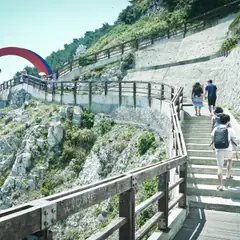
- Stairway to see the stars — 148 steps between the houses
- Gamnae Eoulteo — a former public bathhouse turned Little Prince House
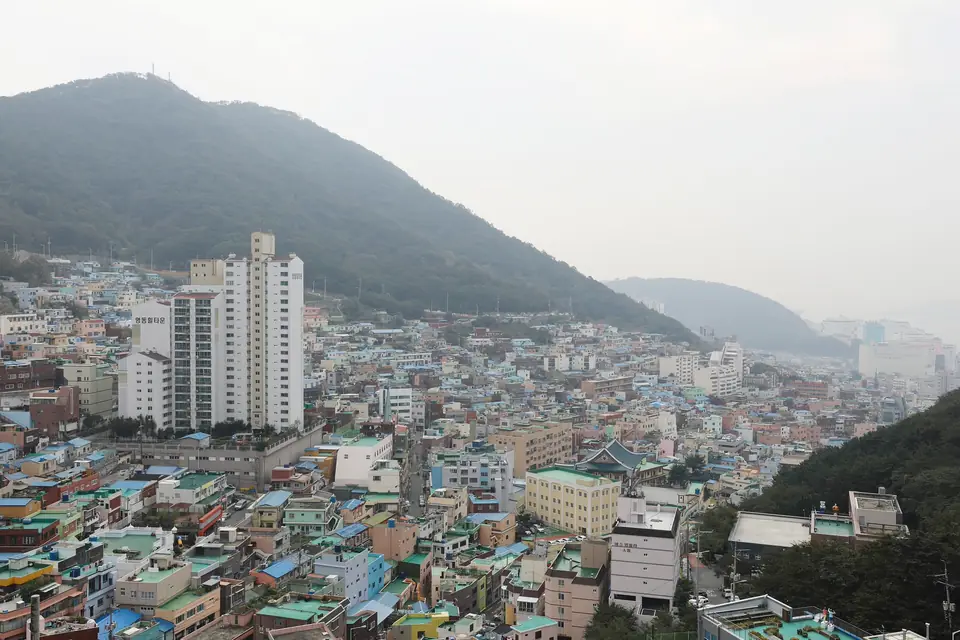
The pink and sky-blue houses of Gamcheon, with their blue roofs and rooftop water tanks, form a mosaic on the hillside that seems made for the camera. It was not. The history of Gamcheon Culture Village is that of the refugees who, from 1950, fled the Korean War to the port of Busan and settled on this hill with a few planks, and that of the Taegukdo followers, who moved the headquarters of their religion here in 1955. For decades the neighbourhood was known as the “Taegukdo village” (태극도마을), and the seat of that faith is still in Gamcheon-dong today.
The origins come with caveats. Most Korean sources date them to the 1950s, from an earlier core of about 20 houses, while others push them back to the 1920s and 1930s, when the Busan authorities are said to have resettled working-class people here. It is also said that on the top of the hill you could barely hear the broad accent of lifelong Busan locals, the one from the markets below: the speech of the newcomers stayed up here.
Between 1980 and 2010 Gamcheon-dong lost almost two thirds of its residents. In 2009, instead of demolishing it, the Ministry of Culture, Sports and Tourism launched the “Dreaming of Busan Machu Picchu” project, and artists turned its alleys into an open-air gallery. What follows is a walk along its high street and passageways, between street art and neighbourhood life, and the audio guide, documented and checked against historical sources, tells at each stop the story the postcard does not show.
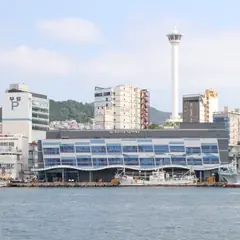
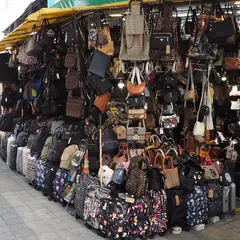
The refugee Busan of those years can still be read down by the harbour, in the aisles of Gukje Market and at the stalls of Jagalchi Market, less than two kilometres away.
From twenty houses to eight hundred shacks
Gamcheon Small Museum
Summary of this stop
The route starts at the entrance to the neighbourhood, at the information centre, where the 2,000-won stamp map is sold, and at the Small Museum, with old photos and everyday objects from Gamcheon. Those images undo the postcard: the place, originally called Gamregeol, was a group of about 20 houses until the war turned it into a settlement of 800 shacks of wood, sheet metal and plywood, with stones on the roofs so the wind would not carry them off.
Cho Cheol-je (1895-1958), founder of Taegukdo, also came to this hillside. He had moved his headquarters to Bosu-dong in 1948 and in 1955 moved it to Gamcheon. He and his followers promised sweets, toothbrushes or rice to refugees who embraced the new faith, and soon almost 90% of the residents practised it. How a prophet and a handful of gifts ended up naming an entire neighbourhood is the first twist in a story best understood in front of those photos.
The neighbourly rule that drew the Machu Picchu of Busan
Haneul Maru
Summary of this stop
The Haneul Maru viewpoint is the converted rooftop of a single-family home, and from it you can see the whole stepped roofscape and, beyond, the harbours of Gamcheon and Busan. On the roof opposite perch the rows of “People and Birds”, the work of Jeon Young-jin: colourful ceramic birds with smiling human heads.
What looks from above like an aesthetic whim is an urban planning rule. After the great fire in neighbouring Bosu-dong in 1955 came a collective relocation, and the neighbourhood was laid out so that all the streets connected and no house blocked the one behind; that is why each dwelling rises above the roof of the one before. Sources disagree on the size of that relocation and its main cause: some speak of about 800 families and attribute it to the change of Taegukdo’s headquarters, others stress the fire.
Beneath the neighbourhood’s name lies a disputed story. At the end of the Joseon dynasty there was a village of about 40 houses here called Gamnae, and the most widespread explanation says Gamcheon refers to how good its water was. Another reading holds that “Gam” comes from “Geom”, an old word for “god”, and the dolmens found in the area feed the idea that this slope may have been a sacred site long before it was a refuge.
The Little Prince, the ravine and the queue
The Little Prince and the Fox sculpture
Summary of this stop
At the end of the street a protective wall was built so cars would not fall into the ravine. On that parapet, facing the neighbourhood, sits the sculpture “The Little Prince and the Desert Fox” by Na In-ju, born of the 2012 Machu Picchu Alley Project. By 2015 you already had to wait ten minutes for a photo with it, and the queue is still part of the scene.
That queue sums up both the success and the problem. Visitors rose from 30,000 in 2011 to 1,381,361 in 2015; the neighbourhood’s physical capacity was estimated at about 2,601 people a day, against an average of 8,296 daily visitors in May 2017. In January 2016 an attempt to charge admission was dropped, and since June 2016 the residents’ association has required groups of 15 or more to buy the map to enter, a measure some criticise as a disguised entrance fee and others defend as a brake on noise and traffic.
Meanwhile, residents registered in the village area fell from 3,161 in 2010 to 1,558 in 2022, and in 2026 more than 80% of visitors were foreign. What all that means for the people who live behind the scenery is what this stop puts on the table.
Seeing stars without looking at the sky
148-step stairway
Summary of this stop
The “stairway to see the stars” (별 보러 가는 계단) drops steeply between the houses over 148 steps. Its name sounds like a romantic postcard, but it does not refer to the sky: it comes from the dizziness of those who climbed it carrying a load and, turning round, saw stars.
That slope is also the reason for the decline. Gamcheon-dong went from over 25,000 residents in 1980 to 9,400 in 2010, because on this hillside nothing could be rebuilt or redeveloped, and by around 2015 there were some 300 empty houses. At the top of the stairs you also find the “public room” designed by Francisco Sanin.
Once a year, the memory of those steps becomes a festival. The Alley Festival is organised by the residents themselves with Saha District, and in 2016 it included a parade of visitors covered in balloons, a singing contest for residents, the re-enactment of a traditional wedding and the “water yoke of memory”, which evokes the time when water was carried up these stairs by hand.
From public bathhouse to the Little Prince’s house
Gamnae Eoulteo
Summary of this stop
In the quietest passageways the neighbourhood’s turn becomes clear. In the second phase of the project, called Miro Miro, six empty houses and six alleys were turned into mini galleries and colour trails, and arrows were painted on facades to guide visitors through the maze. Jin Yeong-seop’s fish also swim along the walls.
That same artist said in 2016 that residents who at first asked for rice or ramen instead of art were by then asking for works in front of their own house or shop; others, when the project began, complained that tourists photographed them “like animals in a zoo”. Tourism slowed the population decline and raised the value of houses on the main street, though in the inner passageways people talk of noise, litter and signs of gentrification.
The route ends at Gamnae Eoulteo, the neighbourhood’s former public bathhouse turned community centre and refitted as Little Prince House, the only permanent installation in Korea endorsed by the Antoine de Saint-Exupéry foundation. It opened on 18 March 2026, on the 140th anniversary of Korea-France relations, with Olivier d’Agay, the writer’s great-nephew, present. How the place where neighbours once went to wash became the official home of the Little Prince in Korea is the last story of the walk, and it is heard in front of its facade.