Buddhist temple by the sea
Haedong Yonggungsa Temple Audio Guide
A Buddhist temple clinging to the rocks of Gijang that, unlike the mountain temples of Korea, is reached by going down: 108 steps toward halls, pagodas and shrines beneath which the surf breaks.
- 60 min of audio
- Korean Buddhism
- Temple by the sea
Haedong Yonggungsa, the “Dragon Palace” of the East Sea, boasts six hundred years: according to tradition, the monk Naong Hyegeun founded it in 1376 as Bomunsa after dreaming of the Dragon King during a drought. Its documented history is more recent and more surprising: rebuilt in the early 1930s by the monk Ungang and renamed in 1974 by the abbot Jeongam after a dream of the bodhisattva Gwaneum riding a dragon.
Few places in Korea gather so many petitions in so little space: a pagoda against traffic accidents, a stone belly polished by those who wish for a son, five Buddhas for passing exams and two golden pigs for good luck. In 1999 Gijang County itself had to correct the founding date, and the main hall that now looks like the ancient heart of the compound was finished in 2005.
Highlights
- 108 steps — a stairway that descends toward the temple and the sea, the reverse of mountain temples
- Road safety pagoda — seven storeys with a machine wheel at its base against traffic accidents
- Four Lions Pagoda — raised in 1990 facing the sea with seven relics brought from Sri Lanka
- Gulbeopdang — a cave hall with the stone Maitreya Buddha to whom childless couples pray
- Haesu Gwaneum Daebul — a Gwaneum about 10 metres tall, carved from a single piece of stone
On the coast of Gijang, north-east of Busan, a Buddhist temple clings to the rocks while the East Sea breaks right beneath its halls. The history of Haedong Yonggungsa begins, according to tradition, in 1376, when the monk Naong Hyegeun, royal teacher to King Gongmin of Goryeo, dreamed of the Dragon King during a drought and built the temple of Bomunsa here. That tale sits alongside another, well documented one: in 1999 Gijang County published the date of 1376 in its official bulletin and then corrected it as unconfirmed, after objections from the Gijang Cultural Centre and local residents, who remembered the site being used for farming and grazing. The date is still disputed.
What is recorded is that the temple burned during the Imjin War (1592-1598), that the monk Ungang, of Tongdosa monastery, rebuilt it in the early 1930s, and that in 1974, according to most sources, the abbot Jeongam gave it its present name. Between one and the other, the architecture of Haedong Yonggungsa tells the story of a living shrine that has grown together with the city: it is said to grant one wish to whoever prays sincerely, at New Year thousands of people come before dawn to see the first sunrise of the year over the sea and, every Sunday, the temple offers visitors a free bowl of noodles. The audio guide covers the whole path, from the zodiac row to the great stone Gwaneum, with documented narration checked against historical sources.
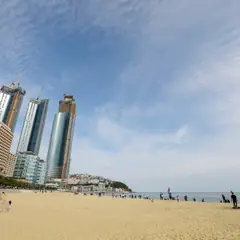
The east coast of Busan continues south to Haeundae Beach, and another Buddhist shrine with relics from Sri Lanka lies hidden in the forest of Taejongdae.
The zodiac row and the pagoda that guards against traffic
Road safety pagoda
Summary of this stop
The entrance path is flanked by twelve stone statues with human bodies and the heads of the zodiac animals, and visitors look for the one of their birth year to pose beside. Legend has it that these twelve guardians protect the twelve directions of the earth against evil spirits, and that the rocky coast and the ridge embracing the temple trace the figure of a dragon: Haedong Yonggungsa would be perched on its shoulder.
Just behind rises a seven-storey pagoda unlike any other: the Gyotong anjeon tap, the road safety pagoda, with a machine wheel at its base, built to ask for protection against traffic accidents. From the very first step, devotion here is practical and modern. What this pagoda reveals about the temple’s way of praying is best understood by listening to the narration on the spot.
Podae Hwasang’s black belly and a stairway that goes down
Podae Hwasang of the black belly
Summary of this stop
At the top of the stairs waits Podae Hwasang, the pot-bellied, smiling monk, his belly black and polished by the thousands of hands that rub it to have a son. It is one of the most photographed corners for those looking for what to see at Haedong Yonggungsa, and also one of the busiest.
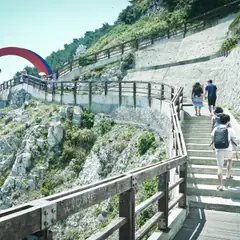
From here begin the 108 steps, the Buddhist number of worldly passions. Their layout reverses the custom of Korean mountain temples, where you climb: here you go down toward the temple and the sea, between stone lanterns, with the halls opening up at every flight. Shortly before the bridge, at the edge of the path, five small statues popularly known as the “Buddhas of academic success” answer the most modern request of all: passing the exam.
Six hundred years in a hall from 2005
Yongmungyo Bridge
Summary of this stop
The stone bridge Yongmungyo gives access to the compound, and beneath it visitors toss coins into small bowls to make a wish. From here you can see the Daeungjeon, the main hall painted in dancheong with the sea behind it, and inside a mural depicts the founding scene repeated by tradition: the dragon who appears in a dream to the monk Naong and asks him to build the temple.
That scene coexists with a more recent story. According to the accounts collected, in September 2004 the site of the main hall was still empty and the Daeungjeon was finished in 2005; many of the gilded statues and the artificial cave on the descent would also be recent additions. For years, getting here required a taxi from Jangsan, the last station on metro line 2, and today the temple has an IKEA, a Lotte department store and the Lotte World park as neighbours. Behind the hall, two golden pigs are credited with the power to bring luck and wealth to whoever rubs their foreheads. How the date of 1376 fits with all this is one of the most revealing moments of the route.
The Dragon King’s coast
Four Lions Pagoda
Summary of this stop
Long before the temple, this stretch of coast was called Wonangdae and Sirangdae, and at the Gyeryongdan altar rain prayers were offered to the sea’s Dragon King. The name Sirangdae keeps, according to a documented tradition, the memory of Gwon Jeok, a senior official demoted to magistrate of Gijang in 1733 who carved on a nearby rock the characters for “the Sirang terrace”, the post he had lost.
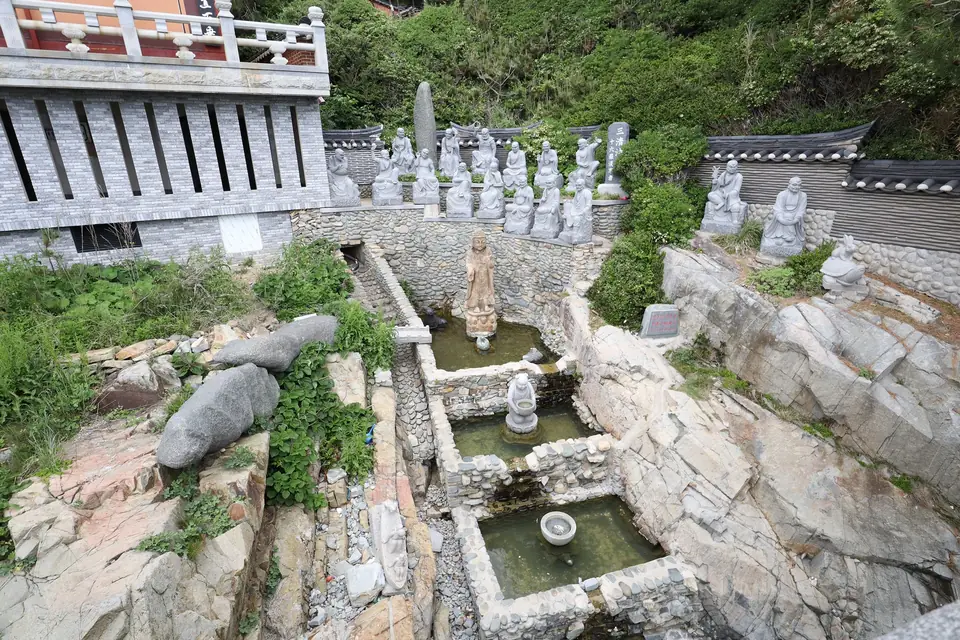
Facing the Daeungjeon, open to the sea, stands the three-storey stone pagoda held up by four lions. The abbot Jeongam built it in 1990 to reinforce the temple’s damaged walls and to keep seven Buddhist relics brought from Sri Lanka. Beside the main hall, the cave hall Gulbeopdang, also called Mireukjeon, houses a seated stone Maitreya Buddha known as Deungnambul, “the Buddha who grants sons”, to whom childless couples pray. Here the rock is prayed to, hollowed into a cave and reinforced against the waves.
The stone Gwaneum facing the East Sea
Haesu Gwaneum Daebul
Summary of this stop
At the highest point of the compound, the Haesu Gwaneum Daebul, the Gwaneum of the sea water, stands about 10 metres tall and is carved from a single piece of stone, gazing out over the East Sea. Beside it is the Medicine Buddha Yaksa Yeorae, nicknamed “the Gatbawi of the East Sea”, alluding to the Gatbawi Buddha of Daegu, also famed for granting wishes.
From this ridge you take in the whole route, and you understand the dream that changed it: in 1974 the monk Jeongam became abbot, performed a hundred-day prayer to restore the temple as a Gwaneum shrine and, after dreaming of the bodhisattva dressed in white rising to the sky on a dragon, renamed it Haedong Yonggungsa. In September 2021 he was still processing its admission to the Jogye Order as a branch temple of Hwaeomsa: a shrine of so many attributed centuries still looking for its place in Korean Buddhism. The closing of the narration, facing the sea, ties up all the loose ends of the route.