Fish market
Jagalchi Market Audio Guide
A former pebble beach on the South Port where returnees, refugees and war widows set up Busan's fish market: the ajimae in red aprons still call out in the street while a building with seagull wings serves upstairs, raw, what is bought alive downstairs.
- 60 min of audio
- Post-war history
- Seafood gastronomy
The story of Jagalchi Market begins on a stony shore that the Japanese called Nambinjeong and used as a bathing beach. From 1945, Koreans returning from Japan opened street stalls there, and with the Korean War (1950-1953) refugees from across the country joined them. Today the market occupies the seven-storey building opened in 2006, whose three-winged facade depicts a seagull taking off, flying and gliding, but a good part of the selling still happens where it began: at ground level, facing the sea.
The contrast is plain to see: while the city invested some 23.5 billion won in two new buildings to take 215 street vendors off the roadway, only 2 signed up in March 2025. The women who built Jagalchi on tubs of fish, and whose goods harbour guards once emptied into the sea, still prefer the street.
Highlights
- Ajimae street stalls: Jagalchi's original selling, in front of tubs of fish
- Ground-floor tank hall: live fish, octopus and shellfish that are eaten as hoe on the second floor
- Row of gomjangeo stalls: hagfish grilled over charcoal briquettes by the shore
- 2006 building with three seagull wings: take-off, flight and glide
- South Port waterfront, with fishing boats and a view of the Yeongdo Bridge
Jagalchi was not raised by any building, but by women who arrived with nothing on a stony beach. The pebble (jagal) shore of Busan’s South Port was called Nambinjeong during the Japanese occupation and was Nambin’s bathing beach; after 1945, the district came to be called Nampo-dong. That same year, Koreans returning from Japan began selling on the shore, and with the Korean War refugees came from across the country, along with widows who kept their families going by selling fish in the street. From them comes the figure of the “Jagalchi ajimae”, the lady in the red apron.
The story of Jagalchi Market has more than one version. On the name, one explanation derives it from those pebbles and another from a fish called jagalchi, widely sold alive at the market. On the origin, the Korea Tourism Organization places it in 1922, with a sales hall of the fishing cooperative, other sources speak of the early 1920s or a fishmongers’ guild in 1925, and Korean Wikipedia dates the current market to the stalls of 1945. Nor is there agreement on its size: it is billed as Korea’s largest fish market, though it is a consumer market, and the great auction that distributes fish across the country is the Busan Cooperative Fish Market, in the same South Port.
What to see at Jagalchi Market runs from the vendors’ street to the tank hall, from the eel braziers to the quay facing the Yeongdo Bridge. It is a route of smells, shouts and haggling that is understood far better on foot with the audio guide, which names what the visitor has in front of them at each point.
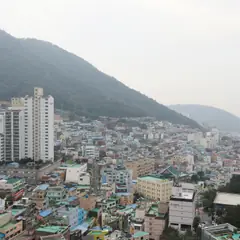
A few steps away, Gukje Market tells the other side of the commerce of refugee Busan; from the top of Yongdusan Park the whole South Port is in view, and on the western slope Gamcheon Culture Village holds the homes of those who arrived fleeing the war.
Red aprons on a pebble beach
Ajimae street stalls
Summary of this stop
The route starts where everything started: in the street, before the rows of vendors seated by their tubs of fish. This ground-level selling is the original form of Jagalchi, the one set up on the old stony shore by the returnees of 1945, the war refugees and, above all, the widows and women who kept their families going. “Ajimae” means “lady” in the Busan dialect, and the red apron still identifies them.
In Busan people speak of the city’s “three great ajimae”, according to a documented tradition: the one of Jagalchi; the jaecheopguk ajimae, who from the 1950s climbed the slopes at dawn with a pot of clam soup from the Nakdong delta on her head; and the kkangkkangi ajimae of the Yeongdo shipyards, named for the noise of her hammer chipping rust off hulls. Of the Jagalchi ajimae it is said that she founded the market, receiving fish from the boats at dawn and selling it on planks. In 2021 the National Folk Museum devoted an exhibition to them.
They were not always tolerated. Before street selling was regulated, harbour guards confiscated their tubs, loaded them onto a truck and emptied the fish into the sea; in 2016 the street stalls were still occupying port land without paying rent. What that resistance says about the whole city is revealed by listening to the narration in the street itself.
Buy it alive downstairs, eat it raw upstairs
Ground-floor tank hall
Summary of this stop
Inside the building, the first floor is a hall of aisles between tanks of live fish, octopus, shellfish and crustaceans. Here you choose and haggle over the piece, which then goes up to the restaurants on the second floor to be served as hoe, Korean raw fish, or in other dishes. It is the logic of the modern market: buy downstairs and eat upstairs, without leaving the building.
The architecture of Jagalchi Market has gone through shacks, fire and rebuilding. In 1969 work began on the first building, of three floors, finished in 1970; with it, the association of street seafood vendors became the Busan Fish and Seafood Processing Association, though many stalls stayed in the street. Sources do not fully agree on this stage: a 2004 report speaks of a reopening in 1974 after tearing down the temporary shacks. What is documented is that a great fire in 1985 destroyed the premises completely and that the market reopened in 1986.
The market’s reputation also has a recent episode. In 2025, a plate of sea cucumber at 70,000 won in a nearby restaurant went viral and set off a national scandal over price gouging; according to the vendors, customers fell to less than half. What some 200 traders then did, in red boots and aprons, is part of the story told at this stop.
Charcoal-grilled hagfish, a tannery leftover
Row of gomjangeo stalls
Summary of this stop
Right by the shore, a row of tent-style stalls grills hagfish (gomjangeo) over charcoal briquette braziers, the yeontan. Some 130 stalls keep up this custom, and their spot beside the water is no accident: in the 1950s, after great fires such as the one at Busan station and at Gukje Market, the city council moved the food stalls that used fire to this shore. Gomjangeo and grilled beef tripe concentrated there.
The dish was born of scarcity. Hagfish skin, more than twice as tough as cowhide, fed a tanning industry that exported until the 1970s, and war refugees grilled the meat that the tanneries threw away. From that use came the dish that now scents this shore with charcoal.
Around 2004, some 3,000 ajimae worked in the market and its surroundings, each specialised in a single product, such as abalone or cutlassfish. One of them, Joo Sun-ja, had been selling only gomjangeo since October 1970. Her case helps to understand how the market works from the inside, something the narration unpacks in front of the braziers.
Seagull wings facing the bridge of the lost
South Port waterfront
Summary of this stop
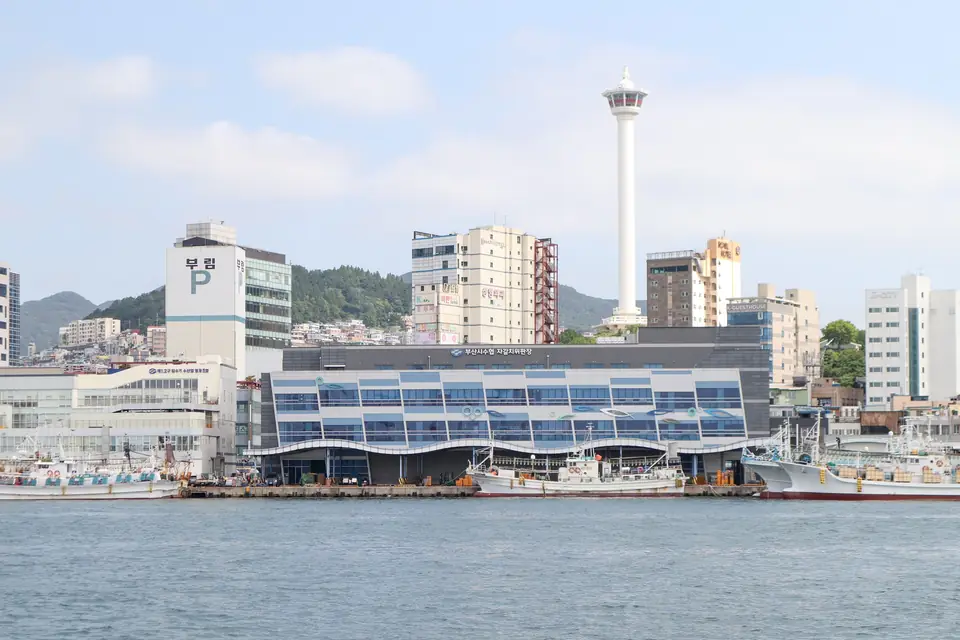
Behind the building, the esplanade opens onto the South Port, with fishing boats moored and the Yeongdo Bridge in view. From here you can appreciate the facade of the present building, constructed between December 2003 and August 2006 at a cost of 40.7 billion won and inaugurated on 1 December 2006: two basement levels, seven floors and 25,910 m², with three wings representing a seagull in take-off, flight and glide.
The shore has also erased things. In 2015 the Geumyang ice factory, standing since the 1930s and listed in Busan’s modern industrial heritage inventories, was demolished to build a single-storey commercial unit. That same year, construction work levelled almost all of Jeombachi alley, “of the fortune-tellers”. According to a documented tradition, refugees looking for relatives who might have arrived on another boat gathered every day beneath the Yeongdo Bridge, and fortune-tellers’ houses set up there to listen to their sorrows.
Beside the market stand the two three-storey blocks of the Jagalchi Ajimae Market, finished in late 2024 for 215 vendors. In June 2025 its opening was postponed indefinitely over complaints about rent, seawater pressure, toilets and goods lifts. Why women who lost everything resist leaving the street is the last piece of the route, and it makes sense when heard facing the bridge.