Busan Future Heritage
Gukje Market Audio Guide
Twelve almost identical blocks hold the memory of refugee Busan: a lot cleared against the bombs that became the great bazaar of the wartime provisional capital and that a film brought back to fame.
- 60 min of audio
- Korean War history
The history of Gukje Market begins in 1945, on a plot in Sinchang-dong cleared in the last months of the Second World War to avoid the effects of Allied bombing. There, Koreans returning from abroad set up their stalls, selling the goods the Japanese left behind. In 1948 twelve wooden buildings went up, the same block grid the market keeps today, and in May 1950 it received its present name: Gukje, “international”.
With Busan turned into the provisional capital during the Korean War, the market grew from about 1,000 traders to tens of thousands. Through its aisles flowed US army goods, humanitarian aid and contraband from Japan, Hong Kong and Macao. It burned down completely in 1953, was rebuilt on two floors, went over to concrete in 1968 and, in 2014, a tiny sock shop became a film set.
Highlights
- Twelve blocks — the 1948 grid that survived the great fire of 1953
- Elevated walkway — the second-floor bridge linking the whole market
- Imported goods shops — the trace of the Korean War Yankee market
- Kkotbunine — the real shop that gave its name to the one in the film Ode to My Father
- Themed alleys — street food, patbingsu, cosmetics and second-hand clothes
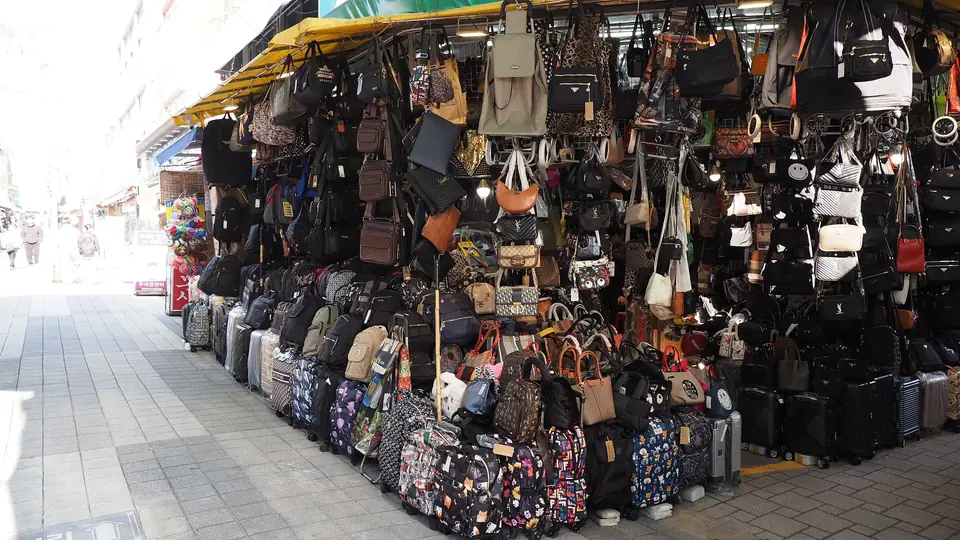
At first glance, Gukje Market is an ordinary maze of blankets, kitchenware, socks and street food in the centre of Busan. But the history of Gukje Market is that of an entire city turned into a refuge. It was born in 1945 on a plot that the Japanese colonial administration had cleared against bombing; it was occupied by Koreans returning from abroad, arranged in 1948 into twelve wooden barracks and, during the Korean War (1950-1953), with Busan as a provisional capital overflowing with displaced people, it became the country’s great bazaar: through it passed US army goods, humanitarian aid and the contraband that came in through the port.
Writers who fled Seoul, refugees from the North and returnees from Japan made their living here. In the early 1950s the market housed Gukje Mungo, its largest publisher of cheap comics (ddakji manhwa), with “The Secret of the Cave” as its star title: it was the first comic shop with a letterer devoted solely to writing the speech bubbles, a trade born in these aisles for refugee children. Then came fire, concrete, competition from the internet and, in 2014, the film “Ode to My Father”, which takes its name from the market and filled it with visitors again. Today, modernised with covered arcades, it is listed as a Busan Future Heritage site, and the audio guide, documented and checked against historical sources, lets you read each block as a layer of that memory over four stops.
The fish market of those same years, Jagalchi Market, is a few streets away, facing the South Port; the neighbourhood’s escalators climb to Yongdusan Park, and the refugee shacks that were painted in bright colours are in Gamcheon Culture Village.
Three names on a cleared lot: the origin of the market
Gukje Market entrance sign
Summary of this stop
Beneath the entrance sign, by the mouth of the aisles from Jungu-ro, the story of Gukje Market begins. The Sinchang-dong plot was left empty in the last months of the Second World War: it was cleared to avoid the effects of Allied bombing. With the liberation of 1945, Koreans returning from abroad settled on the lot and opened street stalls, where the goods the Japanese left behind and what the returnees themselves brought to pay for their journey home were auctioned.
The sign also sums up three names. The first was “Dottegi Market”, of disputed origin: some derive it from a Japanese word meaning “to grab”, others explain it by the Korean for buying “in bulk” and haggling over lots, and others simply translate it as “bustling market”. In 1948 it was officially renamed “Jayu Market”, Free Market, when twelve single-storey wooden buildings were put up. The third, Gukje, “international”, came in May 1950 according to one source, weeks before the war broke out, though others place it more vaguely in the 1950s and tie it to the goods the conflict brought. The narration, right there, reveals what each name says about who sold here and what.
Army tins and a verb for stealing them: the Yankee market
Imported goods shops
Summary of this stop
In the aisle of imported goods shops, the shop windows with American and Japanese items, ever scarcer, are the trace of an era. In the 1950s, US army goods, foreign humanitarian aid and contraband from Japan, Hong Kong and Macao came in through the port of Busan and were redistributed from Gukje to the whole country; one area of the market, nicknamed the “Yankee market”, specialised in foreign products. From early 1951, with the provisional capital overflowing with refugees, traders went from about 1,000 to tens of thousands.
Behind some of the tins and blankets lay a darker episode. It is said that much of the aid arriving through the port was diverted along the way and ended up being sold here, and that a word came into fashion for that petty theft, “yamsaengi”: an account from the time describes bundles thrown from moving trucks and accomplices who vanished into a maze of shacks. The same memory of survival recalls the “kkulkkurijuk”, a porridge boiled from the leftovers of US bases that was also called “UN-tang”, the UN soup.
Until the late 1990s and early 2000s, Gukje was the place in Korea to go to buy imports. The internet took that role away, many traditional shops closed and in their place young traders opened vintage clothing and anime figure shops, which now sit door to door with the last windows of the old bazaar. In this aisle the audio guide reconstructs how that contraband worked, with a verb of its own.
Twelve blocks that were reborn twice: the view from the walkway
Second-floor elevated walkway
Summary of this stop
From the elevated walkway linking the twelve blocks at second-floor level, the architecture of Gukje Market makes sense: low, almost identical buildings, numbered by section, repeating the grid of 1948. That grid survived a disaster. After a first great fire in December 1950, on 30 January 1953 fire broke out in the Chunhyangwon restaurant, in the northern part of the market; it burned for nine hours, until one in the morning, razed the entire market and jumped to the neighbouring Changseon market and the refugee shacks. The toll is still disputed: some sources speak of about 1,600 structures destroyed and others of about 4,000 shops, with tens of thousands affected.
The twelve blocks were then rebuilt on two floors, but the market never regained its former vigour: with the armistice and the return of the refugees it became an ordinary wholesale and retail market. In January 1968, nine of the twelve buildings were rebuilt in reinforced concrete and the land, 2,177 pyeong, was sold to the traders: 1,489 units were registered in each one’s name, though the official market licence did not arrive until 1977.
Nor did fire stay in the post-war years. It is recalled that in April 1992 a fire burned 43 shops in section 4, and that in February 1995 Gukje burned again, with 70 shops lost. From above, the overview is the best spot for the narration to tie together those layers of ash and rebuilding.
A sock shop with a movie script: Kkotbunine
Kkotbunine
Summary of this stop
Between sections 3 and 4 appears the tiny shop with the sign “꽃분이네”, now turned into a café. Kkotbunine existed before “Ode to My Father”: Shin Mi-ran sublet an 8.25 m² shop in March 2013, where she sold socks and belts, and renamed it so; the script took the name, and in July 2014 she lent the shop to the shoot for ten days for 3 million won. Its story links with that of the refugees from the North and the returnees from Japan who, with no roots in Busan, became traders in Gukje and came to dominate the business.
After the release in December 2014 and its more than 14 million admissions, between 80,000 and 100,000 tourists a day filled the market. They took photos in front of Kkotbunine but barely bought anything; the sublessor demanded 50 million won in key money from Shin Mi-ran and neighbouring shops saw sales fall to a tenth, until the city and the district put a photo zone and staff in front of the shop. Today it is still the market’s symbolic spot.
The close is a song. In 1953 Hyun In recorded “Gutseeora Geumsuna”, one of the great Korean songs of the war, in which a refugee separated from his sister on the Heungnam pier ends up in Busan introducing himself as a Gukje Market vendor. The film brings it back in its last scene, and listening to it in front of Kkotbunine is the finale the audio guide saves for the end of the route.