Citadel of the khans
Kunya Ark Audio Guide (Ko'hna Ark)
A city within the city, closed off by its own wall: here the khan of Khiva received nomads in a yurt pitched in the throne courtyard, minted his coins and, in 1918, went so far as to print silk banknotes. From its adobe lookout the whole old town can be seen today.
- 50 min of audio
- Court, mint and tribunal
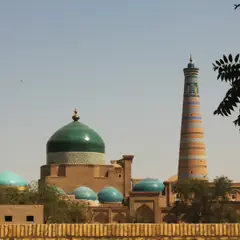
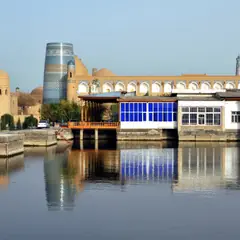
The Kunya Ark is the walled citadel of the khans of Khiva, attached to the west wall of Itchan Kala. It is younger than it looks: in the 1590s Khiva still had no citadel, and the first documented reception hall was built under Arang Khan between 1686 and 1688. Destroyed in the Iranian invasion of the 18th century, it was rebuilt by Eltuzar Khan between 1804 and 1806, and after the unrest of 1855 it was rebuilt again in 1864. Inside sit a summer mosque, a mint, a reception courtyard, a harem, a zindan and a bastion-lookout.
Its name, “old citadel”, is almost a misunderstanding: it began to be used when Allakuli Khan built the new palace of Toshhovli in 1832–1838, but the Ark remained the khans' residence until the Bolsheviks overthrew the khanate in 1920. And its most famous piece is missing: the silver throne of 1816 left Khiva after the Russian conquest of 1873, and the one that fills its niche today is a replica.
Highlights
- Courtyard of the koʻrinishxona — the brick circle where the khan's yurt was pitched
- Throne room — the replica of the silver throne of 1816, whose original left Khiva in 1873
- Mint of the Ark — coins with the khan's seal and silk banknotes stamped by hand in 1918
- Summer mosque of 1838 — a six-column iwan under blue and white majolica
- Oqshayx Bobo lookout — 11 metres of adobe above the whole of Itchan Kala
On the afternoon Khiva fell, in 1873, the khan had already fled. The Russian officers crossed the courtyard of his palace, climbed onto the dais where he used to dispense justice and lay down to rest while the military band played Offenbach. So ended, amid cherries and iced water, the court life of the Kunya Ark, the citadel the khans of Khiva built against the west wall of Itchan Kala and which worked as a city apart: with its own mosque, mint, harem, prison and a bastion from which everything was watched.
The history of the Kunya Ark is that of a building remade again and again. The first reception hall, the koʻrinishxona, was commissioned by Arang Khan between 1686 and 1688; the Iranian invasion of the 18th century razed it, Eltuzar Khan rebuilt it between 1804 and 1806 with the vizier Yusuf Mehtar, the unrest of 1855 destroyed it again and in 1864 Sayyid Muhammad Khan raised it anew. The age of the complex is disputed: some guides place its foundation in the 12th century and the Uzbek encyclopaedia dates the core of the Oqshayx Bobo bastion to around the 2nd–3rd centuries, while Abulgazi Khan records no citadel in Khiva in the 1590s. Nor is there unanimity on who founded it and who rebuilt it in the 19th century.
The architecture of the Kunya Ark mixes sand-coloured adobe with bursts of ceramics: under Allakuli Khan (1825–1842) the ceramist Abdulla Jin clad its iwans in the blue and white majolica that is Khiva’s signature. What to see inside has an almost theatrical order: the single gate, the summer mosque, the vaulted rooms of the mint, the yurt courtyard, the throne room and, at the end, the climb to the lookout.
The audio guide tours the citadel in six stops, with documented narration checked against historical sources, drawing on the testimony of those who came in here to beg, to fear or to conquer.
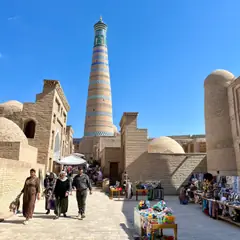
On the way out, the Kalta Minor is a few steps away and the Ota Darvoza Gate, the west entrance of the old town, a hundred metres off. The palace that earned it the nickname of “old citadel” is the Tash Hauli Palace, on the other side of the walled city.
A fortress with its own wall
Wall of the Kunya Ark
Summary of this stop
The tour starts in the square before the east gate, the Ark’s only entrance, flanked by two towers and with a vaulted passage restored between 1969 and 1972. At the end of the 18th century a high wall separated the citadel from the rest of Itchan Kala: the khan’s power was shut inside a city that was already walled.
The square had a double use. It served for military parades and training fights, but by the eastern walls there was a place of execution and a zindan, the prison that is now a small museum with shackles and whips. Ten years before the Russian conquest, the Hungarian traveller Ármin Vámbéry, disguised as a dervish, came out of an audience with Sayyid Muhammad Khan and witnessed in the last courtyard the punishment of a group of Turkmen prisoners.
What that witness saw, and the two words that were enough to send someone from the audience on the way to the executioner, is the account with which the narration opens the visit.
Summer prayer under blue majolica
Summer mosque
Summary of this stop
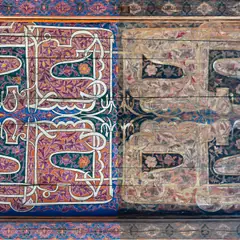
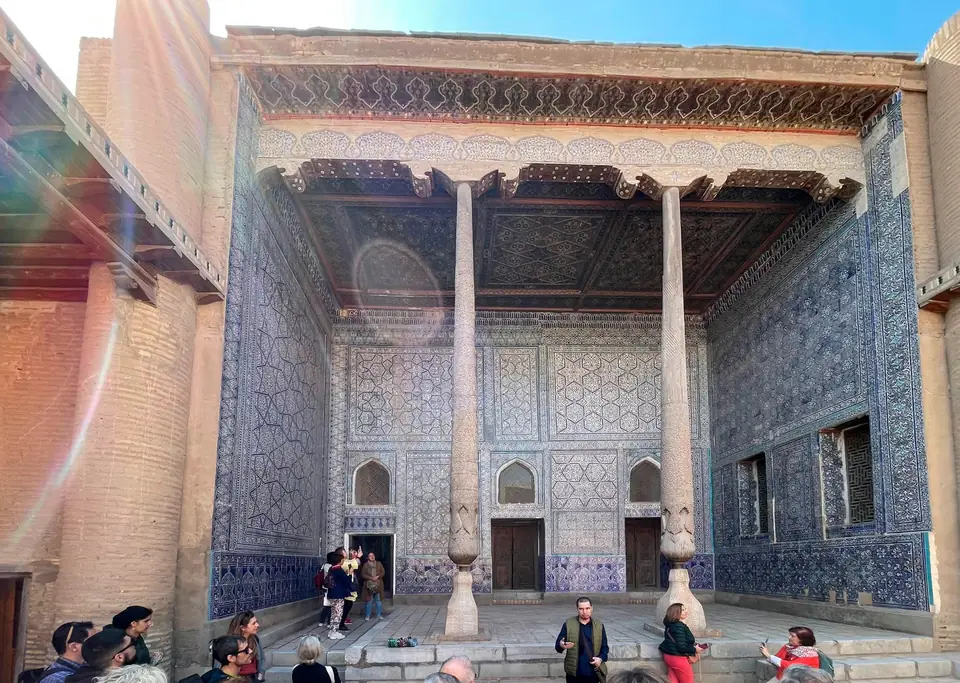
Just inside the gate, on the right, opens the summer mosque of 1838: an iwan of 7.4 by 13 metres open to the courtyard, with six wooden columns in two rows on marble bases, the mihrab in the south wall and the minbar in the southwest corner. The contrast is immediate: behind the smooth adobe walls appears a whole wall of blue and white ceramic with plant motifs, under a ceiling painted in red, orange and gold.
That majolica has an author. During the renovation of the Ark under Allakuli Khan, the ceramist Abdulla Jin clad the mosque and the iwan of the reception hall with Khiva’s traditional tiling. Why a mosque meant for summer opens like this onto the courtyard is one of the keys of this stop.
Silk banknotes nobody redeemed
Mint of the Ark
Summary of this stop
Beside the mosque are the three vaulted rooms of the mint, the zarbxona, built under Muhammad Rahim Khan I (1806–1825). Gold, silver and copper coins were struck here with the seal of the reigning khan; more than 300 Khiva coins are kept today in the Hermitage. The rooms house a small museum with mannequins of coin-strikers, coins and banknotes.
The most unusual piece is made of cloth. From October 1918, for lack of paper, the mint printed banknotes of local silk: a ribbon 11 centimetres wide cut into pieces of 15 and stamped by hand with elm-wood seals, with values from 200 to 2,500 tangas in its first issue. When in 1923 the Khiva notes were ordered to be exchanged, not a single silk one turned up. Where they ended up is the domestic twist that closes the story of this money.
A yurt in the throne courtyard
Yurt platform
Summary of this stop
In the middle of the koʻrinishxona courtyard, of 13.5 by 17.5 metres, rises a brick circle. On it a yurt was pitched in which the khan received the ambassadors of his nomad neighbours: a city sovereign who, to deal with the steppe, spoke from a tent. The hall around the courtyard is the one destroyed and rebuilt in 1804–1806 and again in 1864.
In 1819 the Russian captain Nikolai Muraviov came here without his sabre, because Khivan custom forbade appearing armed before the khan. He was led through a succession of courtyards, in one of them he was shown seven Russian-made cannon with broken wheels, and at the end Muhammad Rahim Khan was waiting, seated at the entrance of his kibitka. Why the tsar’s envoy believed, a few steps from the yurt, that he had been brought there to be executed is what the narration tells beside the brick circle.
A silver throne that travelled north
Iwan and throne room
Summary of this stop
At the back of the courtyard rises the tall iwan of the reception hall, tiled in blue and white, on two wooden columns; one of its bases carries engraved verses by the poet and historian Agahi. Inside, among carved plaster and muqarnas, a niche holds the replica of the throne the Khivan master Muhammad made in 1816, of wood covered with finely engraved silver plates. The original went north after the Russian conquest of 1873: encyclopaedic sources place it in the Kremlin Armoury, although one travel account puts it in the Hermitage.
It was not the only thing missing. In the 1873 inventory, the orientalist A. L. Kun found almost all the treasure chests empty, recorded 200 coin dies and 300 manuscripts, and the khans’ library ended up in St Petersburg. From the gallery where the khan sat to judge, General Kaufman proclaimed to the notables that the enmity was over. What happened next on that same dais, with a Parisian operetta in the background, is the scene the narration keeps for this point.
The sheikh’s cell that watches over Khiva
Oqshayx Bobo lookout
Summary of this stop
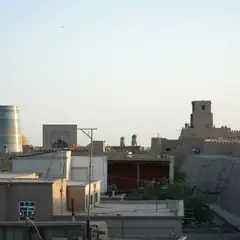
The ending is up above. The Oqshayx Bobo bastion, an adobe mass of 60 by 40 metres and 11 high, is the highest point of the Ark and is climbed by a steep staircase with a separate entrance. It was the cell of Sheikh Oqshayx Bobo, teacher of Sheikh Mukhtar Vali; later it served as a lookout and a powder store. From the top, the west wall of Itchan Kala and the whole old town lie at eye level, and at sunset it becomes the city’s great viewpoint.
From here the name also makes sense. Koʻhna Ark means “old citadel”, and it began to be called that when Allakuli Khan raised the Toshhovli palace in 1832–1838. Even so, the khans went on living in this enclosure until 1920. How each courtyard you have walked fits into that long farewell is the close of the visit.