Shrine of Khiva's patron saint
Pahlavan Mahmud Mausoleum Audio Guide (Pahlavon Mahmud maqbarasi)
Khiva's largest dome crowns not a palace but a furrier's workshop. There Pahlavon Mahmud, poet and undefeated wrestler, asked to be buried, and at his feet the city's most powerful khans later wished to lie.
- 25 min of audio
- 19th-century majolica
Pahlavon Mahmud (1247-1326) was a poet, furrier and wrestler, and asked to be buried in his own leather workshop. The tomb became a place of pilgrimage and around it grew, between 1664 and 1913, a complex of buildings from different eras covering some 50 by 30 metres. In 1810 Muhammad Rahim Khan I rebuilt the mausoleum so that the necropolis of his Qungrat dynasty would lie at the patron saint's feet, and under Allakuli Khan the building was clad in majolica.
Among the blue and white tiles inside runs a band with ruba'is by the saint himself, mixed with religious maxims and the names of the craftsmen. One of them, the draughtsman Abdulla “Jin”, left a verse boasting that his colours serve as a model for spring. And in the courtyard waits a crypt of 1913 built by a khan who never came to occupy it.
Highlights
- Turquoise dome — Khiva's largest and the only one of that colour in Itchan Kala
- Courtyard of the well — pilgrims who pray and drink the saint's water
- Majolica khanqah — ruba'is by Pahlavon Mahmud and Abdulla “Jin”'s signature in verse
- Tombs of khans — Muhammad Rahim Khan I on the central axis and the slabs of 1663 and 1681
- Qorikhona of 1913 — the crypt Asfandiyar Khan reserved for himself and never occupied
All the splendour of the Pahlavan Mahmud Mausoleum was built around something very modest: a furrier’s leather workshop. Pahlavon Mahmud, born in 1247 and died in 1326, was also a poet and a competition wrestler, and asked to be buried right there, among his hides. The tomb became a goal for pilgrims, the furrier became Khiva’s patron saint and, for two and a half centuries, the city’s sovereigns vied to rest beside him.
The history of the Pahlavan Mahmud Mausoleum has layers, and not all of them fit. The most quoted sources speak of a small first mausoleum of 1664, but the inscription in the gatehouse dates the construction to 1701, under Shohniyoz Khan, and other sources take the original building back to the 14th-16th centuries. The present great mausoleum is dated to 1810 or, in another version, to between 1825 and 1835. Nor is there unanimity about the saint: an Iranian legend identifies him with Pourya-ye Vali and places his tomb in Khoy, and his death is dated between 1322 and 1326. In Khorezm he is called Pahlavon Pir, and the complex Hazrati Pahlavon Pir or the mausoleum of Polvon ota.
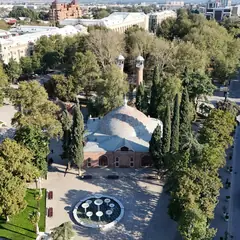
The architecture of the Pahlavan Mahmud Mausoleum is that of a complex that grew by additions: the portal of the old cemetery, a funerary courtyard with its well and the ayvan of a summer mosque, the khanqah under the dome, the saint’s room, an east wing of 1825 and a two-storey qorikhona of 1913. It all fits in some 50 by 30 metres, and almost all of it is clad in blue and white majolica.
The audio guide tours it in four stops, with documented narration checked against historical sources, from the south portal to the railing that guards the furrier’s sarcophagus.
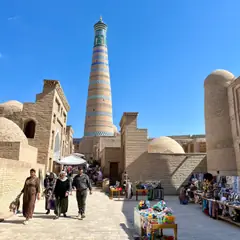
About 65 metres away rises the Islam Khoja Minaret, the tallest in Khiva, and 90 metres off the Juma Mosque hides its forest of columns. Majolica by the same Abdulla “Jin” covers the courtyards of the Tash Hauli Palace.
The only turquoise dome in Itchan Kala
Turquoise dome
Summary of this stop
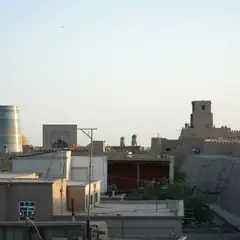
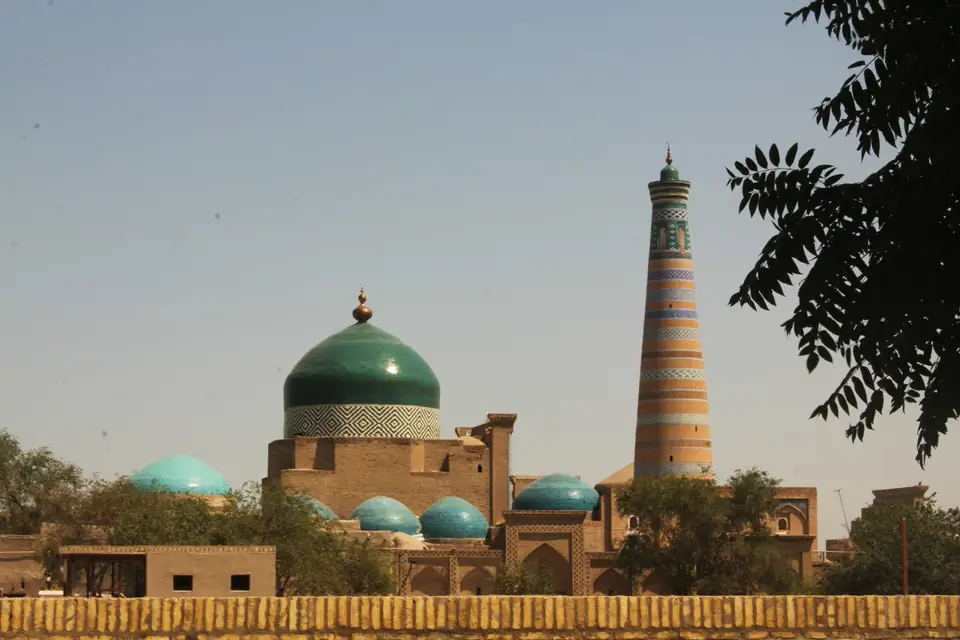
From almost any corner of Itchan Kala the same silhouette shows: a dome of glazed blue tile with a gilded finial. It is Khiva’s largest and the only turquoise one in the whole walled city. Whoever reaches the south portal expects to find a palace beneath, and finds the tomb of a furrier.
That man’s weight in the city is measured in details. One of the gates of Itchan Kala, the Palvon-darvoza, bears his name, as does the Palvon-yab canal that irrigates the oasis. And in 1719 Shergazi Khan raised his madrasa south of the cemetery, orienting it expressly toward the mausoleum, like someone bowing to him.
According to tradition, Mahmud was born in the cart of his father, a furrier who had emigrated from Gurganj, the old capital of Khorezm, just as the family was entering Khiva. He inherited the workshop, but his fame came as a pahlavon, an undefeated wrestler who travelled through Iran, Afghanistan and India. How that circle between the cart, the city gates and the dome closes is what the narration tells at the entrance.
The saint’s well and the empty crypt
Funerary courtyard and well
Summary of this stop
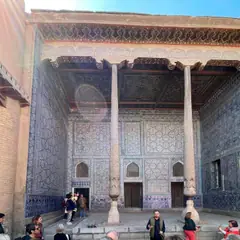
Beyond the portal opens a funerary courtyard strewn with tombs, with a deep well on one side and, in the southeast corner, the ayvan of the summer mosque held up by carved columns. It is no stage set: worshippers come here to pray before the saint’s tomb and to drink what they call his holy water. In 2017, during a restoration that even brought modern climate control, the complex received on average some 400 pilgrims a day.
Everyone wanted a place around that tomb, and the complex grew without pause between 1664 and 1913. The last piece was added by Asfandiyar Khan on the west side of the courtyard: a two-storey qorikhona with a large family crypt.
His mother, Kutlug-biki Khanum, rests in it. He does not. Why the khan who had it built stayed out of his own crypt is a story of 1918, of a palace outside the walls and of a custom that admitted no exceptions, and it is heard beside the well.
A khan at the centre, verses on the walls
Khanqah and niche of Muhammad Rahim Khan I
Summary of this stop
Under the dome, the khanqah is clad in blue and white from the plinth to the keystone. The room is, above all, a statement of power. In 1810, after a victorious campaign against Kungrad, Muhammad Rahim Khan I rebuilt the mausoleum so that the necropolis of his Qungrat dynasty would lie at the saint’s feet. The work was directed by the master Adina Muhammad Murad of Hazarasp, and the khan, who died in 1825, occupies the central axis: a majolica sarcophagus in a pentagonal niche, facing the entrance.
Beside him were placed the marble slabs of Abulgazi Khan (1663) and Anusha Khan (1681), brought from elsewhere to the new building. Thus a single gesture brought together the predecessors, the new lineage and the saint under the same vault.
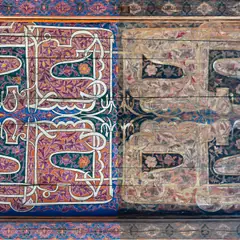
The walls speak too. In the epigraphic band between the blue and white ornament you can read ruba’is by Pahlavon Mahmud himself, alongside religious maxims and the names of the master craftsmen. The majolica designs are by Abdulla “Jin”, who could not resist signing in verse; what exactly his tile says, and what it has to do with spring, is left for the narration beneath the dome.
The furrier’s tomb behind a railing
Sarcophagus of Pahlavon Mahmud
Summary of this stop
Through the west door of the khanqah you pass into the ziyaratjona, the saint’s room. There, behind a low railing, is Pahlavon Mahmud’s glazed sarcophagus, on the spot where, according to Khiva’s tradition, his leather workshop stood. The carved wooden door of this room is dated 1810; the outer one, 1894, both the work of Khivan masters.
It did not always look like this. In 1863 the traveller Ármin Vámbéry found the shrine, which he called “Hazreti Pehlivan”, dark inside, with tasteful tiles barely visible and swarms of blind Quran reciters under the dome and in the courtyards. His account adds a doubt: he identifies the buried saint with another name, which corresponds to Abdal Bobo, a different saint with a mausoleum in Dishan-Kala.
There remains the legend that made Pahlavon a hero. It is recorded in the “Manokib”, his hagiography: after saving the life of a king of India in the midst of battle, the wrestler refused half a kingdom and a princess’s hand and asked for something else. The popular version adds a cowhide and a furrier’s cunning; how it was used to measure freedom is the end of the tour, before the railing.