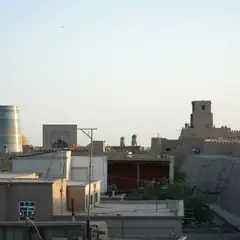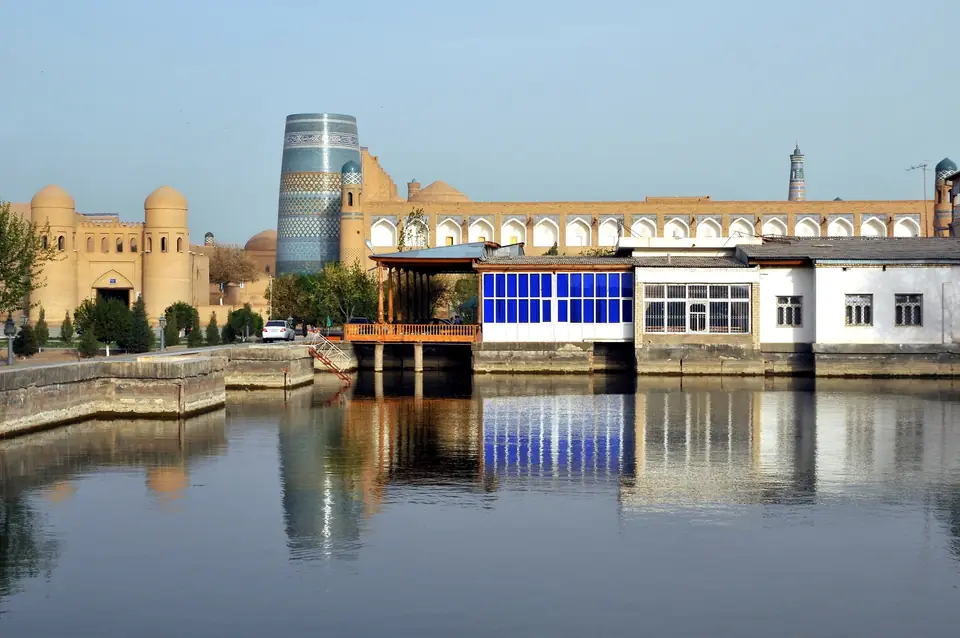
West gate of Itchan Kala
Ota Darvoza Gate Audio Guide
Almost everyone who arrives in Khiva comes in through the Gate of the Father, and almost nobody suspects that the khanate portal they cross was built in the 20th century, closed with doors salvaged from a vanished palace. Two centuries on, the gate still does what it did then: charges for passage.
- 20 min of audio
- Adobe wall
The Ota Darvoza is the western and main gate of Itchan Kala, Khiva's walled inner city. It is usually dated to 1828-1829, under Allah Kuli Khan, although other sources take it to 1842 or to the reign of Eltuzar Khan. It was a customs gate: under its vaults worked the customs house, a currency exchange and the porter's room, and behind it stretched rows of shops and a covered bazaar, the chorsu. In 1920, by the most widespread account, it was pulled down to make way for a road.
The gate everyone photographs today, 10 metres high and 4 wide, is a reconstruction of the 1970s made from archive material. Its carved wooden leaves are not the originals either: they closed the entrance of the country palace Muhammad Amin Khan had built at Angarik in 1850-1851, and their provenance is known only from two photographs by Khudaibergen Divanov, the Khiva court photographer who was executed in 1938.
Highlights
- Two-tower façade — a crenellated front rebuilt between 1974 and 1978
- Carved wooden leaves — eight-pointed stars, the Al-Ikhlas sura and the shahada
- Doors from Angarik — brought from Muhammad Amin Khan's country palace
- Statue of al-Khwarizmi — the father of algebra whom Khiva claims as a son
- Vaulted passage — former customs house and exchange, now the Itchan Kala ticket office
A mosque that no longer exists lives on in the name of a gate. “Ota” means “father” in Uzbek, and the Ota Darvoza, also called the Shermuhammad Ota gate, translates as “Gate of the Father”. One explanation attributes it to the mosque of Sher Muhammad Ata and its pool, which stood in front and vanished without a trace; another, simpler, to its being the main entrance of Itchan Kala. Neither has closed the debate.
The history of the Ota Darvoza has three lives. The first begins in 1828-1829 under Allah Kuli Khan, according to the most quoted dating, although some sources speak of 1842 or of the reign of Eltuzar Khan. It was gate, customs house and market at once. The second ends with its demolition, placed almost always in 1920 and, in one version, in the 1930s. The third is the one seen today: a reconstruction raised in the 1970s from archives, closed with wooden leaves that came from another building and turned into the ticket office that almost every visitor to Khiva passes through.
What to see at the Ota Darvoza goes beyond the arch. Outside wait the statue of al-Khwarizmi and the adobe wall; on the threshold, carved leaves with inscriptions from the Quran; inside, the vaulted passage of the old customs house and the street that crosses the walled old town. The audio guide tours the gate in four stops, with documented narration checked against historical sources.
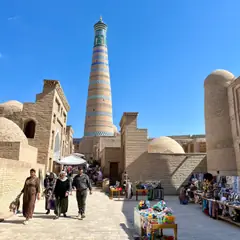
Right after crossing it appears the Kalta Minor, the turquoise minaret that stopped halfway, and a hundred metres on rises the Kunya Ark, the citadel of the khans, also against the west wall.
Al-Khwarizmi waits at the foot of the wall
Statue of al-Khwarizmi
Summary of this stop
The tour starts outside, in front of the gate, where a seated stone figure greets whoever arrives. It is Muhammad al-Khwarizmi, the 9th-century mathematician born in Khorezm, as the sculptor S. Babayan portrayed him: meditating over a scroll-shaped treatise that falls from the stone to the ground. Behind, the wall of Itchan Kala recedes to both sides: a little over 2 kilometres in perimeter, between 8 and 10 metres high and between 6 and 8 wide, made of adobe bricks of 40 × 40 × 10 centimetres and rebuilt several times over the centuries.
In Khiva they insist the father of algebra was born right here, and that is why his statue welcomes you to the city. His birthplace, however, is not so clear. Ibn al-Nadim places it in Khorezm, but the chronicler al-Tabari calls him “al-Qutrubbulli”, a nickname that would point to Qutrubbul, near Baghdad.
A single word in a medieval chronicle is enough to move his birthplace to the banks of the Tigris. Whether that word is a slip of the pen or a clue is the discussion the narration raises at the statue’s feet.
Towers of 1975 with a khanate face
Gate towers
Summary of this stop
Before the arch, the Ota Darvoza looks as if it came intact from the 19th century: a tall brick front flanked by two towers, the guldasta, topped with battlements and with the passage open in the centre. It is the most repeated image on Khiva’s postcards, and also the most deceptive.
The architecture of the Ota Darvoza is, in fact, of the 1970s. The original gate, usually dated to 1828-1829, was pulled down in 1920 to make way for a road, by the most widespread account, and with it lost its doors and its look. The present one, 10 metres high and 4 wide, was raised from archive material; most sources set the work in 1975, the year its four main rooms were rebuilt, and others extend it from 1974 to 1978.
That reconstruction has an author almost nobody knows. Who the master was who directed with a firm hand the gate’s return to its original look, and how the work was done, is the episode told between the two towers.
Leaves from a palace that no longer exists
Carved wooden leaves of the gate
Summary of this stop
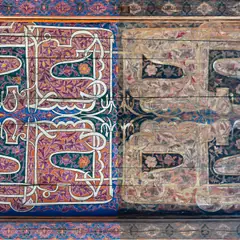
On the threshold close two great leaves of carved wood, divided into equal squares of 85 × 85 centimetres with eight-pointed stars and arabesques. In the circles of the right leaf is the Al-Ikhlas sura of the Quran; in the left, the shahada, the Islamic profession of faith.
These leaves were not born for this gate. They were mounted at the entrance of the country palace that Muhammad Amin Khan built in 1850-1851 in the village of Angarik, near Khiva. The palace vanished, and if today it is known where the leaves come from, it is thanks to two photographs taken there before its destruction, kept in the Itchan Kala museum.
They were signed by Khudaibergen Divanov, born in 1879, court photographer and later finance minister of the Khorezm People’s Soviet Republic, executed on 4 October 1938 in a prison camp at Yangiyul. His camera scandalised Khiva’s religious men before becoming its memory; what the khan did when the complaints reached him is the story waiting beside the leaves.
The customs house that now sells tickets
Vaulted passage and ticket office
Summary of this stop
The passage through the gate is covered by two domes and opens onto vaulted rooms on both sides. Here worked the customs house, the bojxona; the currency exchange, the sarrof xona; and the porter’s room. Behind the gate stretched rows of shops and a covered bazaar, the chorsu, although sources do not agree on how many stalls it had.
Since 1978 the rebuilt gate has been adapted as a shop, and today its rooms house the ticket office where the combined ticket to the Itchan Kala monuments is sold, some 250,000 som for foreigners in 2026. Where duties were once paid and money changed, today you pay to get in.
On leaving the passage, the Ko’hna Ark, the citadel of the khans, is on the left, and Muhammad Amin Khan’s madrasa, with the Kalta Minor in front, on the right. From here starts the only main street of Itchan Kala, running straight from west to east to the Polvon Darvoza. How that street fits into the life of the old customs gate is what closes the tour.