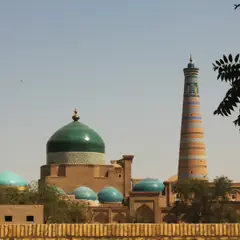
Minaret of 1910
Islam Khoja Minaret Audio Guide (Islomxo'ja minorasi)
Khiva's tallest tower stands beside its smallest madrasa, and it was paid for by a grand vizier who wanted to bring the telegraph, the hospital and electric light to the khanate. Three years after finishing it, he was stabbed at night in a city street and nobody wanted to find out who did it.
- 30 min of audio
- Khiva's highest viewpoint
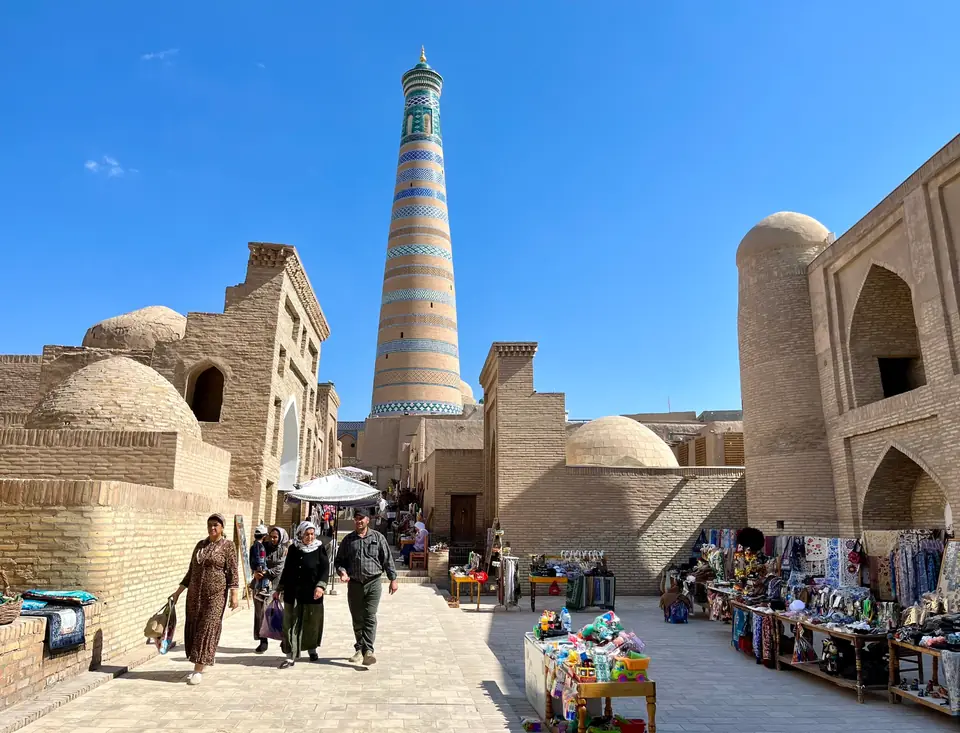
The Islam Khoja Minaret was built between 1908 and 1910 in the southeast of Itchan Kala, on the initiative and with the money of Islam Khoja, grand vizier of Isfandiyar Khan and also his father-in-law. The work was directed by the master Khudoibergan Haji, and the tile was laid by Bolta Voisov and other masters from the village of Madir to drawings by the painter Eshmuhammad Khudoiberdiyev. Its most quoted height is 56.6 metres on a base 9.5 across, and its lantern, at 45 metres, is the city's highest viewpoint.
The whole plays with disproportion: Khiva's tallest minaret paired with its smallest madrasa, a tiny courtyard and a low-domed mosque that make the tower look even more gigantic. The tile bands that girdle it and the sharply tapering shaft reinforce the effect, to the point that some measurements lower the real height to about 44.5 metres and put the rest down to an optical illusion.
Highlights
- Tiled shaft — dark blue, white, blue and green bands over ochre brick
- Spiral staircase — 175 steps up to the lantern, at 45 metres
- Khiva's smallest madrasa — 42 cells, now the Khorezm Applied Arts museum
- Islam Khoja — the reformist vizier stabbed in 1913, an unsolved crime
- Chain of minarets — the row of towers of Itchan Kala seen from the very top
In 1910, the year this minaret was finished, the man who was paying for it received the greetings of the khan’s courtiers in his own house as if he were the sovereign. Islam Khoja, born in Khiva in 1872, was grand vizier and father-in-law of Isfandiyar Khan, and had turned his residence into a kind of parallel court, a “little palace” where affairs of state were discussed. He had travelled several times to St Petersburg and Moscow with Khivan delegations and, according to tradition, had talked there with Tsar Nicholas II about world politics. The date of his appointment as grand vizier, by the way, is unclear: some sources place it in 1898 and others in 1907.
The history of the Islam Khoja Minaret is that of an ambition. The vizier paid out of his own pocket for a cotton-ginning factory, the khanate’s first power station, a hospital, a pharmacy, a post office, a telegraph, secular Jadid schools and a Russian school. One of the men on his diplomatic mission, Khudaibergen Devanov, came back from St Petersburg with a Pathé camera and in 1910 shot the first Uzbek documentary with it. In 1912 the complex bearing the vizier’s name added a new-method school to the madrasa and the minaret: religion, prestige and modern teaching in a single commission.
That modernity had enemies. In 1911 a written protest against the vizier ended in the arrest of several members of the rival clan at court, although it remains disputed whether the dignitaries themselves promoted it or the khan, to set his men against each other. In August 1913 Islam Khoja died stabbed, soon afterwards his only known son was killed and his right-hand man was found buried alive. Who ordered the crime is still debated: some historians point to the khan himself, the Russian administration pointed to another courtier and another version holds that the vizier died without the sovereign’s consent. A century later, in 2018, Uzbek cinema shot the film “Islomxo’ja” in Itchan Kala to reopen the case.
On the architecture of the Islam Khoja Minaret there is no unanimity either. Some see in it the form of a minaret of the 11th-12th centuries and others trace it to the 14th century and the towers of Kunya-Urgench; some give it as the tallest of the old khanate and the official tourism portal as the second in Central Asia, after the Kutlug Timur of Kunya-Urgench. The audio guide tours the tower, the madrasa and the viewpoint in four stops, with documented narration checked against historical sources.
About 65 metres away, the Pahlavan Mahmud Mausoleum holds the tomb of Khiva’s patron, and a hundred metres off the Juma Mosque raises its own minaret. The inevitable rival stands by the west gate: the Kalta Minor, the tower that was to be the tallest in the world and stopped halfway.
The tallest tower beside the smallest madrasa
Islam Khoja Minaret
Summary of this stop
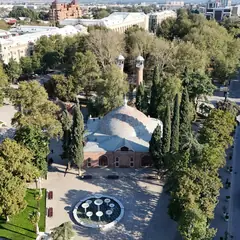
From the alley, at the foot of the tower, the first thing is the scale. The ochre brick shaft rises from a solid base 9.5 metres across and climbs, tapering sharply, to a lantern visible from almost anywhere in Khiva. Beside it, the city’s smallest madrasa, with its tiny courtyard and a low-domed mosque, looks almost like a toy: the disproportion is deliberate and makes the tower even more gigantic.
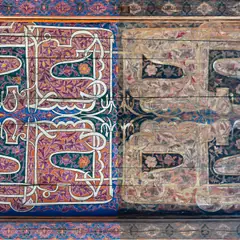
The minaret’s skin is that of 1910. Horizontal bands of glazed mosaic in dark blue, white, blue and green girdle the brick, and the lantern at the top ends in a muqarnas cornice and ceramic lattices called panjara. Behind it were the master builder Khudoibergan Haji, the tilers from the village of Madir led by Bolta Voisov and the painter Eshmuhammad Khudoiberdiyev, author of the drawings.
Those rings of colour have their trick, and also their legend: it is said the tower served as a military lookout and a guide for caravans crossing the Kyzyl Kum desert, like a tiled lighthouse. It is more image than verified history, and why the tower deceives the eye so much is what the narration reveals at its foot.
The vizier who brought the telegraph to Khiva
Portal of the Islam Khoja madrasa
Summary of this stop
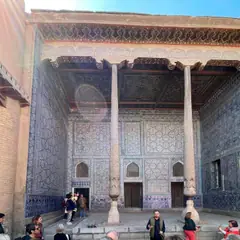
Facing the madrasa portal, the blue and white majolica, the tympana and the tile bands form a backdrop to the minaret. This is the place to ask who paid for all this: Islam Khoja, grand vizier of Isfandiyar Khan and father of one of his wives, who raised the complex between 1908 and 1910 with his own money.
When Isfandiyar took the throne in 1910, the vizier, aged 38, became the most powerful man in the khanate: appointments went through his recommendation and his house received the khan’s own intimates. He was also the reformer who had brought electricity, the hospital, the telegraph and modern schools to Khiva. But the new khan did not want to be a puppet sovereign.
On 6 November 1912, during the Qurbon hayit festival, a scene in the middle of the procession made it clear before the whole city that the vizier’s power was cracking. Who starred in it and what was shouted is what is told before this portal.
Forty-two cells that outlived the vizier
Courtyard of the 42 cells
Summary of this stop
The madrasa courtyard measures 23 by 20 metres and is ringed by 42 single-storey cells, with undecorated walls. Fifty students studied here, supported by the 14,451 tanob of land that Islam Khoja granted as waqf, a pious endowment. In the attached mosque a majolica and carved-plaster mihrab, the ganch, is preserved.
Today the cells are the rooms of the Khorezm Applied Arts museum: wood sculptures, metal objects, carpets, stones with old Arabic inscriptions, great khum jars, coins and everyday objects. The calm of the courtyard contrasts with what came after.
On the night of 9 August 1913, returning from Nurullabay’s palace to his residence without an escort, the vizier died stabbed. His coachman was wounded with a sabre and the dead man was robbed of neither money nor valuables. There was a witness, a lead and a public interrogation that was cut off abruptly; why the case was closed falsely is the darkest part of the tour.
A chain of minarets from the lantern
Minaret lantern
Summary of this stop
To get to the top you climb a fired-brick spiral staircase inside: 175 steps in the half-dark up to the lantern with arched windows. Its platform, at 45 metres, is Khiva’s highest observation point.
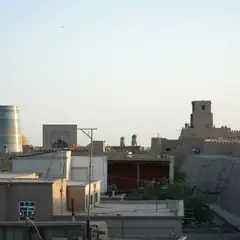
From there you see the domes and roofs of Itchan Kala, the Khorezm oasis opening toward the desert and, above all, the other minarets. They follow at intervals of about 200 metres: entering by the Koy-Darvaza gate, from the east, Abdal-bobo, Palvan-kari, Seyid-Shelikerbay, Islam Khoja, Juma, Kalta Minor and Bika-jan-bika link into a single image. Of the nearly one hundred minarets the city had, some 20 remain today.
Why this tower is still the compass of Itchan Kala is the close of the vizier’s story, told from the highest point.