Shrine of the patroness
Basilica of La Soledad Audio Guide (Basílica de Nuestra Señora de la Soledad)
A low, stubborn green-stone church that, according to tradition, was chosen not by a bishop but by a mule with no owner. Inside waits the patroness of Oaxaca, a Virgin who is only a head and hands beneath a mantle of stories.
- 30 min of audio
- New Spanish Baroque
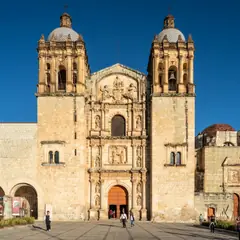
Built between 1682 and 1690 beside the Fortín hill and consecrated on 6 September 1690 by Bishop Isidro Sariñana y Cuenca, the shrine of the Virgin of La Soledad is the great Baroque church of Oaxaca's patroness. It was deliberately built low, with short towers, because earthquakes had already ruined several of the city's major buildings, and in 1959 it received the title of minor basilica.
Almost thirty years after the consecration, between 1717 and 1718, a yellow-stone portal in the shape of a folding screen was added, spreading like wings across the green walls of the church. At its centre, a weeping Virgin kneels before a cross too small for her body, and inside sounds an organ of 1719, one of the oldest in Mexico.
Highlights
- Folding-screen portal of 1717-1718 — yellow stone, three tiers and niches with saints
- Railed-off rock — tied to the legend of the mule that brought the Virgin
- Virgin of La Soledad — a dressed image with a 2-kilo gold crown and 600 diamonds
- Organ of 1719 — one of the oldest in Mexico, restored in 1998-2000
- Jardín Sócrates — the old Soledad square, an ice-cream garden since 1881
The history of the Basilica of La Soledad begins before its stone. Beside the Fortín hill stood the hermitage of Saint Sebastian Martyr, of the confraternity of San Sebastián and the Soledad of Our Lady, which already dedicated a chapel to the Virgin of La Soledad. On that spot the present shrine was begun in 1682, attached to the convent of the Augustinian Recollect nuns of Santa Mónica and paid for by the bequest of Pedro Otálora y Carvajal; according to most sources it was finished in 1690, although others give different dates. Since then Oaxaca has never stopped dressing, hiding, losing and celebrating its patroness. The 30-minute audio guide walks through the church in five stops, from the atrium to the Jardín Sócrates, with documented narration checked against historical sources.
Its Baroque converses with that of the Santo Domingo Church and the Oaxaca Cathedral, half a kilometre to the east; the 20 de Noviembre Market is also a short walk away.
A yellow screen on green stone
Basilica of La Soledad
Summary of this stop
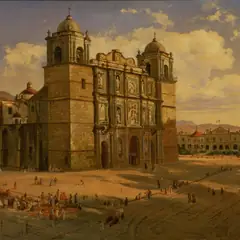
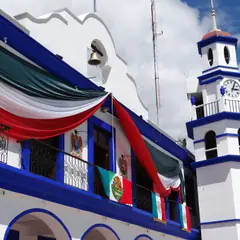
From the atrium, the first thing that strikes is the contrast: the body of the church is Oaxacan green stone, while the portal, carved between 1717 and 1718, is yellow stone and projects slightly toward the atrium relative to the bell towers. It is not a flat wall but a folding screen: three tiers and a pediment that open like wings from a recessed centre, with Doric, Ionic and Corinthian columns and niches full of saints, from Saint Peter and Saint Paul to Saint Rose of Lima or Saint Sebastian.
The towers, by contrast, are short and the silhouette of the whole is low on purpose. In 1682, when work began, several important buildings in Oaxaca had already been ruined by earthquakes, and the church was conceived to withstand them. The authorship of the façade is still disputed: different sources attribute it to different names.
Above the main door, a large relief shows the Virgin of La Soledad kneeling and weeping at the foot of a cross, with a skull and a view of Jerusalem behind. The cross is strikingly small for the size of her body, and that mismatch is only the first of the oddities the narration unpicks in front of the portal.
The rock where the mule lay down
Railed-off rock
Summary of this stop
Just inside, on the right, an outcrop of rock stands enclosed behind an iron grille. According to tradition, a muleteer driving his pack train between Veracruz and Guatemala found in the nearby hills one mule too many, loaded with a chest that nobody claimed. On reaching the hermitage of San Sebastián, the mule lay down with its load and there was no way to raise it.
Inside the chest, the tale goes, appeared a Christ, a head of a Virgin, a pair of carved hands and a label: «Our Lady of La Soledad at the foot of the Cross». Bishop Fray Bartolomé de Bohórquez e Hinojosa ordered a church to La Soledad built there. Versions do not agree on the ending of the mule or on the date of the event, which depending on the source is placed in 1543, in 1617 or in 1620, with no primary documentation to confirm it.
What is documented is the passage from a confraternity hermitage beside the hill to a shrine consecrated on 6 September 1690 by Bishop Isidro Sariñana y Cuenca. The stop joins the concrete stone with the legend and with the history that followed.
A Virgin with no body and her lost pearls
Image of the Virgin of La Soledad
Summary of this stop
On the high altar, lit in the chancel, the image of the patroness wears a long mantle and crown. What cannot be seen is that it is a dressed image: only the head and hands were carved, and the garments hide that it has no body. It arrived together with an image of the risen Christ that ended up in the hermitage of the Santa Veracruz, in the Carmen de Arriba.
The Virgin of La Soledad was also the patroness of sailors, who covered her in pearls, and her gold crown weighs 2 kilos and carries 600 diamonds. Pius X granted her canonical coronation at the start of the twentieth century, and in 1959 the church became a minor basilica.
Legend has it that, during the Reform, the faithful hid their jewels and vestments, and that in 1888 workmen found under the floor of a shop in the Portal de la Clavería an iron chest full of pearls and the Virgin’s old tunic. The rest of the episode, with a new tunic embroidered by the nuns and a theft almost a century later, is kept for the narration before the chancel.
The 1719 organ and its lost bellows
Upper choir organ
Summary of this stop
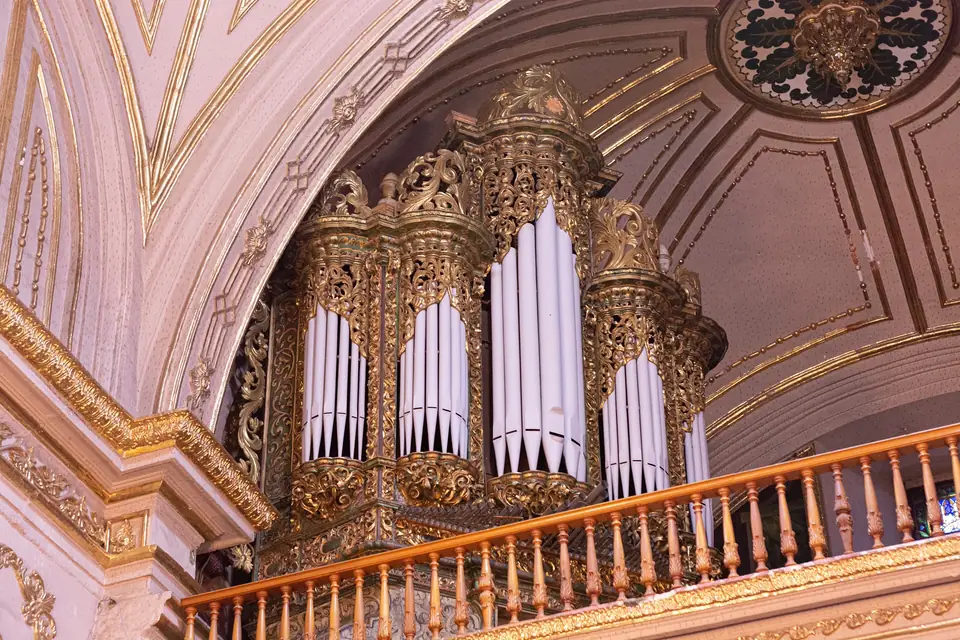
In the upper choir, above the entrance, an organ of 1719 is preserved with a carved, painted and gilded case, one of the oldest in Mexico. It was not born up there: in 1718 a raised gallery was built to the right of the high altar and the instrument was installed in it, paid for, like the church and convent, by the bequest of Pedro de Otálora, who died in 1691 with the works still under way. In 1908 the Wagner company dismantled it and raised it to the choir, where only three of its four bellows fitted.
The choir had another function too. Until the Reform of the 1860s it connected with the Augustinian nuns’ convent to the right of the church, a building that is now the seat of Oaxaca’s municipal government.
In the 1970s the organ was modernised and its case repainted in greys and greens; the restoration of 1998-2000, directed by Pieter Visser and finished by Ignacio Zapata, gave it back its Baroque character. And in 2019 a surprise came from a storeroom of the basilica itself, which the audio guide tells while looking toward the choir.
Burnt-milk ice cream in the old square
Jardín Sócrates
Summary of this stop
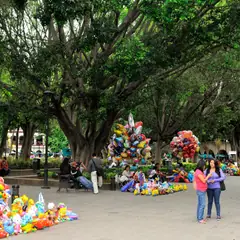
Facing the atrium, the Jardín Sócrates was the old Soledad square until in 1881 it became a public garden. Today it gathers almost a dozen ice-cream stalls with tables under the trees, where burnt milk and prickly pear are the classics.
Devotion here is also a neighbourhood festival. The main feast is 18 December: after a novena with a rosary at five in the morning, the first mass is held at midnight with mañanitas, and on the eve pilgrimages arrive from Tlacolula, Ejutla, Ocotlán, Zimatlán and Zaachila with dances such as the Pluma or the Negritos.
That night of the 17th, according to a documented local custom, a convite goes around the neighbourhoods visiting the godparents and returns to the church in the small hours. What happens then in front of the main door, among dances, band and gunpowder, closes the tour with the most festive side of Oaxaca’s patroness.