Main square
Oaxaca Zócalo Audio Guide (Plaza de la Constitución)
The square from which Oaxaca's grid was laid out in 1529 is now an open-air living room of laurel trees, marimbas and arcades. It is also where the city has decided, again and again, who rules and who sells.
- 30 min of audio
- History and local life
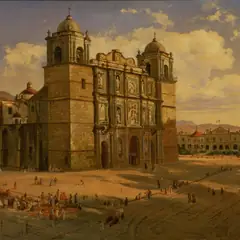
Laid out in 1529, when the town of Antequera was organised, the square was the starting point of every street in the centre. Under the viceroyalty it was a bare earth clearing with a single marble fountain; since 1901 it has been presided over by an Art Nouveau-influenced bandstand, with the green-stone Government Palace to the south and four arcades all around.
The same bandstand where marimba and wind band play every afternoon saw tear gas fired from a hotel window and from a helicopter in 2006. And the arcades where people now dine to music were in 2002 the front line of a tamale feast that left a McDonald's unopened.
Highlights
- Art Nouveau bandstand of 1901, with shops in its base since 1967
- Government Palace, green-stone façade on the south side
- Four arcades: Palacio, Claverías, Flores and Benito Juárez
- Night of the Radishes, every 23 December since 1897
- Marimba and wind band every afternoon under the laurel trees
Its official name is Plaza de la Constitución, but in Oaxaca nobody calls it that. The word «zócalo» comes from Mexico City, from the plinth of an Independence column that was never finished in its main square; Oaxaca adopted the term for its own. And its own has a precise origin: in 1529 Juan Peláez de Berrio organised the town council of the villa of Antequera and the surveyor Alonso García Bravo laid out the city taking this space as the starting point of the grid. Sources disagree on how that authorship was divided, but they agree on the essential: every street came from here.
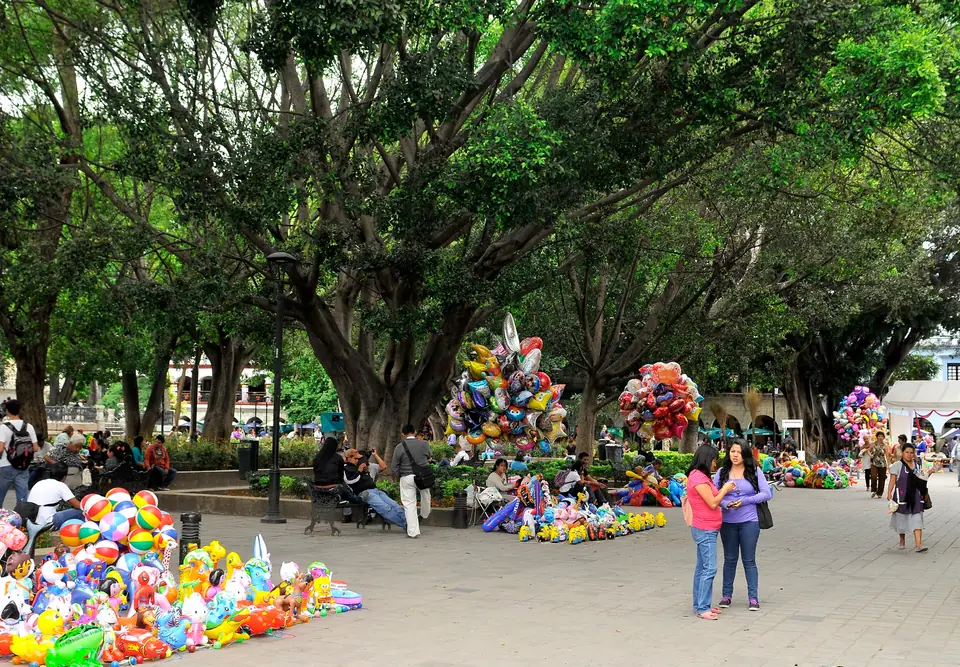
What can be seen today is an open-air living room, pedestrian and shaded by Indian laurels, with diagonal walkways converging on the bandstand. Beneath that calm lie almost five centuries of tenants who succeed each other in the centre, of weekend markets, of arcades that burned and of protests that ended with water-cannon trucks. The history of the Zócalo is the history of who occupies the square, and the audio guide reads it off stop by stop, in a circle, between the palace façade and the terraces of the arcades.
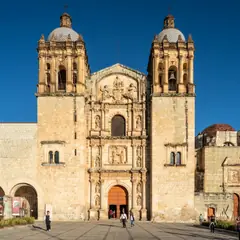
On the north side of the square rises the Oaxaca Cathedral, and a few blocks to the south the 20 de Noviembre Market steams. Outside the city, some 40 kilometres across the valley, the Zapotec palaces of Mitla wait.
A bandstand at kilometre zero
Art Nouveau bandstand
Summary of this stop
The geometric centre of the square has changed hands several times. Throughout the viceregal period it was bare earth, with no paving or pavements, and a single ornament: a marble fountain placed in 1739. Around 1857, according to the most coherent chronology, the fountain gave way to a first bandstand surrounded by trees, and on 15 September 1885, with that bandstand removed, a statue of Benito Juárez was unveiled in the centre.
In 1901, at the height of the Porfiriato, the current Art Nouveau-influenced bandstand arrived. In 1967 its base was fitted out with restrooms and shops, and fountains with figures were placed around it, later replaced by the green-stone ones that surround it today. In other words, the marimba stage literally has a shopping floor beneath it.
One absence remains: the statue of Juárez. It is said that years later it left the square for Guelatao, the mountain village where the Benemérito was born, in a move that sparked controversy. Whether that journey was a tribute or an exile is one of the questions the narration raises in front of the bandstand.
Tamales against a hamburger
Benito Juárez Arcade
Summary of this stop
Four arcades enclose the square: the Palacio, whose façade was finished between 1834 and 1837; Claverías, or Neverías, destroyed by a fire in 1936 and replaced by the hotel that still stands facing the square; Flores, formerly called del Señor; and Benito Juárez, or Mercaderes, now occupied by restaurants and shops.
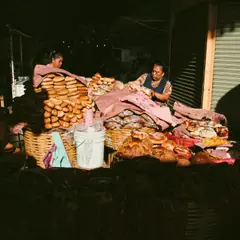
Selling in the Zócalo has never been a minor matter. In 1886 the then Plaza de Armas worked at weekends as a public market, while selling was also starting in the neighbouring Plaza de Cortés. More than a century later, in August 2002, the painter Francisco Toledo organised a tamale feast here against the opening of a McDonald’s in the arcades next to the town hall: some 3,000 people ate tamales, more than 10,000 signatures were gathered, and the administration of Gabino Cué did not authorise the restaurant.
Under the arches of the Benito Juárez Arcade, the audio guide connects those episodes and shows why the question of who sells in the square is still open.
Gas at dawn in front of the Palace
Oaxaca Government Palace
Summary of this stop
The south side is presided over by the Government Palace, with its Doric green-stone façade, its arcade and the bell gable that serves as the base of the flagpole. On this site the town council built its first council house in 1576, and between 1775 and 1783 Nicolás de Láfora designed and directed a new building, later damaged by the earthquakes of 1787 and 1801. The dates of construction of the present palace vary by source, and the tour presents them for what they are: a disputed chronology.
In 2005 Governor Ulises Ruiz Ortiz banned political demonstrations in the Zócalo and the historic centre, remodelled the square for tourism and moved the government out of the palace, which became a museum. The teachers’ occupation of each summer had been repeated since 1989. At 4:30 a.m. on 14 June 2006 the state police burst into the sit-in that had occupied the square since May, with tear gas fired from a hotel window and from a helicopter; by about 10:00 the teachers had retaken the square. The toll of that eviction is still the subject of competing accounts.
The episode did not end there. On 29 October 2006, after five months of what was called the «Oaxaca Commune», thousands of federal agents broke the barricades with water-cannon trucks and took the square. How that Sunday was lived in front of this façade is what the narration reconstructs at this point.
Marimbas and radishes under the laurels
Flores Arcade
Summary of this stop
The living square is best understood from the Flores Arcade. Every afternoon the bandstand hosts concerts alternating marimba and wind band, and on Sundays at midday the State Band, of about 70 musicians, plays in the shade of the trees. One of them is missing: in June 2022 a storm brought down a laurel about 130 years old, the tree under which the concerts used to be held, and in falling it damaged other trees, benches and lamp posts.
Every 23 December the square fills with figures carved from radishes. The first exhibition was organised here by Francisco Vasconcelos Flores on 23 December 1897, born from the Christmas market of the market gardeners, and the Night of the Radishes has not been interrupted since; in 2012 it brought together 61 growers with almost 3,000 radishes each.
Almost every night, from 19:30 to 22:00, a family marimba orchestra sets up in front of an arcade terrace and plays salsa, cumbia and danzón, while dancers gather spontaneously under the laurels. Who that family is and how it turns the square into a ballroom is revealed by listening to the narration right there.