Oaxacan Baroque
Oaxaca Cathedral Audio Guide (Catedral Metropolitana de Nuestra Señora de la Asunción)
Low, green and always surrounded by people: a Baroque cathedral that earthquakes forced to crouch and that Oaxaca uses at once as an altar, a festival stage and a protest blackboard.
- 25 min of audio
- Baroque architecture
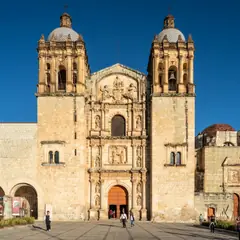
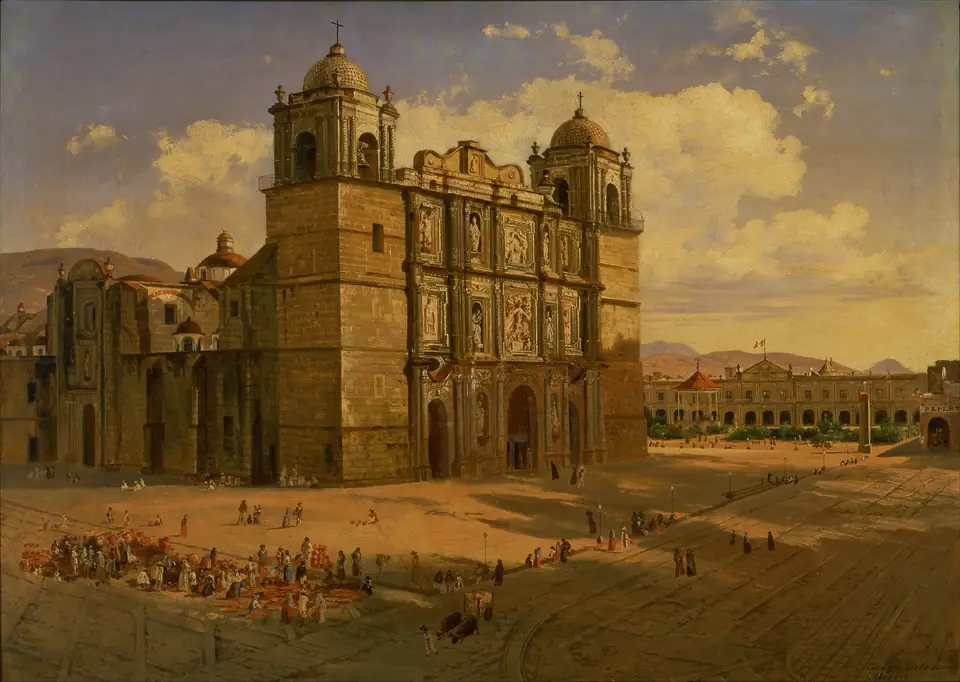
Antequera, today's Oaxaca, was the seat of a bishopric from 1535, but its first cathedral was a provisional, austere church. The building that presides over the Alameda de León today went up in the eighteenth century with the proportions of a seismic zone: no tall towers or great domes, resting on thick, massive walls. Its great asset is not height but a three-tier façade carved in green stone with the Assumption of the Virgin on clouds and cherubs.
The same stone that the IUGS designated a Geoheritage Stone in 2026 receives a cascade of white fire every October at the feast of the Lord of the Lightning, and in 2024 restorers supervised by INAH removed more than 520 m² of graffiti from its four façades. Inside wait the oldest surviving organ in Oaxaca and the wood of a cross that, according to tradition, no corsair managed to tear out.
Highlights
- Green-stone façade: volcanic tuff that darkens in the rain, designated a Geoheritage Stone in 2026
- Relief of the Assumption with Saint Peter and Saint Paul and the dove of the Holy Spirit on top
- Low towers rebuilt after the 1931 earthquake and a clock that four kings are said to have given
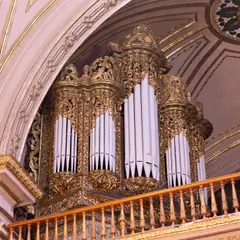
- Organ of 1711-1712 by Matías de Chávez, the oldest securely dated organ in Oaxaca
- Chapel with remains of the Cross of Huatulco and the Christ of the Lord of the Lightning
The history of Oaxaca Cathedral begins far more modestly than its façade suggests. Antequera received the title of city in 1532 and in 1535 became the seat of a bishopric. Between 1535 and 1544 the chapel of Saint Catherine Martyr served as the cathedral, on the site of today’s Church of San Juan de Dios, which an earthquake destroyed in 1662; the first cathedral church proper, finished in 1540, was a provisional and very austere building.
The present church is a child of the eighteenth century and, above all, of tremors. Sources disagree on whether work began in 1702 or in 1724, when the architect Miguel de Sanabria started a new building after the quake of 1714; what is documented is that it was finished and consecrated in 1733. From that comes a very particular cathedral architecture: squat, with no tall towers or great domes, with thick walls and a façade that does all the work. The audio guide covers its south side, its great Assumption portal and, once inside, the choir and the chapels, with documented narration that saves its most surprising episodes for the place itself.
Its south side faces the Oaxaca Zócalo, and the same green stone clads, a few blocks to the north, the Santo Domingo Church; to the west, half a kilometre away, stands the Basilica of La Soledad.
A cathedral that crouched before earthquakes
Clock and south portal
Summary of this stop
The tour starts on the south side, facing the Zócalo, where the silhouette of the church tells its own story. In 1714 a strong tremor damaged the previous cathedral so badly that it had to be closed, and the building that replaced it was designed to resist: low height, massive walls and nothing that could easily collapse.
Even the current towers are not the original ones. The earthquake of 14 January 1931 brought down the earlier ones, in a quake that destroyed or seriously damaged 70% of the city’s buildings and left 114 dead. The two low towers that flank the façade today are the seismic lesson in plain view.
On this same side, facing the Zócalo, a clock with a tangled history strikes the hour. Everyone in Oaxaca agrees it was a gift from a king of Spain; which one, not so much. Versions circulate attributing it to Charles V, Philip V, Ferdinand VI and Ferdinand VII, and none has prevailed. What concrete clue feeds one of them, and where to look for it, is revealed by listening to the narration right there.
The green-stone façade before the Alameda de León
Alameda de León
Summary of this stop
In front of the main façade, the cathedral shows its most famous face. The Baroque portal, of three tiers and three doors, is carved with reliefs of the Assumption of the Virgin on clouds and cherubs, crowned by the Holy Trinity. Saint Peter and Saint Paul flank the central door and, at the top, the Holy Spirit appears as a dove seen from the front with wings spread. The stone is cantera verde, a volcanic tuff that the International Union of Geological Sciences designated a Geoheritage Stone in 2026: its colour runs from pale grey to bluish green and deepens when rain wets it.
That façade is not just a stone altarpiece: it is a surface the city uses. Each October, around the 23rd, the feast of the Lord of the Lightning culminates in a fireworks castle before it that ends in a cascade of white fire running down the whole portal. And the graffiti of social protests has piled up year after year: in a five-month intervention completed in December 2024, restorers supervised by INAH removed more than 520 m² of paint from the four façades.
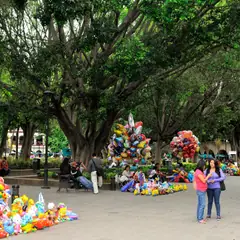
The square that opens in front also has its past. The Alameda de León was a plot granted in 1576 by Viceroy Martín Enríquez that ended up as a pottery market, the Plazuela de Cántaros, until it became a garden in 1843. In 1982 the atrium railing was removed and church and garden became a single space.
The oldest organ in Oaxaca
Choir organ
Summary of this stop
Once inside, looking back toward the entrance, the carved and gilded case of an organ built in 1711-1712 by Matías de Chávez, an organ builder from Puebla settled in Oaxaca, appears above the choir. He reused three ranks of pipes from an earlier organ of 1569-1570, and the result is the oldest securely dated surviving organ in Oaxaca; its 1711 contract turned up in 2002 in the Oaxaca Notarial Archive.
Its story is one of mutilation, silence and return. Between 1912 and 1957 it was modernised until its Baroque character was erased: the wind chest and keyboard were reversed so the organist faced the altar, and the paint on the façade pipes was scraped off. In the 1970s it fell silent, and did not sound again until the rebuilding of 1996-1997 by the organ builder Susan Tattershall, with a reopening concert in January 1998.
On either side of the entrance hang two large canvases by the Oaxacan painter Marcial de Santaella, from a family of Indigenous artists: the Seven Archangels and a Saint Christopher dated 1726, in the same years the church was going up. What trace of the organ’s original paintings survived the scraping is one of the details the audio guide points out on the spot.
The Cross of Huatulco and the corsair
Chapel of the Cross of Huatulco
Summary of this stop
The tour ends in the second chapel on the right, which holds remains of the Cross of Huatulco, a wooden relic that came from the Oaxacan Pacific coast. According to tradition, a cross that healed the sick was venerated on the beach at Huatulco from before the Spanish, and it is said that in 1587 the English corsair Thomas Cavendish tried to destroy it without success: neither saws, nor axes, nor fire could overcome it. In 1612 Bishop Juan de Cervantes brought part of the cross to the cathedral.
The documented tradition also places in a side chapel, in glass urns, the remains of Juan Bautista and Jacinto de los Ángeles, two Zapotec fiscales who died in 1700 and were beatified in 2002, a goal for pilgrims. On the other side of the nave, in the last chapel on the left, waits the Christ of the Lord of the Lightning, whose name, the legend says, comes from a bolt that fell on a sunny day and from a fire from which only the image was saved. How Cavendish tried to rip the cross from the sand, and why the bishop decided to bring it inland, is left for the end of the narration.