Nabataean sanctuary
High Place of Sacrifice Audio Guide (Al-Madhbah)
On the summit of “the mountain of the altar”, the Nabataeans did not build their sanctuary: they sculpted it by removing rock. Two obelisks over 6 metres tall, a banqueting courtyard and an altar of blood wait at the edge of a 170-metre cliff above Petra.
- 90 min of audio
- Nabataean obelisks and altar
The High Place of Sacrifice crowns Jabal al-Madhbah, a mountain about 1,070 metres high overlooking an almost vertical cliff above Wadi Musa. Nabataean processions climbed up there by a staircase chiselled out from near the theatre, to set down the images of the gods, share a banquet on the rock and sacrifice before the altar. The sacrifices, according to the sources, lasted until the Nabataeans embraced Christianity in the 4th century, and in Crusader times the summit served as a link between the castles of al-Wu'ayra and al-Habis.
The most astonishing thing about this summit is what is missing. The two obelisks on the ridge were not raised: the stonecutters lowered that whole side of the mountain and left the two spires standing, still joined to the bedrock. In 1882 the photographer Edward L. Wilson measured one of them and noted it as his “first disappointment in Petra”, without seeing that the real monument was the void around it.
Highlights
- Wadi al-Mahfur staircase — the Nabataean processional way, with passages chiselled through projecting rock
- Zibb Attuf obelisks — two spires over 6 m that were left standing when the summit was lowered, linked to Dushara and al-Uzza
- Triclinium courtyard — benches carved for the ritual banquet and a motab where the gods were set down
- Altar of blood — a basin and drain for animal sacrifice, beside a tank for purification water
- Lookout over the void — a 170 m cliff with Petra at one's feet and Aaron's tomb on Jabal Haroun
Its Arabic name, al-Madhbah, means “the altar”, and the whole mountain bears it: Jabal al-Madhbah. On its summit the Nabataeans chiselled down an esplanade above a 170-metre cliff and turned it into an open-air sanctuary, with a triclinium, altars and two obelisks that rise from the rock itself. Who carved it first is not entirely settled: some sources speak of a reused Edomite sanctuary or an Iron Age altar, while the archaeological park authority and a good part of the studies describe it as a Nabataean high place, probably dedicated to Dushara, with no known excavation backing the older origin.
The story of its “discovery” is not linear either. In 1882 Edward L. Wilson described the altar with its steps and published it in The Century Magazine in 1885 and in a book in 1890; even so, later tradition christened it “Robinson’s High Place”, after George L. Robinson, who is credited with having recognised its religious meaning. In 1902 the Americans William Libbey and Franklin E. Hoskins climbed up with camera, plates and rifles, and on the summit reread Robinson’s article to check it on the ground. What to see at the High Place of Sacrifice, how its rite was organised and what is true in its unsettling name is what the audio guide unpacks in four stops and ninety minutes of climb, summit and views.
The processional staircase starts near the Petra Theatre; the cult on the summit complements the one celebrated before Qasr al-Bint, and its sacred stones have a precedent in the betyls of the Siq.
A staircase for climbing to the gods
Wadi al-Mahfur staircase
Summary of this stop
The climb is part of the sanctuary. Nabataean religious processions ascended to the Madhbah from the area next to the theatre along Wadi al-Mahfur, by a staircase for which the engineers chiselled deep passages through projecting rock that would otherwise have been impassable. The carved steps, fitted into those cuts, still mark the ceremonial way today.
The first Westerner to leave a record of the summit reached it the wrong way round. In 1882 Edward L. Wilson pointed out to his guide, Mousa, a great ravine that climbs from Qasr al-Bint; the answer was a flat “La! la! mafeesh!”, it is not worth it. Wilson climbed anyway, passed a hall of fluted columns and stairways with niches, and arrived at the top with the afternoon falling and in a hurry to reach the summit before dark. Where he came down that night, and why today almost everyone makes the journey the other way round, is an episode the narration keeps for the first steps.
The monument is the void
Zibb Attuf obelisks
Summary of this stop
On reaching the ridge, on the left, appear two spires of rock over 6 metres tall, joined to the mountain at their base and surrounded by a flat surface. They were not placed or built: the Nabataean stonecutters lowered that whole side of the summit and left them standing. The void around them measures how much rock was removed, and on the side sheltered from the prevailing winds one of them keeps the diagonal fluting typical of Nabataean carving, the chisel mark that allows them to be attributed to that people.
Modern maps keep for this ridge the Bedouin name Zibb Attuf, “the phallus of mercy”, often softened to Amud Attuf, “the column of mercy”, and the two obelisks are associated with the Nabataeans’ main divine pair, Dushara and al-Uzza. Wilson measured one at about 20 feet high and 12 wide and considered it unworthy even of the name obelisk. In front of the one closest to the path, Libbey and Hoskins saw in 1902 a quarry halted midway, with blocks already loose that nobody took away; they attributed the abandonment to “some violent event”, an explanation that remains open and that the audio guide examines beside the spires.
Banquet on the summit
Triclinium courtyard
Summary of this stop
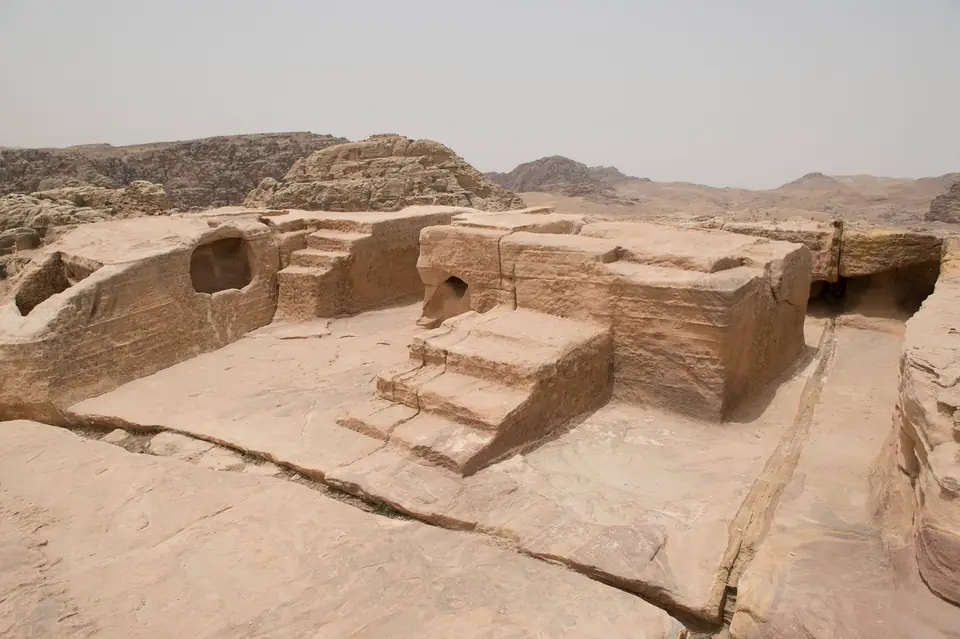
Sunk into the summit rock is a rectangular courtyard of about 15 by 6 metres, although another measurement gives 14.4 by 6.4. Three benches carved in the form of a triclinium surround it, and in the centre stands a block preceded by steps: the motab, where the statues of the gods arriving in procession were set down. On those benches, the participants in the sacrifice shared a communal dinner under the gaze of their deities.
To give flesh to those diners there is an ancient testimony. Strabo, drawing on what his friend the philosopher Athenodorus told him, who lived for a time in Petra in the 1st century BC, describes Nabataean banquets in groups of thirteen with two singing girls, and royal feasts with a limit on golden cups and a king who served the table with his own hands. How many cups exactly and what else was offered to the gods at the top of the houses is told by the narration in the centre of the courtyard.
Blood, Baal and Sinai
Altars on the western edge
Summary of this stop
Against the western edge rise the altars: the main one on steps and, beside it, a platform with a basin for the rainwater of purifications and a drained bowl to carry off the blood of the sacrificed animals. Wilson described in 1882 an altar on isolated rock with four steps, a circular bowl of 48 inches and a drain towards a cistern, and took it for one of the “altars on the high places” consecrated to Baal that the Old Testament condemns. The modern name invites one to imagine something darker, but in Petra there is no material proof of human sacrifice nor have traces of fire been found on the altar: what is likely are libations, incense and animal sacrifice.
Behind, the void. The platform leans out over an almost vertical cliff of 170 metres above Wadi Musa, “the valley of Moses”, with Petra seen from a bird’s-eye view and, in the distance, Aaron’s tomb on the summit of Jabal Haroun. In 1927 the Danish researcher Ditlef Nielsen even proposed that this mountain was the biblical Mount Sinai. What that hypothesis rested on is what closes the route at the edge of the abyss.