Nabataean royal tomb
Treasury Audio Guide (Al-Khazneh)
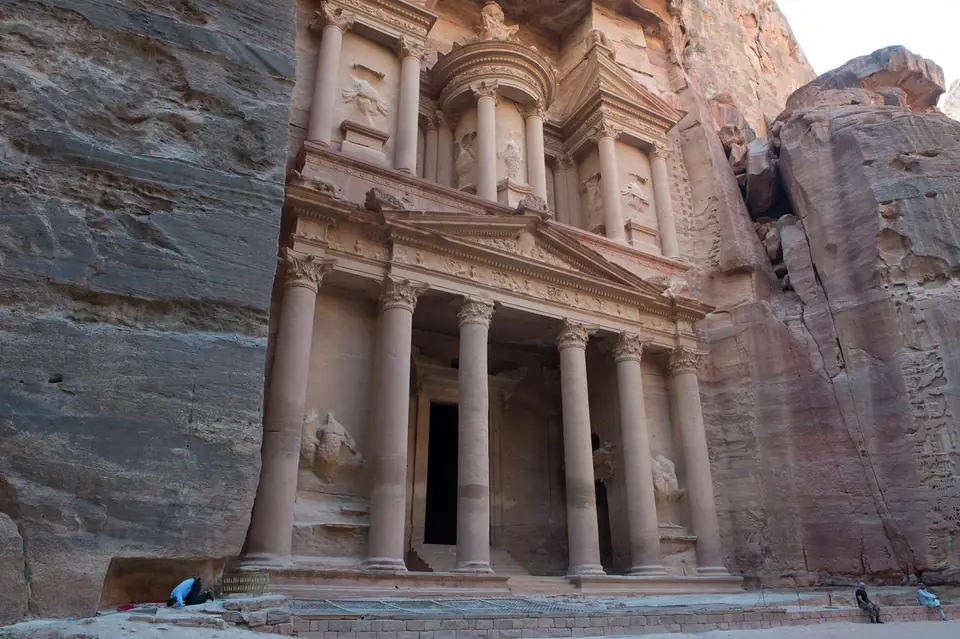
Almost 40 metres of facade carved in the sandstone at the end of the Siq, with a solid urn riddled with bullets by those hunting the pharaoh's gold: the Treasury never held riches, only the dead, and more keep turning up beneath its plaza.
- 30 min of audio
- Facade carved in the rock
Al-Khazneh was carved as a mausoleum and crypt in the early 1st century AD, in the time of the Nabataean king Aretas IV Philopatris, although another line of research pushes it back to the 1st century BC. Its two-storey facade, about 25 metres wide and 39 high, mixes Nabataean, Egyptian and Greek gods, and the closed valley it was dug into, Wadi al-Jarra, has shielded it from wind and rain, keeping its capitals crisp.
The name Treasury comes from a Bedouin belief: the urn at the top hid the pharaoh's gold. It is solid sandstone, and the bullet marks left by those who tried to bring it down are still visible. Meanwhile, the real contents of the place lay underfoot: in 2003 Nabataean tombs turned up more than six metres beneath the plaza, and in 2024 ground-penetrating radar located another with twelve complete skeletons.
Highlights
- The urn at the top — some 3.5 metres of solid sandstone, pitted by bullets from hunters of the pharaoh's gold
- The tholos of the upper level — Isis equated with the Nabataean goddess al-Uzza, between the eagles of Dushara
- The restored portico column — re-erected around 1962 with a capital of about 10 tonnes hollowed out to lighten it
- The grille over the buried tombs — Nabataean tombs more than six metres below today's plaza floor
- The libation basin at the threshold — a feature no other monumental tomb in Petra shares
On 22 August 1812, a Swiss traveller disguised under the name Sheikh Ibrahim came out of the Siq and found himself face to face with this facade. Johann Ludwig Burckhardt heard the locals call it Kaszr Faraoun, the Pharaoh’s castle, and say it had been the residence of a prince; he, instead, saw a tomb in it. He was right. Al-Khazneh, the Treasury, was carved in the sandstone as a mausoleum and crypt, by the most widespread dating in the early 1st century AD, during the reign of Aretas IV Philopatris, although some place it a century earlier, perhaps under Aretas III.
The story of Al-Khazneh is that of a very long misunderstanding. It was credited with a treasure, proposed as a temple or even a library, painted enlarged for Victorian Europe and turned by the cinema into the door of the Holy Grail. What to see at Al-Khazneh, how its architecture reads from top to bottom and what has turned up beneath its plaza in the last two decades is what the audio guide covers in four stops and thirty minutes, with a narration documented and checked against historical sources.
The Treasury plaza is reached through the Siq; its facade scheme reappears, on a larger scale, in the Monastery, and the royal funerary facades continue at the Urn Tomb.
The first European who did not dare to measure it
Exit from the Siq
Summary of this stop
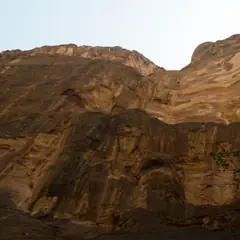
The exit of the Siq is a slit between high walls, and at the end the pink facade appears piece by piece. It is carved into an ellipse of rock called Wadi al-Jarra, the valley of the Urn, which has sheltered it from wind and rain since it was cut: that is why its capitals keep a crispness other monuments in Petra lack. The figures impress on paper, about 25 metres wide and 39 high in two storeys, with columns of about 12 metres below and 9 above, but the jolt of scale comes in the plaza.
Burckhardt could not check any of those measurements. According to a tradition recorded in his own account, the inhabitants of Wadi Musa believed that a true magician only had to observe where a treasure was hidden and then order its guardian to send it to him flying; taking the measurements of a column was considered magic. His guide warned him that they would not let him take away a single coin of the valley’s treasures, and he feared they would confiscate his diary as a book of spells. What eyeballed estimate he dared to jot down is the detail the narration opens with, at the exit of the Siq.
Bullets against a solid stone urn
Al-Khazneh
Summary of this stop
From the centre of the plaza, the facade reads from top to bottom. The upper level is crowned by an urn of about 3.5 metres, and from it comes the monument’s name: Bedouin belief held that the pharaoh’s gold was inside, hence also the variant Khaznat al-Far’oun, Treasury of the Pharaoh. The urn is solid sandstone, and local men riddled it with gunfire to bring it down. The impacts are still there. Versions of the tale vary, from the gold of the Exodus created by magic to the loot of bandits or pirates, and it is not even clear since when people have spoken of a treasure, because in 1812 it was called a castle.
Beneath the urn, in the circular shrine or tholos, a female figure represents Isis, equated with the Nabataean goddess al-Uzza; two eagles of Dushara perch on the broken pediments, and at ground level appear the horsemen Castor and Pollux, badly damaged by iconoclasts. One of the two central columns of the portico had already fallen when Burckhardt arrived: around 1962 Jordan’s Department of Antiquities raised it again with scaffolding in 4-metre pieces carried up the Siq on donkey back and a capital of about 10 tonnes, hollowed out to lighten it.
In 1839 the Scottish painter David Roberts, a former theatre set designer who travelled dressed as an Arab, painted “El Khasnè” here, still taken for a pharaoh’s treasure. His lithographs, backed by Queen Victoria, sold more than two thousand copies before they were published. What decorator’s trick Roberts used to enlarge the facade is revealed by the audio guide in front of it.
A cemetery beneath the plaza
Grille over the buried tombs
Summary of this stop
In the plaza floor, amid the comings and goings of visitors, there is a grille. Through it one glimpses older facades and tombs, several metres below today’s level. In 2003 the team of Suleiman Farajat, of Jordan’s Department of Antiquities, found more than six metres below the ground three Nabataean tombs cut into the rock, with access steps and an altar with traces of incense. The Treasury was carved above them, and those finds, together with the pottery, are what part of the researchers use to date the work to the time of Aretas IV.
In August 2024 a Jordanian-American team located another tomb under the Treasury with ground-penetrating radar and opened it: inside were 12 complete skeletons and objects of bronze, pottery and iron. It was presented as an unprecedented discovery, although specialists outside the project considered it to be expected after what was excavated in 2003. What one of those dead held in his hand, and why it recalled a film, is told beside the grille.
Behind the Grail door, a bare chamber
Portico and main chamber
Summary of this stop
In the portico, before the central door, appears the detail that tips the balance on the building’s function. On the threshold of the main chamber there is a sunken basin with a channel to the outside, designed for libations or ritual ablutions: no other monumental tomb in Petra has one, and only the High Place of Sacrifice shares it. Together with the tombs below, it points to a royal tomb or a tomb-temple with a cult, against the old hypotheses of the treasure, the temple or the archive.
From the door the main chamber can be seen: a bare hall with three side chambers and some 2,000 cubic metres of volume. Nothing like the Holy Grail temple that “Indiana Jones and the Last Crusade” presented behind this facade in 1989; the interiors were shot at Elstree Studios, in England. The stone, however, shows the effects of fame: the rubbing of visitors who touch it or lean on it has made its surface recede 40 millimetres in under ten years.
At night, the plaza changes its skin. When sleeping in the ruins was banned, agencies in Wadi Musa devised “Petra by Night”: the Siq is walked in darkness and silence, among more than 1,500 candles, to the illuminated facade, where the public sits on mats, tea is served and a rababa is played. How that ritual ends, and what story closes it, is the last thing the narration keeps.