UNESCO heritage
Petra Theatre Audio Guide
A sandstone auditorium hollowed out of the mountain in the time of Aretas IV, opened with a chisel inside a cemetery: above the top row, Nabataean tombs sliced in half still look down on the stage like an audience that never left.
- 20 min of audio
- Nabataean theatre cut in the rock
Petra's theatre was carved in the 1st century AD, at the height of the Nabataean kingdom under Aretas IV (9 BC–40 AD), long before Rome annexed the city in 106. The cavea and orchestra were hollowed out of the living rock of Jabal al-Madhbah; only the stage building and the outer wall were raised in built stone. The result is a semicircle 95 metres in diameter and 23 high, with 45 rows of seats in three tiers separated by aisles and reached by seven staircases.
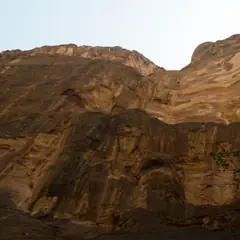
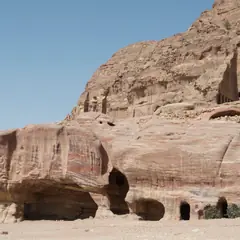
To open up that auditorium a cemetery had to be cut through. The dark rectangular openings in the rock wall above the seats are the interiors of Nabataean tombs sliced through when the cavea was excavated, and the Romans cut more when they enlarged the capacity to some 8,500 seats, close to a third of Petra's population by the most quoted figures. A traveller who published his account in 1837 took those tombs for boxes for the city's princes: without knowing it, he hit upon the most unsettling image of the place.
Highlights
- Cavea cut in the rock — 45 rows in three tiers, 95 m in diameter and 23 m high
- Sliced tombs — a row of black openings above the top seat, remains of the cemetery the theatre cut through
- Roman enlargement — up to some 8,500 seats after the annexation of Petra in 106
- Restored stage — with the outlines of the actors' three doors and the void of a three-storey marble front
- Survivor — collapsed around the earthquake of 363, choked by gravel and cleared in 1961–1962
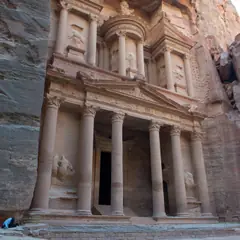
Beside Petra’s main path, where the valley opens up after the funerary facades, the mountain has a semicircular bite taken out of it. It is the theatre, carved in the sandstone in the 1st century AD, when the Nabataean kingdom was living its best moment under Aretas IV. Its story is not that of a building that was raised but of one that was excavated: the seats were hollowed out of the rock and, in doing so, split in two the tombs of an earlier cemetery. As early as 1828 the Frenchman Léon de Laborde marvelled that anyone would choose for entertainment a place surrounded on all sides by “death and its mansions”.
What to see at Petra’s theatre, how it was carved and why almost nothing remains of its stage is what the audio guide unpacks in four stops and twenty minutes, from the foot of the auditorium to the gap where the stage front once stood. Along the way appear 19th-century travellers who ate, sketched and even unmasked an invented landscape from these very seats, and a history of collapses that runs up to 2023. The narration is documented and checked against historical and archaeological sources, and marks where the data end and the hypotheses begin.
Beside the auditorium starts the staircase that climbs to the High Place of Sacrifice, and opposite lines up the row of Royal Tombs opened by the Urn Tomb.
A mountain hollowed out with a chisel
Carved auditorium
Summary of this stop
From the main path, facing the auditorium, the theatre reads at a glance: the cavea and orchestra were not built stone by stone but torn out of the living rock of Jabal al-Madhbah. Only the scaena, the stage building, and the outer wall were raised in dressed stone. The work belongs to the 1st century AD, to the reign of Aretas IV (9 BC–40 AD), the period of greatest political and cultural splendour of the Nabataeans, decades before Rome annexed Petra in 106.
A tradition picked up by the Jordanian press goes further and attributes the commission to the king’s wedding to his second wife, Shaqilath; it is even said that coins minted for the occasion turned up in the theatre itself. Shaqilath’s coin exists, but academic sources only describe it as possibly commemorating the marriage, and none ties its discovery to the foundation of the theatre. What is true in that nuptial origin, and what remains pretty legend, is what the narration untangles in front of the seats.
An audience of the dead
Sliced tombs above the cavea
Summary of this stop
At the foot of the auditorium, the eye climbs 45 rows of sandstone spread over three horizontal tiers, separated by aisles and linked by seven staircases: a semicircle 95 metres in diameter and 23 high. And right at the top, above the last row, appears a line of black rectangles opened in the rock wall. They are the interiors of Nabataean tombs sliced through when the cavea was excavated: the theatre was carved inside a cemetery that already existed.
Shortly after their arrival in 106, the Romans enlarged the capacity to some 8,500 seats, around 30% of Petra’s population, and to make room for the upper rows they cut more tombs. The figures vary by source, from the 3,000 seats Burckhardt calculated in 1812 to estimates of up to 10,000, and there is no agreement either on who cut each tomb, the Nabataeans when carving it or the Romans when enlarging it.
The traveller John Lloyd Stephens, who published his journey in 1837, had lunch on these seats with his servant and took those doors in the rock for the seats of the princes and wealthiest residents of Petra, “like a row of private boxes in a modern theatre”. He was wrong, but he sensed something that the audio guide finishes off right there, looking upwards.
Marble, curtain and a Hercules under the boards
Orchestra and restored stage
Summary of this stop
In the centre of the orchestra, also cut in the rock, the raised stage is a partial restoration by Jordan’s Department of Antiquities. On it the outlines of the three doors the actors came out through can still be partly made out. Behind it rose the frons scaenae, now gone: a built facade of three storeys, with niches painted in fresco and columns clad in marble.
Beneath the stage floor there were storerooms and a slot into which the curtain was lowered at the start of the show; beside it an almost complete statue of Hercules turned up. A network of channels diverted rainwater so it would not flood the stage, and in that drainage pottery from the early 1st century AD was found.
What was performed here is another matter. There is no archaeological evidence of gladiator fights, and the Roman layout does not require us to think of Greco-Roman comedies: it may have hosted Nabataean spectacles or political-religious acts, and some even propose a funerary use. One hypothesis points to an altar in the orchestra, where pilgrims would have gathered before the Roman shows arrived; the narration sets it out at the exact spot where it may have stood, with the caution it demands.
Earthquakes, gravel and fire
Gap of the stage front
Summary of this stop
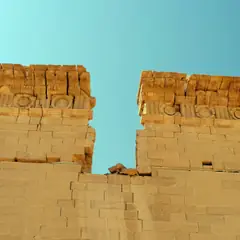
From the stage, where the three-storey facade once rose, only the void remains today, with the view open to the valley. In the mid-4th century AD, around the time of the earthquake of 363, the stage building, its upper storeys, the side walls and the galleries collapsed at once; two coins of Constantine I and one of Constantius II date the collapse, although some add a second quake in 419. The theatre was then occupied again, and later walls of reused stone closed off the stage area for other uses.
Over the centuries the winter torrent kept filling it with gravel. That is how the Swiss Johann Ludwig Burckhardt saw it in August 1812, with all its seats in view and the sand floor choked with sediment. Between 1961 and 1962, an American team led by Philip C. Hammond, together with Jordan’s Department of Antiquities, cleared it completely. But the story does not end there: in December 2023 an arson fire destroyed the finds accumulated at Petra over thirty years, among them all the material gathered at the theatre in the French-Belgian campaigns of 2022 and 2023.
In the middle of that chronology there is a dark and almost comic episode: in April 1858, the painter Edward Lear, surrounded since before dawn by some two hundred men demanding tribute, escaped to the top of these seats to sketch for half an hour against the clock. How that morning ended, and what he wrote about it afterwards, is the close of the route.