Entrance to Petra
Siq Audio Guide
A mile-long crack in the sandstone, only three metres wide in places, which the Nabataeans tamed with a dam, a tunnel, water channels and sacred stones with eyes, and which ends in a slit of light where the Treasury peeks through.
- 40 min of audio
- Nabataean gorge
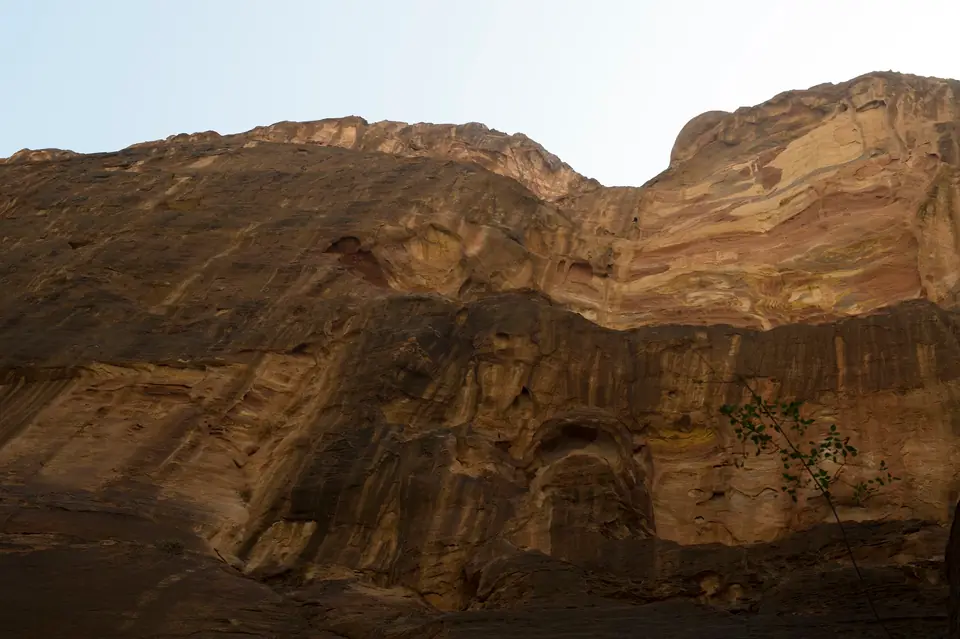
The Siq is the on-foot entrance to Petra: a fault of about 1.2 km that tectonic forces split open and water later polished, with walls reaching between 91 and 182 metres according to the most quoted measurement. The Nabataeans turned it into the gateway to their capital and into a piece of hydraulic engineering: they closed its mouth with a dam, dug an 88-metre tunnel to divert the floods of Wadi Musa and carved into the rock a channel that runs beside the path from start to finish.
For centuries the most astonishing part of the gorge lay under two metres of earth. In 1997 excavations brought to light the ancient paving and, at the great bend halfway along, a caravan of camel drivers carved on a giant scale, older than the floor itself and than the channel that passes behind the animals' legs. Before it became a ceremonial way, this corridor was the route of the merchants who made Petra rich.
Highlights
- Wadi Mudhlim dam and tunnel — 88 m of gallery dug by the Nabataeans to divert the floods
- Abutments of the monumental arch — what remains of the arch an earthquake brought down in 1896
- Channel and terracotta pipes — water carried along the Siq some 2,000 years ago
- Niche of the two betyls — sacred stones with square eyes attributed to Dushara and al-Uzza
- Camel caravan — reliefs 3.5 m high and more than 9 m long, buried until 1997
On 22 August 1812, a traveller calling himself Sheikh Ibrahim ibn Abdallah told his guide that he wanted to sacrifice a goat at the tomb of Aaron. He was Johann Ludwig Burckhardt, and that pretext led him down a narrow valley to Petra, the first view of it any modern European had. That valley was the Siq, and it is still the way into the Nabataean capital on foot: a rock corridor of about 1.2 km that at its narrowest leaves barely three metres between one wall and the other.
What to see in the Siq, what its history is and how its architecture of water and gods is explained is what the audio guide unpacks in five stops and forty minutes of walking. The narration, documented and checked against sources, follows the gorge from the dam at the entrance to the final slit, and presents the Siq as what it was: a dangerous crack that the Nabataeans tamed with engineering, religion and trade, and that still has to be watched today so that Petra can be entered.
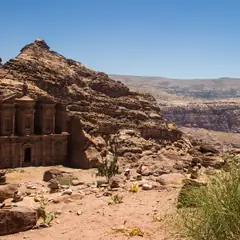
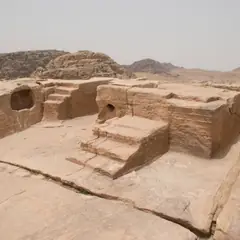
At the end of the crack waits the Treasury, and the gorge’s sacred stones find an echo in the obelisks of the High Place of Sacrifice.
A crack nobody dug
Dam and arch abutments
Summary of this stop
Beside the bridge where the Siq begins stands a modern dam built on top of a Nabataean one, and to its right opens the mouth of a tunnel cut through the rock: 88 metres long and 12.8 high, to divert the water of Wadi Musa along Wadi Mudhlim towards reservoirs, cisterns and dams. That was the great Nabataean work here. The gorge, by contrast, was already there. Among those who work at Petra there is a conviction that the Nabataeans themselves opened it with picks, and as proof they point to the tool marks on the walls, but the crack is natural and far, far older.
How exactly it formed is still debated. The most widespread explanation speaks of a fault opened by tectonic forces and later polished by water; a 2012 geological study, after measuring dozens of bends and more than a thousand joints, argues instead that it was the floods of Wadi Musa that gradually widened the rock over some two million years.
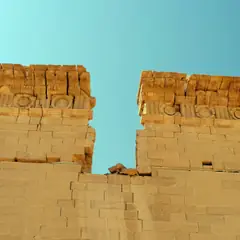
On either side of the entrance stand two abutments with the remains of niches and pilasters smoothed by erosion. They are what survives of a monumental arch that spanned the mouth of the Siq until an earthquake brought it down in 1896, and whose appearance is known thanks to the lithographs of Matthew Boulby and David Roberts. What those plates reveal about the arch is the first detail the narration keeps for this spot.
The corridor that turns into a trap
Walls that fit together
Summary of this stop
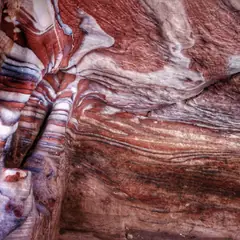
In the first narrow stretch, the veins and grain of one wall match those of the wall opposite, like two pieces that fit together. That minimum width is also the problem: when the Nabataean dam stopped being maintained, the floods began to enter the Siq again instead of being diverted through the tunnel. In 1963 one of them swept away a group of more than twenty French tourists, among them the archaeologist Miriam Astruc; the exact casualty figures vary by source. The dam seen today at the entrance, smaller than the original Nabataean one, was built in the wake of that tragedy, and in the 1990s structures were added to return the water to the same tunnel of two thousand years ago.
Since 2014, moreover, a siren system watches over the access and goes off when a flood exceeds four metres. It sounded for the first time on 9 November 2018: the warning came minutes before the water, visitors ran along the Siq towards the Treasury and the torrent ended up flowing down the canyon at knee height. Almost 4,000 tourists were evacuated that day. How that afternoon was lived inside the gorge is told by the audio guide on the very ground along which they fled.
Stones with eyes beside the path
Niche of the two betyls
Summary of this stop
Along the left wall runs a Nabataean channel carved in the rock, and on the right remain traces of terracotta pipes some 2,000 years old, in places still fitted in position. The water travelled beside the walkway. About halfway along the Siq, a free-standing block holds the largest votive niche known in the gorge, with two betyls: the large one has square eyes and a schematic nose. They are attributed to Dushara and al-Uzza, dated to the first half of the 1st century AD, were discovered in 1977 by Jordan’s Department of Antiquities and look towards whoever is leaving the city.
Further on, the station of Sabinos Alexandros gathers betyls dedicated in the 2nd or 3rd century AD by a master of ceremonies of the cult of Dusares who came from Adraa, today’s Daraa, in Syria: one reproduces the domed betyl of the god of his city and another shows Atargatis on two lions. Some see in all this a sacred way in the Greco-Roman manner, with each niche as a station of the procession; it is a debated interpretation, and the narration explains what it rests on.
The caravan that slept underground
Camel caravan reliefs
Summary of this stop
At the great bend halfway along, the 1997 excavations removed two metres of accumulated earth and brought to light a stretch of Roman-period pavement, the floor that originally paved the Siq from end to end. And in the rock something more appeared: two reliefs of camel drivers with camels laden with goods, 3.5 metres high and 9.5 and 10.3 metres long, among the largest relief sculptures of the ancient world. Some sources date the discovery to 1998 and do not agree on how many figures they describe.
Today they are heavily eroded at the top, but the camel drivers’ sandals, the humps and the animals’ legs can still be made out, with the water channel running behind. That detail is a chronological clue: the caravan predates the paving of around 50 BC and is older than the channel itself. What this says about who used this corridor before anyone else is the central finding of the route.
The slit where the Treasury appears
Final gorge to the Treasury
Summary of this stop
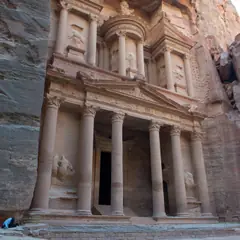
The last stretch turns dark and narrow, and at the far end it frames a strip of the facade of al-Khazneh. It is the scene Burckhardt lived in 1812 with his goat and his disguise, and the one every visitor who gets this far lives.
That one can pass is no coincidence. After several rockfalls, UNESCO’s Siq Stability Programme, with Jordan’s Department of Antiquities, the Petra Archaeological Park and funding from Italian cooperation, has consolidated large blocks of these walls using Italian alpine climbers and Jordanian climbers. The audio guide closes the gorge right where the view opens, with the full story of the traveller who pretended to be going to a tomb.