Hindu temple
Bindhyabasini Temple Audio Guide
At the top of the hill where the old Newar bazaar ends, Pokhara's protector goddess is worshipped as a fossil stone: according to legend, she arrived in a palanquin from India and one night decided not to move any more.
- 40 min of audio
- Hindu hilltop shrine
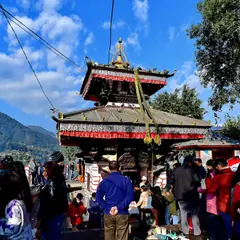
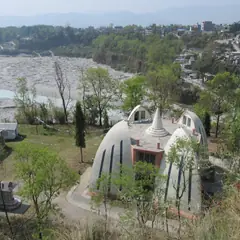
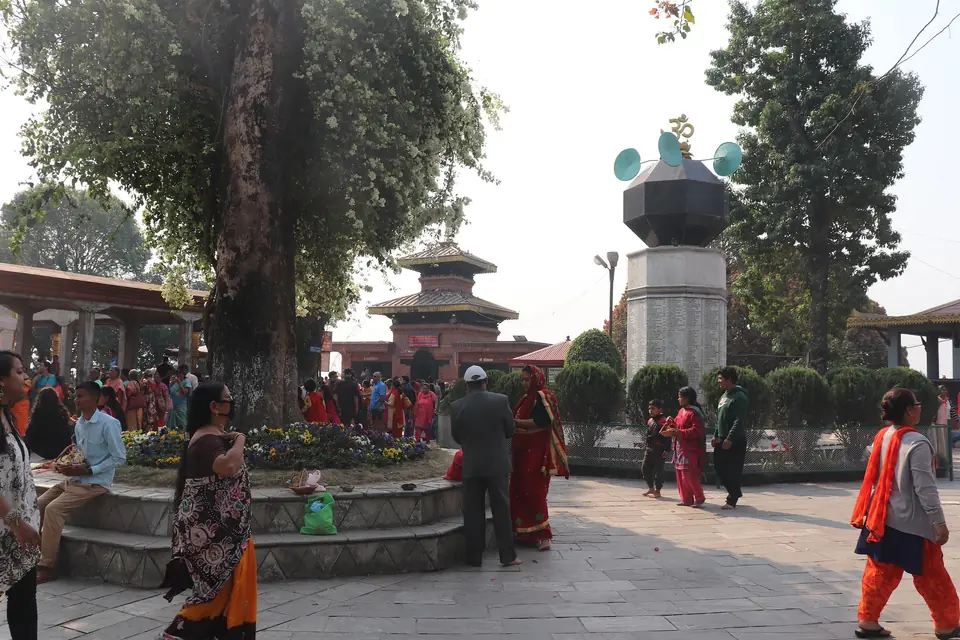
The worship of Bindhyabasini came to Pokhara with King Siddhi Narayan Shah of Kaski, before the unification of Nepal, from the shrine of the same name at Vindhyachal, in present-day Uttar Pradesh. The current temple was built in the year 1842 of the Bikram Sambat calendar, around 1785, on a compound of 47 ropanis at the top of the hill. In the centre rises a white octagonal shikhara, surrounded by minor shrines dedicated to Saraswati, Shiva, Vishnu, Radha-Krishna, Sitaram and Lakshminarayan.
Inside, the goddess has no statue form: she is a shaligram, a fossil ammonite from the Kali Gandaki basin. And this placid viewpoint, with Machhapuchhre in the background, is still a temple of animal sacrifice dedicated to Bhagwati, a form of Durga or Kali that tradition describes as thirsty for blood. On Tuesdays and Saturdays, the postcard and the sacrifice share the same esplanade.
Highlights
- Goddess worshipped as a shaligram, a fossil ammonite from the Kali Gandaki basin
- White octagonal shikhara shrine, with a gilded metal door guarded by two golden lions
- 26.5-foot trishul beside the Shiva temple and two yagya mandap for weddings and fire offerings
- Compound of 47 ropanis built around 1785 on the summit of the old Newar bazaar
- Balcony viewpoint with views of the Annapurna range and Machhapuchhre
The story of Bindhyabasini is, to a large extent, the story of Pokhara. Around 1752, Siddhi Narayan Shah, last king of Kaski, obtained from King Ranajit Malla of Bhaktapur a group of about 150 merchants and craftsmen, mostly Newar, and from them was born the old bazaar that climbs to this hill. The same king brought the worship of the goddess from Vindhyachal, in India, according to most sources; others attribute it to King Khadgaman Malla of Parbat, and one travel guide to Prithvi Narayan Shah. There is no full agreement on the date either: the most quoted for the building is 1842 BS, around 1785, but others circulate, from the 1760s to “at least 300 years”.
Over two centuries the hill has been much more than a shrine. In 1901 Prime Minister Dev Shumsher opened a Sanskrit school here, one of the first educational institutions in Pokhara, and in 1946 the locals stopped the teacher Gyanman Dangol, sent by the government from Bhaktapur, from setting up a Gandhian school beside it. In 2020 the compound housed 6 priests, 6 teachers and 12 batuk, Brahmin apprentices who came from distant districts such as Jumla, Kalikot or Achham. On Saturdays it is one of the city’s favourite places to marry, and it is venerated by Hindus and Buddhists alike.
It is usually presented as Pokhara’s oldest temple, although the Badrakali temple claims the same title and the Bhimsen temple, in the old bazaar, is the city’s oldest Newar-style temple. The audio guide walks the compound in four stops, from the stairway to the viewpoint, with documented narration checked against historical sources that explains what to see at Bindhyabasini, its history and its architecture.
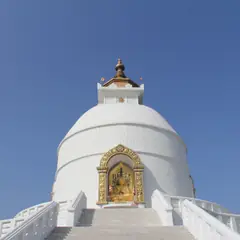
Less than a kilometre away, the river runs wedged into the rock in the Seti River Gorge. Pokhara’s other great devotion is on the lake, on the islet of the Tal Barahi Temple, and its Buddhist face looks over the city from the World Peace Pagoda.
Vermilion Hanuman and the threshold of the bazaar
Vermilion Hanuman and Ganesh temple
Summary of this stop
The climb ends at the entrance to the compound, where a stone statue of Hanuman, covered in sindoor and facing east, welcomes those who arrive by the stone stairways. Opposite him, the small Ganesh temple is the first thing that appears on crossing the threshold, and the gongs of the main shrine are heard before the temple is seen.
This point marks the border between the city below and the sacred hill. The bazaar behind you did not arise by chance: it was formed by those Newar merchants and craftsmen whom the king of Kaski brought from Bhaktapur around 1752, and its street ends precisely at the foot of this 47-ropani compound.
What relationship there was between the market and the goddess, and why the city grew in this direction, is what the narration poses at this first breather after the climb.
The goddess who would not be moved
Bindhyabasini Temple
Summary of this stop
In the centre of the compound rises the main shrine: a white octagonal temple in shikhara style, with a gilded engraved metal door flanked by two large golden lions. Several websites describe it as a multi-roofed pagoda, but it has no tiered roofs: its form is that of a shikhara tower.
According to tradition, Siddhi Narayan Shah heard of the goddess’s power at the temple of Vindhyachal and sent for an image of her. The priest replied that they had no statues to give, until a dream ordered him to hand it over. The image travelled in a doli, a palanquin carried on shoulders, and the party camped one night on this hill, at the place called Mohariya Tole. The next morning, the legend says, it weighed so much that nobody could lift it, and the king ordered it installed right there.
What the interior holds is another twist: the goddess is worshipped as a shaligram, a sacred stone that is a fossil ammonite from the Kali Gandaki basin. How a fossil from the floor of an ancient sea comes to be Pokhara’s protector is revealed by listening to the narration in front of the golden door.
Blood, offerings and power beneath the trident
Trident pillar and yagya mandap
Summary of this stop
To the west of the main shrine, beside the Shiva temple, stands a 26.5-foot trishul. Very close are the two yagya mandap, pavilions with a ritual fire pit where weddings, bratabandha and fire offerings are held. Here the goddess is worshipped as Bhagwati, a form of Durga or Kali that tradition describes as thirsty for blood: animal sacrifices are concentrated on Tuesdays and Saturdays, and during the nine days of Dashain long queues of worshippers form.
Devotion has always coexisted with power. In June 1815 King Girvan Yuddha Bikram Shah appointed Kahindra Padhya Poudel as priest, replacing Harivamsha Padhya, with the right to use the temple’s guthi lands. For almost 300 years the cash offerings remained in the priest’s hands, until in 2017 a state directive passed them to the compound’s development committee, which years earlier had already accused the priests of handing over only part of them.
Before the pandemic, the temple received between 700 and 1000 worshippers a day, up to 4000 on Tuesdays and Saturdays and up to 10 000 a day during Dashain, with some 25 lakh rupees a month in offerings. How that dispute ended and what changed for the priest is told beneath the trident.
The city that burned at the goddess’s feet
Bindhyabasini balcony viewpoint
Summary of this stop
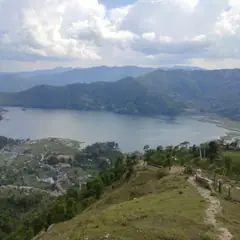
The route ends at the edge of the esplanade, a balcony with the Annapurna range and Machhapuchhre to the north and the city of Pokhara spread out to the south. On the northeast side of the hill stands the tower of a 33-foot lift, paid for by the Laxmi Group and inaugurated by the President of Nepal on 7 March 2019.
From here you can understand the bond between the hill and the city. The great fire of 1949, which destroyed most of Pokhara, allegedly started at this temple during an offering and spread out of control, although that origin is passed down only as alleged.
In March 2020, with the COVID-19 lockdown, the courtyard pigeons were left without grain and the bells fell silent for almost three weeks. What the temple then did with the money from its offerings, and why that gesture reversed the meaning of centuries of worship, is the closing the audio guide saves for this viewpoint.