Mountain museum
International Mountain Museum Audio Guide
A steel roof that copies the mountain range, three eight-thousanders in view and halls that were born almost empty: the museum through which Nepal tells itself the Himalaya.
- 90 min of audio
- Himalaya and mountaineering
The International Mountain Museum was the personal project of Dawa Norbu Sherpa, former president of the Nepal Mountaineering Association, who gathered funds from alpine clubs around the world, above all in Japan. His death in 1997 halted the work, which was rescued with the climbing fees of 18 trekking peaks and finally opened on 5 February 2004 at Rata Pahiro, south of Pokhara. The architect Narendra Pradhan oriented it so that the first piece of the visit would be the view north, towards Machhapuchhare and the wall of the Annapurnas.
In May 2003 the only piece to have arrived from Everest was an oxygen cylinder rescued from the Base Camp rubbish dump. Today the museum receives on average some 200,000 visitors a year, mostly Nepali schoolchildren who come to get to know the Himalaya, and since 2025 it holds on loan the original ice axe of Maurice Herzog, the man of the first ascent of an eight-thousander, Annapurna I, in 1950.
Highlights
- Fan-shaped steel roof by Narendra Pradhan, with views of three eight-thousanders: Annapurna I, Manaslu and Dhaulagiri
- Climbable 31-foot replica of Manaslu, about 9.4 metres, in front of the main building
- Maurice Herzog's original ice axe, on loan since 2025, and statues of the 1950 Annapurna expedition
- Hall of the Mountains with the 14 eight-thousanders, rocks up to 570 million years old and a corner devoted to the Yeti
- Exhibition on Everest's rubbish and Ken Noguchi's clean-up crusade
The story of the International Mountain Museum is that of a building that was late for every appointment. It was meant to open for Visit Nepal Year in 1998, but its driving force, Dawa Norbu Sherpa, died in 1997 and the work stopped. From 1 January 2000 the Nepal Mountaineering Association raised the climbing fees of 18 trekking peaks of between 5,555 and 6,654 metres and put a good part of the increase towards finishing it. It also missed the 50th anniversary of the first ascent of Everest, on 29 May 2003: the grand inauguration was postponed to the following February and the museum opened on 5 February 2004. Sources do not even agree on when construction began, whether in the 1990s or only in 2002; the opening date, by contrast, is not disputed.
Today the Rata Pahiro compound, south of Pokhara, brings together a statue garden, an artificial mountain to climb, halls devoted to the 14 eight-thousanders, to mountain peoples and to expeditions, and a view that the building itself treats as its first piece. What to see at the International Mountain Museum runs from the architecture of its roof to the history of its display cases, and the audio guide walks it in five stops, with documented narration checked against historical sources that explains why this museum was conceived, above all, for Nepalis themselves.
Very close, in the same south of the city, water sinks underground at Davis Falls, and the Annapurna peaks that preside over its halls are reflected in Phewa Lake, around the islet of the Tal Barahi Temple.
A roof that imitates the mountain range
International Mountain Museum
Summary of this stop
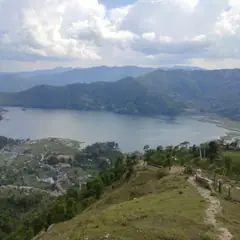
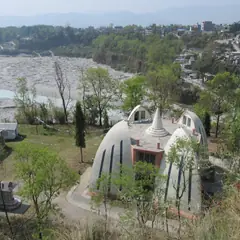
The route begins outside, in the entrance garden, looking north. The architect Narendra Pradhan oriented the building so that the first thing the visitor would meet was not a display case, but Machhapuchhare and the wall of the Annapurnas. From this compound you can see three of the planet’s fourteen eight-thousanders: Annapurna I, Manaslu and Dhaulagiri. Above, the roof of steel and coloured beams fans open like another mountain range; in 2000, with the work half done, the structure could already be made out from the planes landing in Pokhara.
Pradhan also made a decision that puzzled the French and Japanese advisers who visited the site: he moved the toilets and the cafeteria outside the main hall, so that the smell of fried momos and urinals would not reach the exhibition halls.
That roof, the pride of the project, also starred in one of its most awkward episodes soon after the inauguration, and on the least opportune date. What happened that day in 2005 and who had to leave the hall is told in the narration, under the same roof.
Dawa Norbu Sherpa and the founders of the museum
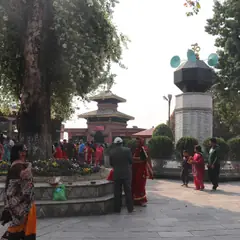
Statues of the founders
Summary of this stop
In the garden stand the statues of the museum’s three promoters: the geographer Harka Gurung, Kumar Khadga Bikram Shah, first president of the Nepal Mountaineering Association, and Dawa Norbu Sherpa. It was the latter, former president of the association, who turned the idea into a personal project and raised funds from alpine clubs from half the world, with Japan as the main contributor.
His death in 1997 left the work paralysed and the opening planned for 1998 was lost. The rescue came from the mountains themselves: the climbing fees of the trekking peaks, raised from 2000, paid for a good part of what was missing. The museum opened on 5 February 2004 and since then every February it celebrates its anniversary as museum day.
In front of these three figures, the stop reconstructs how an interrupted dream came to be inaugurated six years late and why its author never saw it finished.
A nine-metre Manaslu to climb
Manaslu replica
Summary of this stop
In front of the main building stands a climbable replica of Manaslu of 31 feet, about 9.4 metres, which visitors scramble up. The real mountain, another of the eight-thousanders visible from the compound, was first climbed on 9 May 1956 by the Japanese Toshio Imanishi and the Nepali Gyalzen Norbu, and the museum hosted in May 2026 the events for the 70th anniversary of that summit.
What dominates this point, more than the artificial rock, is the public. The museum receives on average some 200,000 visitors a year and most are Nepali students from the middle hills and the Terai who come to get to know the Himalaya. It is no coincidence: as early as 2000 the project was conceived above all so that Nepalis would understand their own mountain surroundings.
Amid the shouting of the schoolchildren, this climbing game tells of a conquest shared between Japan and Nepal, and the audio guide explains what that mixture says about the meaning of the whole museum.
A ridge straddled and a wool Yeti
Hall of the Mountains
Summary of this stop
Now inside, the Hall of the Mountains orders by height the posters of the 14 eight-thousanders, with fragments of the accounts of their first climbers. One of them is that of Toshio Imanishi on the summit of Manaslu in 1956: the ridge began to crumble beneath his feet and he had to sit astride it, as if on horseback. Very close, the geology section changes the scale of time with display cases of rocks collected in Palpa, Kaski, Syangja and Nuwakot, between 2.5 and 570 million years old.
A few steps from the scientific panels on ecosystems, the museum devotes a corner to the Himalaya’s most famous monster. A wool Yeti two and a half metres tall, with black gloves for paws, presides over a repertoire of alleged proofs: the footprints photographed by Eric Shipton’s expedition on the Menlung glacier in 1951, the so-called Yeti scalp of Pangboche monastery or a Bhutanese stamp that paints it as a Himalayan King Kong.
Legend has it that nobody has seen it, although many want to believe in it. The last display cases, however, play at debunking it, and what animal might hide behind the myth is revealed in the narration, at the end of the hall.
From a cylinder in the rubbish to full display cases
Mountain activities gallery
Summary of this stop
In May 2003 the three halls were still almost empty and the only piece from Everest was an oxygen cylinder rescued from the Base Camp rubbish dump. The mountain activities gallery measures how much has changed since then: display cases with expedition equipment from different decades, the first trekking permit of the Swiss Toni Hagen, the jacket and sleeping bag of Kumar Khadga Bikram Shah and watercolours and office supplies of Harka Gurung.
The most recent piece arrived on 5 June 2025, on the 75th anniversary of the first ascent of an eight-thousander, Annapurna I, on 3 June 1950. Mathias Herzog lent the museum the original ice axe of his father, Maurice Herzog, made of wood and metal, by the firm François Simond & Fils and owned by the Olympic Museum in Lausanne. That day statues of Herzog, of the sirdar Ang Tharkay Sherpa and of Walung Sonam Sherpa, the first Nepali on the summit of Annapurna, were also unveiled.
At the back of the museum, an entire exhibition on Everest’s rubbish recounts the crusade of the Japanese Ken Noguchi, who between 2000 and 2003 returned four times to the mountain, not to climb but to clean up, and brought down more than seven tonnes of waste. Behind one of those cylinders lies a very uncomfortable encounter, and the audio guide saves it for the close of the route.