Buddhist shrine
World Peace Pagoda Audio Guide (Shanti Stupa)
A white dome above Phewa Lake, facing the Annapurnas, that seems to have always been there and that the Nepali state itself in fact tore down in 1974: it took a quarter of a century to rise again.
- 60 min of audio
- Japanese peace stupa
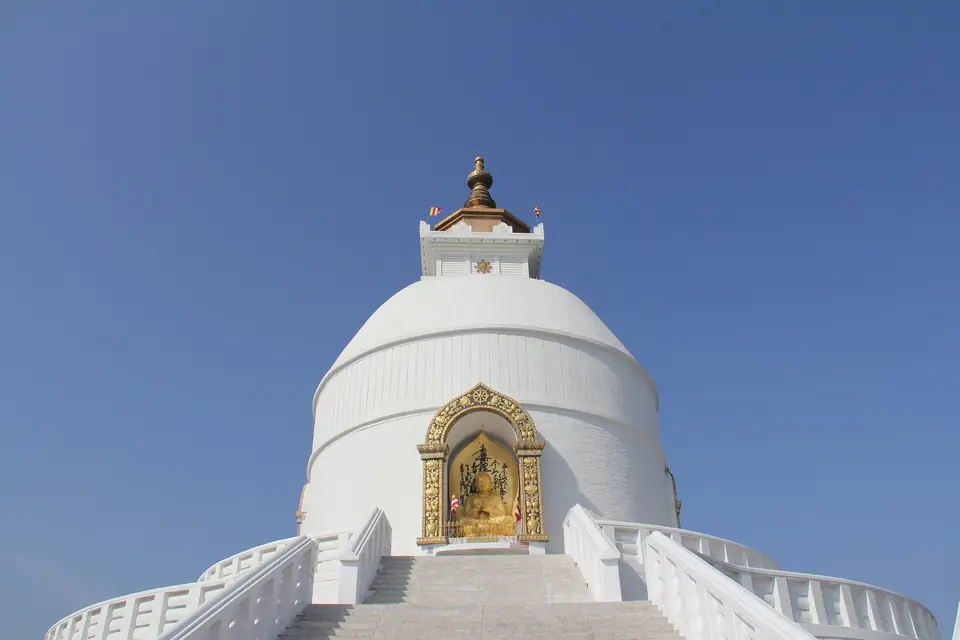
The World Peace Pagoda crowns Anadu hill, above Phewa Lake. Its story begins on 12 September 1973, when the Japanese monk Nichidatsu Fujii, founder of the Nipponzan Myohoji order, laid the first stone here together with relics of the Buddha. The present stupa, consecrated on 30 October 1999, is Nepal's first peace pagoda and the 71st the order has raised in the world: it stands about 35 metres high with a perimeter of 344 feet, with two terraces to walk around it.
Beneath that serenity lies stubbornness. When the first stupa reached 35 feet, the government forcibly tore it down on 31 July 1974, and the man who had donated the land, Min Bahadur Gurung, spent 18 months in prison. Today a statue of him stands in front of the dome, and four Buddhas given by Japan, Sri Lanka, Thailand and Nepal occupy the niches of a structure that the authorities had wanted to be only 4.5 metres tall.
Highlights
- Statue of Min Bahadur Gurung, the donor of the land who served 18 months in prison for the project
- Four Buddhas given by Japan, Sri Lanka, Thailand and Nepal in the niches of the second level
- Staircase of 50 steps: 38 for the blessings and 12 for the links of dependent origination
- 13-storey pinnacle made with gold and jewels donated by Nepalis, topped by a blue crystal from Sri Lanka
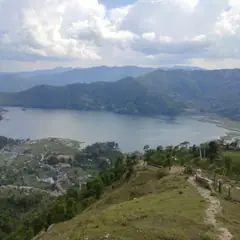
- Terraces with views of Phewa Lake, Sarangkot, Dhaulagiri, Annapurna and Machhapuchhre
The story of Pokhara’s World Peace Pagoda begins far from this hill. In December 1972 the Japanese monk Nichidatsu Fujii arrived in Nepal and met King Birendra to explain why stupas had to be raised in the country. His first idea was Lumbini, the Buddha’s birthplace, where he went as far as buying the land and seven million bricks, until in February 1973 the royal palace decreed that he could not build a new stupa there, only restore the existing ones. So he came to Pokhara, and so Anadu hill, above Phewa Lake, took the place of the original plan.
What followed is a story of clashing with power: a peace pagoda torn down by the state in 1974, a donor jailed, a Japanese monk beaten at the top of the works and eighteen years of struggle until Prime Minister Girija Prasad Koirala laid the first stone again in 1992. The white stupa that crowns the hill today was consecrated in 1999 and is Nepal’s first peace pagoda.
What to see at the World Peace Pagoda goes far beyond the panorama: the statue of the man who gave the hill, a staircase loaded with symbolism, four Buddhas from four countries and a pinnacle made with the jewels of Nepalis. The audio guide walks the compound in four stops, from the entrance courtyard to the terrace above the lake, with documented narration checked against historical sources that tells why this serene dome is, above all, an act of stubbornness.
From the terrace you overlook Phewa Lake with the islet of Tal Barahi, and the Hindu face of the city waits to the north, in the old bazaar, with the Bindhyabasini Temple.
The donor who ended up in prison
World Peace Pagoda
Summary of this stop
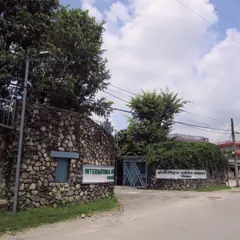
The first figure the visitor meets in the entrance courtyard is not the stupa but a man: the statue of Min Bahadur Gurung, a former deputy minister of defence. On 7 July 1973 he met in Pokhara with Nichidatsu Fujii and the nun Dharmashila, and it was he who donated the land at the summit. The statue was raised in recognition of that donation, which would cost him dearly.
Work advanced quickly. On 12 September 1973 Fujii laid the first stone together with relics of the Buddha, and by 28 November of that same year the prayer hall, with its statue of the Buddha, and the guesthouse were already installed. To the left of the climb, the vihara of the Nipponzan Myohoji order, with its Buddhas and bodhisattvas, maintains the Japanese presence on the hill.
That Pokhara was a plan B, after seven million bricks waiting in Lumbini, changes the way you look at this courtyard. Why that same kingdom would end up tearing down the work it had let begin here is what the narration starts to reveal in front of the statue.
The stupa that fell in 1974
Front staircase of the stupa
Summary of this stop
At the foot of the staircase, several signs ask visitors to take off their shoes about 20 metres before the base and keep silent, and a guard sees that it is respected. That watched silence has a backstory: on this same summit there was a half-built stupa. When it reached 35 feet in height, the government forcibly tore it down on 31 July 1974, and nothing of it remains in view.
According to the accounts gathered, on 19 July the Panchayat regime had arrested Min Bahadur Gurung, accused of felling the forest and building without municipal permission; he served 18 months in prison, and the regime considered him a sympathiser of the Congress Party. It is said that the Japanese monk Morioka Sonin, a disciple of Fujii, was beaten and thrown from the stupa for protesting. The real reason for the demolition is still disputed: some versions speak of security, others of urban planning and others of political persecution against Gurung.
Then came years of petitions. The authorities eventually gave way, but on one condition: the stupa could not exceed 4.5 metres. In 1987 a committee chaired by the monk Bhikkhu Sudarshan Mahasthavir, with Gurung at his side, revived the project. How Pokhara responded to the idea of a small stupa is told right at the start of the climb.
Four Buddhas from four countries
Niches of the four Buddhas
Summary of this stop
On 21 May 1992, after eighteen years of struggle, Prime Minister Girija Prasad Koirala climbed Anadu hill and laid the first stone again; the consecration was held in his presence on 30 October 1999. The result is the opposite of the dwarf stupa that had been demanded: about 35 metres high and 344 feet in perimeter, the 71st peace pagoda of Nipponzan Myohoji in the world.
The front staircase can also be read like a text. According to the most detailed description of the monument, it has 50 steps: the first 38 represent the 38 blessings, the Uttam Mangal, and the last 12 the twelve links of dependent origination, the Pratitya Samutpada. Another source counts fewer steps up to the second level, and the figure is not unanimous.
Above, in the niches of the second level, four Buddhas given by four countries wait: at the front, the Japanese one, under a golden torana, in the gesture of turning the wheel of the dharma; to the west, the one from Sri Lanka, in meditation; the Thai one, 6 feet long, reclining in parinirvana; and to the south, the Nepali one, representing the birth of Siddhartha in Lumbini. Why that last Buddha closes the circle of the whole story is something revealed by listening to the narration on the spot.
A pinnacle of jewels above Phewa
Viewpoint over Phewa and the Annapurnas
Summary of this stop
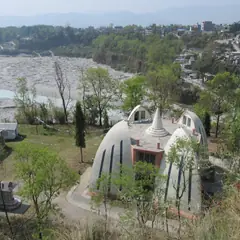
From the terrace, the view opens over Phewa Lake, with Lakeside on the east shore, Sarangkot opposite and, to the north, Dhaulagiri, Annapurna and Machhapuchhre. Above the dome gleam four golden wheels of the dharma and an octagonal harmika that holds a relic of the Buddha presented by a rajguru from Thailand. On top rises the 20-foot, 13-storey pinnacle, a symbol of the 13 worlds, made with gold and jewels donated by Nepalis and topped by a blue crystal from Sri Lanka.
In the Dhamma hall beside the stupa, Buddhist rituals are held daily, and every full moon there are large pujas in which pilgrims light butter lamps. In the small Japanese temple, monks and nuns of Nipponzan Myohoji beat a hand drum as they chant “Namu Myoho Renge Kyo”, the same practice Fujii took in 1933 to Gandhi’s ashram in Wardha. Gandhi added it to the ashram’s prayers and began to call him “Guruji”, the name by which he is known in Nepal.
On leaving Nepal after the 1974 demolition, Fujii left a saying: this time he had not been able to build the pagoda, but he had already planted seeds of a pagoda in the minds of Nepalis. How far that prophecy came true, in view of a pinnacle made with the jewels of the Nepalis themselves, is the closing the audio guide saves for this terrace.