Island temple
Tal Barahi Temple Audio Guide
A tiny pagoda in the middle of Phewa Lake, reachable only by boat, shelters Barahi, the boar-faced goddess: an islet that legend saved from the waters and that engineers are still fighting to keep afloat.
- 40 min of audio
- Nepali pagoda on the water
The Tal Barahi Temple began as a straw hut on a sacred stone. It was raised by Kulmandan Shah, king of Kaski and ancestor of Prithvi Narayan Shah, the unifier of Nepal, at the spot where a shila on a mound of earth had begun to be worshipped as the goddess Barahi. Its existence is recorded from the year 1669 of the Bikram Sambat calendar, around 1612 CE, and some records take it back to 1447 BS, around 1390. In 1960 King Mahendra replaced the hut with the tiered-roof pagoda that is reflected in the water today, and since then the island has been Pokhara's great religious and tourist destination.
What looks ancient is newly made: the 2015 earthquake tilted the temple three inches to the south, and between 2023 and 2026 craftsmen from Bhaktapur and Lalitpur dismantled it and rebuilt it piece by piece with wood and brick. Before touching it, a puja was held to ask the goddess for forgiveness. And on this postcard island, facing Machhapuchhre, tradition keeps up the Saturday offerings of goats and chickens to Barahi.
Highlights
- Islet in Phewa Lake about five minutes by boat from Barahi Ghat, with a compound of just under 1,800 m²
- Pagoda raised by King Mahendra in 1960 and rebuilt between 2023 and 2026 by craftsmen from Bhaktapur and Lalitpur
- Three-inch tilt to the south caused by the 2015 earthquake
- Sacred stone worshipped as Barahi, the boar goddess honoured by Hindus and Buddhists alike
- Lamp aarati every evening, around six o'clock, at Barahi Ghat, with Machhapuchhre and the Annapurna reflected in the lake
The story of Tal Barahi begins with a stone. On a mound of earth in the middle of what is now Phewa Lake, a shila came to be worshipped as Barahi, the boar-shaped manifestation of Ajima, the female force. Right there Kulmandan Shah, king of Kaski and a figure regarded as the founder of the Shah dynasty, raised a straw hut. Nepali sources date the temple to at least 1669 of the Bikram Sambat calendar, around 1612 CE, and some records take it back to 1447 BS, around 1390; other publications mix calendars and give different figures, so its exact age remains open.
It is said that the king ordered the shrine built after seeing the goddess in a dream, and another tradition holds that Durga, after finishing off the demons, came to Pokhara, found it so beautiful that she decided to stay and made the islet her home. The present form arrived in 1960, when King Mahendra replaced the hut with a pagoda; the walls that ring the island date from 1982, and the pagoda itself has just been dismantled and rebuilt after being tilted by the 2015 earthquake.
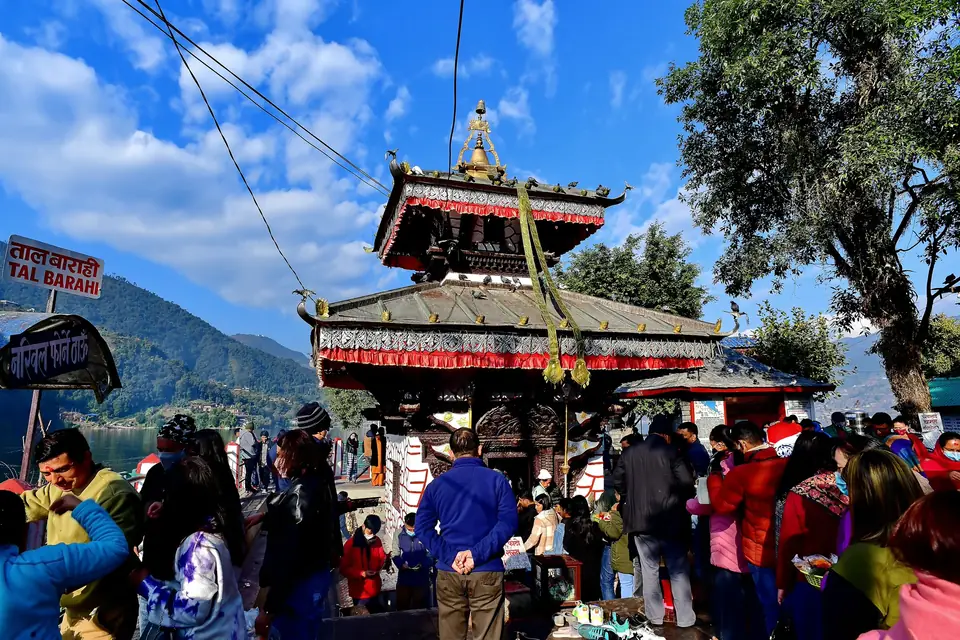
Today the temple combines living faith and a boat ride: on Saturdays the queues at the jetty grow longer, its great fairs are held in Baisakh and Kartik, and a flock of pigeons coos on the roofs. The audio guide walks the islet from the shore to the door of the shrine, with documented narration checked against historical sources about what to see at Tal Barahi, its history and the architecture of a pagoda that looks old and is not.
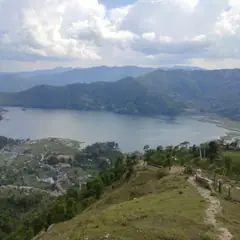
The islet rises in the middle of Phewa Lake, whose shore has its own history of dams and disputed plots. Another widely venerated goddess of Pokhara has her shrine to the north, at the Bindhyabasini Temple, and the peaks that are reflected in the water star in the halls of the International Mountain Museum.
Barahi Ghat, the temple that begins by boat
Barahi Ghat
Summary of this stop
The visit does not begin on the island but on the Lakeside shore. At Barahi Ghat the boats that cross to the temple in about five minutes are waiting, and from here you can appreciate how small the destination is: the whole compound covers three ropani, eight anna and two dam, just under 1,800 m². An entire shrine, with its pagoda, its ceremonial pit and its worshippers, fits in that patch of land.
The jetty has a life of its own as evening falls. Every day, around six o’clock, the Mata Talbarahi Aarati Sewa Samiti, founded in 2018, holds a lamp aarati here facing the island that gathers hundreds of devotees, locals and tourists on the benches along the shore. At the full moon of Kojagrat Purnima, the annual fair fills the islet with worshippers from neighbouring districts, Hindu and Buddhist, because Barahi is worshipped by both.
Why a goddess who reigns in the middle of the water makes all her worshippers cross it to reach her is the first key the narration reveals at the foot of the boats.
A wall against the lake that surrounds it
Islet wall
Summary of this stop
On landing, the first thing you touch is the retaining wall that rings the islet. According to tradition, where the lake now lies there was a village. An old jogi, or the goddess herself disguised as an ascetic, asked for shelter and only one old woman opened her door, with a bran roti as her whole supper. In the morning, the stranger warned her that the village would be left under water and that she should climb to a high place. The water rose, and only the mound in the centre survived, where a flood later left the image of the goddess. Another version replaces the old woman with a couple from Kathmandu who served rice and vegetables.
The island that survived in the legend has needed very earthly help. The walls around it were built in 1982, and when they cracked, the conservation committee proposed lowering the lake level by at least six feet to rebuild them. The boatmen and the Jalari fishing community, who live off Phewa, opposed it.
The way out was sought by a technical committee coordinated by engineer Ram Prasad Aryal: instead of emptying the lake, place up to 25,000 concrete blocks from the surface to the bed, at an estimated cost of 13.1 million rupees, to stop the temple from sinking. What really lies beneath this wall is one of the secrets told at this stop.
The pagoda that tilted and was born again
Tal Barahi Temple
Summary of this stop
In front of the pagoda, the carved wood, the windows and the traditional doors suggest centuries of history. But the pagoda form dates from 1960, the work of King Mahendra, and the building you see today is younger still. The 2015 earthquake tilted it three inches to the south, something that only became visible when a tree beside it was removed and that technicians of the Department of Archaeology confirmed.
Before dismantling it, in 2023, a chhyama puja was held for two days, a puja of forgiveness so that the goddess would not punish any mistakes that might be made during the work. Afterwards, craftsmen brought from Bhaktapur and Lalitpur, in the Kathmandu valley, rebuilt it piece by piece with wood and brick and the same traditional form.
The work cost about 15 million rupees, according to the final tally, although the figures published during the works do not always agree; the Department of Archaeology contributed 600,000 and the rest came from the donations of devotees. What changed and what was meant to be kept intact in the new pagoda is revealed by listening to the narration in front of its roofs.
The stone that recovered its goddess
Sacred stone of Barahi
Summary of this stop
At the door of the shrine you reach the heart of the worship: the ancient shila venerated as Barahi, the very stone on which Kulmandan Shah raised his straw hut. While the temple was dismantled, the goddess was worshipped in a silver idol installed beside the Havan Kund, the ceremonial fire pit. The reopening to worshippers was set for Ghatasthapana, on 12 October 2026, with a puja to return the goddess’s power to the ancient stone.
Some call the temple Varaha Mandir and believe it to be dedicated to Vishnu in his boar avatar, but tradition is clear: the one who lives on the island is a goddess. Barahi, as Varahi is known in Nepal, is one of the Matrikas or mother goddesses, and here she is worshipped as Matsya Varahi, with a boar’s head and a human body, a cup in one hand and a fish in the other, attributes typical of her tantric images.
Her great fairs come in the Nepali months of Baisakh, between April and May, and Kartik, when the belief that the darshan of Talbarahi grants wishes fills the boats. Why a fish fits like no other attribute in this goddess’s hand is the closing the audio guide saves for the end.