Museum of Lapland and the Arctic
Arktikum Audio Guide
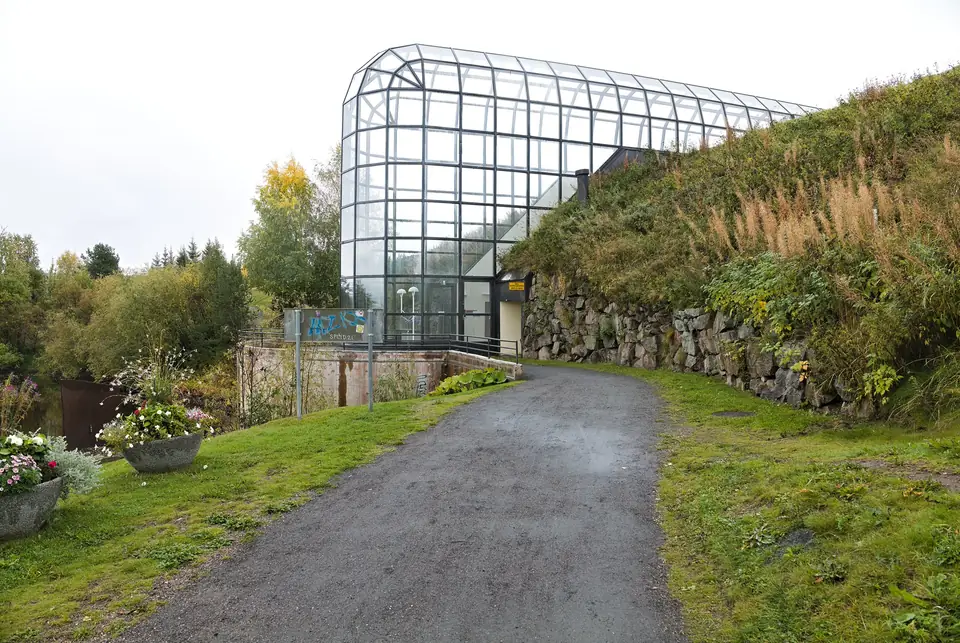
From the bank of the Ounasjoki all that shows is a glass tube pointing north: the rest of the museum of Lapland and the Arctic lives underground, in a city that burned in 1944 and learned to tell its own story.
- 90 min of audio
- Underground architecture
Arktikum was inaugurated on 2 December 1992 and opened to the public on Independence Day, 6 December, as a gift for Finland's 75th anniversary. It houses the Lapland Provincial Museum and the Arctic Centre of the University of Lapland, and its architecture came out of an international competition entered by eight northern-hemisphere countries and won by the Danish team of Claus Bonderup with the proposal “The Inextinguishable”.
The only part of the building that shows is a 172-metre glass gallery, covered by about a thousand panes and split in two by the Kittilä road. Below, the halls take up an area equivalent to Rovaniemi City Hall, inside a concrete vessel calculated so that the river can rise around it without getting in.
Highlights
- Glass tube — 172 metres and about a thousand 2 m² panes pointing north
- Gate to the North — a gallery over Perttaus granite and lime-treated Lapland pine
- Northern Ways — two models of Rovaniemi before and after the Lapland War
- Arctic Opposites — simulated auroras, a woolly mammoth and a hundred Finnish words for snow
- Arctic Garden — the statue of Nätti-Jussi, the lumberjack who told impossible tales
The story of Arktikum begins far from Lapland. In the 1970s Finland debated the idea of an arctic institute based in Rovaniemi, inspired by the arctic research centre created in France in 1958. The city council joined in because the Lapland Provincial Museum, founded in 1975, needed a new building, and in the 1980s an international architecture competition gathered entries from eight northern-hemisphere countries, among them three Estonian ones submitted through the Soviet Union. One of them, “CDF”, imitated the ice ridges of Caspar David Friedrich’s painting “The Sea of Ice”. Another idea won: an illuminated “finger of ice” pointing north.
The project went ahead as a gift for the 75th anniversary of Finland’s independence and opened its doors in December 1992, in a city whose centre had lost about 90% of its buildings in 1944. In 1997 a crescent-shaped wing was added, by Claus Bonderup and Janne Lehtipalo, and in 2025 its halls received 172,661 visitors, 65% of them foreign. The history and architecture of Arktikum are best understood by walking from south to north along its gallery, going down to the buried halls and coming out into the garden on the riverbank, which is exactly the route the audio guide follows.
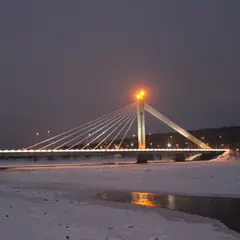
About 800 metres away, over the Kemijoki, stands the Jätkänkynttilä Bridge; the city of the post-war models is the one Alvar Aalto redrew and crowned with the Aalto Centre, and the Arctic Circle waits to the north, at Santa Claus Village, which also has a route for families, Santa Claus Village for Kids.
A glass finger pointing north
Arktikum
Summary of this stop
From outside, Arktikum almost does not exist. On the bank of the Ounasjoki only a 172-metre glazed gallery shows, pointing north, and for one stretch the 30-metre-wide Kittilä road cuts across it and divides it in two. It is the “finger of ice” with which the Danish team of Claus Bonderup, from the studio Birch-Bonderup & Thorup-Waade, won the competition under a motto that was already a statement of intent: “The Inextinguishable”.
The skin of the tube is made of about a thousand special 2 m² panes, tempered on the outside and laminated on the inside, designed so that if one breaks it does not fall on anyone passing below. Everything else, the halls and the collections, is hidden underground. Why an Arctic museum chooses to make itself almost invisible is the question the narration opens with, in front of the glass.
The Gate to the North, a birthday present
Glass gallery
Summary of this stop
The lobby is at the southern end, so the visit begins by walking north along the so-called “Gate to the North”. It is not a floor-plan detail: the building turns the route into a journey towards the Arctic, with the sky on the other side of the glass.
The Danish architects wanted that path to be made of Lapland materials: floors of Perttaus granite and lime-treated Lapland pine, and chairs of birch and reindeer hide. Beneath that gallery, the exhibition halls add up to an area equivalent to Rovaniemi City Hall.
The complex was officially inaugurated on 2 December 1992 and opened to the public four days later, on 6 December, Independence Day: a gift for a country turning 75. What that anniversary meant for a northern city rebuilt from the ashes is left for the walk along the gallery.
Two models: the city before the fire
Rovaniemi models before and after the war
Summary of this stop
The permanent exhibition “Northern Ways” of the Lapland Provincial Museum covers the region in three parts, Rovaniemi, Southern Lapland and Upper Lapland, with halls on Sámi culture, reindeer herding and Petsamo, Finnish territory between 1920 and 1944. But the point that most invites a pause is two models of the same city.
One shows Rovaniemi before the Lapland War (1944–1945); the other, after. Between them almost everything disappears: German troops burned the town in October 1944 and the centre lost about 90% of its buildings. What is unsettling is that between 1940 and 1944 some 6,000 Germans had lived in Rovaniemi alongside as many locals, a coexistence the museum exhibited in 2015 with “Wir waren Freunde – Olimme ystäviä” (“We were friends”), whose promotion with matchboxes ended up banned by the city council and turned into a collector’s item.
How the burning came about is still debated: some present it as a strategic consequence of the war and not as pure malice, and the historian Matti Enbuske argues it was partly accidental, because the explosion of an ammunition train would have spread a fire intended only for public buildings and barracks. The houses missing from one model to the other are best looked for with the narration in the ear.
The mammoth that lived underground
“Arctic Opposites” exhibition
Summary of this stop
The “Arctic Opposites” hall, the Arctic Centre’s science exhibition entirely redone in 2024 and reopened on 6 December that year, brings together simulated northern lights, a hundred Finnish words for snow and a woolly mammoth. All of it inside a building prepared for the river: the vessel is lined with waterproof moraine, the walls are 50 cm of concrete, the ground-floor level sits 20 cm above the maximum flood level and the basement goes under water during floods. Arktikum would hold even when almost the whole Saarenkylä district was already flooded.
The most curious piece has a police story. An enormous woolly mammoth tusk found in Yakutia, in Siberia, was confiscated by Finnish Customs and donated to the Arctic Centre in 1993, just after the museum opened. Since January 2021 it has been displayed half hidden, “as if under the ice”. It fits a belief of several Indigenous peoples of Siberia, according to which the mammoth lived underground and died if it accidentally came up to the surface, and the word “mammoth” itself comes from those same peoples. What that belief has to do with a buried museum is revealed by the audio guide beside the display case.
Nätti-Jussi, the lumberjack who lit the auroras
Nätti-Jussi sculpture
Summary of this stop
At the exit waits the Arctic Garden, some seven hectares of arctic and mountain plants on the bank of the Ounasjoki, partly on a small island. There stands Risto Immonen’s sculpture dedicated to Nätti-Jussi, Johan Viktor Nätti (1890–1964), whom tradition calls “the king of the day labourers” of the logging camps of Lapland.
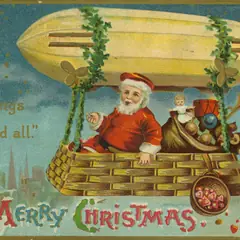
In the bunkhouses, where at first there was not even a radio, the lumberjacks gathered to hear him, and he stretched every story by delaying the ending. As the tale goes, he claimed to have met Hitler as a young man in Liverpool, to have gone to the opera in Rome with the Pope, to have hunted with Native Americans and to have flown in a zeppelin. He died in a lumberjacks’ home and was buried in a common grave, until in 2006 he received a headstone of his own in the Viirinkangas cemetery, engraved with a saying of his that makes him a partner of Saint Peter in the northern lights business. The end of that saying, and why it invites a look at the northern sky that very night, is kept for the last stop of the route.