Church of the reconstruction
Rovaniemi Church Audio Guide (Rovaniemen kirkko)
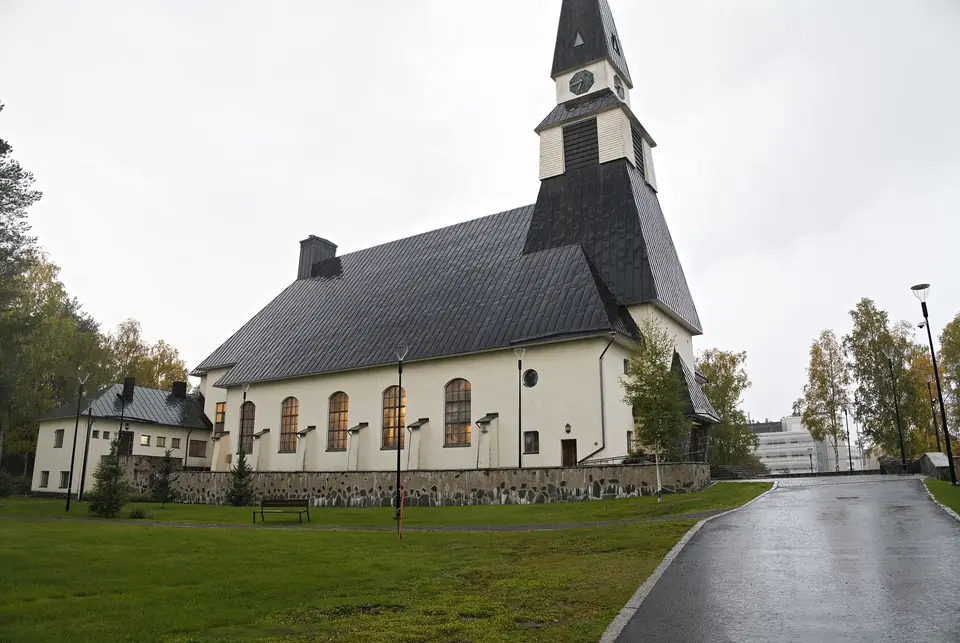
A Lutheran church raised in 1950 on the ashes of the Rovaniemi burned in 1944, with a tower turned towards the river, a cross that glows red at night and a Christ who rises from a Lapland landscape.
- 30 min of audio
- Post-war architecture
In October 1944, during the German retreat of the Lapland War, the old wooden church of 1817 burned along with 87% of Rovaniemi's buildings. After two architecture competitions and a parish that asked for the church to “look like a church”, Bertel Liljequist's design was consecrated in the summer of 1950, on the same sacred site as its predecessors, paid for in part by Lutheran congregations in the United States and decorated with collections from Swedish parishes.
Outside, a 54-metre tower with clocks that run fast and a gilded cross with red neon whose colour is still debated in town. Inside, the Bible told in a northern accent: a reindeer in place of the lamb, a Lapland swan feeding its young with its own blood and a 14-metre fresco where the faithful and the wolves share the choir wall.
Highlights
- 54-metre tower — turned towards the river, with clocks that run fast and louvres that muffle the bells
- Cross of red light — a neon on a gilded globe and cross whose colour still gives people something to talk about
- A reindeer for the lamb — paintings and stained glass by Antti Salmenlinna with scenes of northern Finland
- Lapland swan — Gunnar Uotila's carving that feeds its young with its own blood
- “Elämän lähde” fresco — 14 metres by Lennart Segerstråle with the Lapland War in the background
At six in the evening of 16 October 1944, from the Ounasvaara hill, the group of forestry manager Jarl Sundqvist watched as arsonists smashed the windows of Rovaniemi’s wooden church with clubs and threw incendiary bottles inside. The church, finished in 1817, burned along with almost the whole town: that October 87% of the buildings were destroyed, including 548 homes in the centre. Rovaniemi Church, Rovaniemen kirkko in Finnish, is the answer to those ruins and chimneys: a Lutheran church consecrated in the summer of 1950 on the same sacred site as the old parish church, founded in 1632 as a chapel of Kemi.
The story of Rovaniemi Church is also that of a city rebuilt with help from afar. There was a general competition in 1947 and an invitation one in 1948; the parish rejected the prize-winning designs because it wanted the church to “look like a church” and ended up choosing the architect Bertel Liljequist, although his project had not won, a decision criticised by the magazine Arkkitehti. Lutheran congregations in the United States paid for part of the work, and collections from parishes in Sweden covered much of the art, the chandeliers, the bells and the 45-stop Christensen organ.
What to see at Rovaniemi Church runs from the tower to the choir: an architecture of rendered walls and a copper roof, renewed in 2005, that hides inside a painted and carved Lapland. Beside the church, the Kirkkolampi pond, which according to those who look after it nobody dares to spoil in the shadow of the church, completes the picture. The audio guide, researched and checked against historical sources, covers the site in four stops, from the tower to the great fresco of the altar.
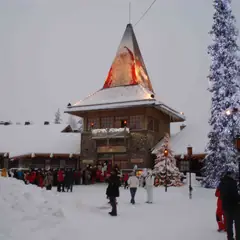
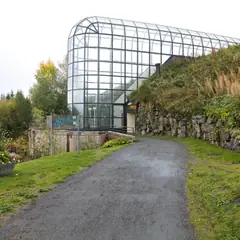
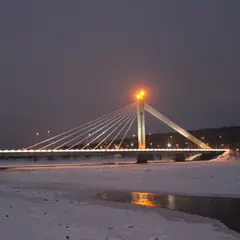
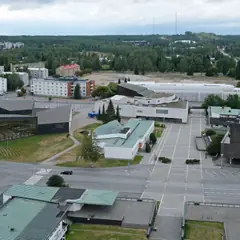
Less than 400 metres away, the Aalto Centre shows the other face of the reconstruction; the river the city crossed on temporary bridges after the war is now spanned by the Jätkänkynttilä Bridge, and the aid that came from the United States has another chapter in the cabin raised for Eleanor Roosevelt at Santa Claus Village.
A tower turned towards the river
Rovaniemen kirkko
Summary of this stop
The route begins outside, in front of the tower. The plan follows the model of a long church with a gable tower, very popular in Ostrobothnia in the 17th century, but with a deliberate twist: the tower stands at the east end and not at the usual west, so that the entrance would open towards the riverside settlement. It is 54 metres tall and carries clock faces on its sides, as the parish asked for in the competition; its old mechanism runs fast, so roughly once a month the hands stop for a few minutes, and not a few passers-by have thought they were late on looking at it.
Up above, three bells were hoisted in the spring of 1950, each with its own Bible verse. The slatted louvres open and close like blinds to regulate how much is heard and are usually shut, because some neighbours are bothered by the ringing. Higher still, a gilded globe and cross covered in gold leaf; at night the cross glows with red neon, and that colour set off a wide debate in town that still has no single explanation.
The tower is not made for visits. In 2016 two journalists climbed it with the parish and had to come down in a hurry through a maze of wooden stairs: a single peal, so discreet from the street, is enough to damage hearing up there. On the landing of the windows the winch that hoisted the bells in 1950 still waits, with its cables. What is told of that climb, and the different readings of the red cross, are left for the narration in front of the tower.
The ashes of the 1817 church
Memorial to the earlier churches
Summary of this stop
East of the church, inside a stone wall, lies the parish’s oldest cemetery, with a memorial to the churches and the bell tower that preceded the present building. It has been sacred ground for centuries: the 1950 church stands exactly on the site of its predecessors, among them the wooden one that burned on 16 October 1944.
This stop explains why the fire was so devastating. According to one version, the retreating troops’ initial plan was to burn only the important public buildings and their own barracks, but everything got out of hand when an ammunition train exploded at the station and the wooden houses burned faster than expected; the blast even threw charges placed on a bridge over the Kemijoki, three kilometres away, into the river. It is a disputed story: some Finnish commandos claimed the demolition and rumours of sabotage have circulated ever since, while German documents speak of an overturned stove inside a wagon.
North of the church, in the second cemetery, consecrated in 1833, rest 603 soldiers fallen in the Winter War, the Continuation War and the Lapland War, beneath the statue by Wäinö Aaltonen unveiled in 1954. How each version of the fire fits with what is known today is unpacked in the audio guide, beside the memorial.
A reindeer where the lamb should be
Folded-vault nave
Summary of this stop
Down the central aisle of the nave, the gaze climbs to a folded concrete vault lined with narrow boards, with side aisles crossed by oblique pilasters. It is the interior of a church made of decisions and gifts: those of a parish that insisted the church look like a church and those of donors in the United States and Sweden who helped build it and fill it with art.
Antti Salmenlinna designed the interior, the decorative paintings and the stained glass, and filled the Bible scenes with everyday life in northern Finland: in his murals, the symbolic lamb of the Bible is a reindeer. Gunnar Uotila carved in wood the four evangelists with their symbols and a great Lapland swan that feeds its young with its own blood, one of those figures the eye goes looking for up the nave.
At the far end stands the Christensen organ, paid for in part by Swedish parishes. What other traces of Lapland hide in the stained glass and carvings, and who paid for them, is part of what the narration reveals while walking the nave.
Christ rises from a Lapland landscape
Elämän lähde fresco
Summary of this stop
The route ends before the back wall of the choir, covered entirely by “Elämän lähde” (“The Fountain of Life”), a fresco 14 metres high and 11 wide at the base that Professor Lennart Segerstråle painted in 1951, a year after the consecration according to most sources. The sketch had existed since 1936 and was first conceived for the church of Rajamäki; for Rovaniemi, the painter incorporated the destruction of Lapland in the last year of the war.
In the centre, a figure of Christ rises from a Lapland landscape between two halves: on one side the faithful; on the other, drunkards fighting and wolves lying in wait. Segerstråle described it as a cut through the human heart between the good thief and the bad thief. In Rovaniemi there is also a secret reading, never confirmed, that sees Masonic symbols in its sun; others remember above all the children shivering on the shadowed side of the fountain.
This last wall gathers the whole route: the war, the burned city and a Lapland that recognises itself again in its church. What exactly is painted in each half of the fresco, and why it deserves a second look, is discovered by listening to the audio guide in front of the choir.