Arctic Circle
Santa Claus Village Audio Guide
Santa Claus Village in Rovaniemi began with a log cabin raised in a week for Eleanor Roosevelt, on the site of a former German air base. Behind every letter, every painted line and every pendulum lies a real story.
- 120 min of audio
- Christmas all year round
Beside the Arctic Circle, on the outskirts of Rovaniemi, Santa Claus Village (Joulupukin Pajakylä) brings together Santa Claus Main Post Office, the hall where Santa has received visitors free of charge since 1985 and the white line of the Arctic Circle. Its oldest building is the small Roosevelt Cabin, dating from 1950, which for fifteen years was the only building on the Arctic Circle open to the public.
The contrast is sharp: Santa Claus Village stands where German troops had Luftwaffe barracks, workshops and storehouses, in a region that was left burned and strewn with mines in 1944. And the famous Arctic Circle line, the one in the obligatory photo, marks where the circle was in 1865, not where it is today.
Highlights
- Roosevelt Cabin — a 1950 log house designed in one night and built in a week for Eleanor Roosevelt
- Santa Claus Main Post Office — some 17 million letters since 1985 and a red postbox that holds postcards until Christmas
- Arctic Circle line — the white stripe in the square marks the 1865 position; the real circle moves about 14.5 metres a year to the north
- Santa Claus Office — free entry, a record of more than 330,000 visits in 2011 and a giant pendulum that, according to its sign, regulates the Earth's rotation
- Pine woods behind — grounds of a former Luftwaffe base, with barracks remains still visible in the 2010s
The story of Santa Claus Village does not begin with reindeer or elves, but with a war. In 1941 German troops took the Rovaniemi airfield and extended their Luftwaffe base into the area the village now occupies; in October 1944, in full retreat, they burned the town, destroyed more than 90% of its buildings and left the region strewn with mines. That is why Lapland was among the first to receive UNRRA reconstruction aid, and why in June 1950 Eleanor Roosevelt, widow of President Franklin D. Roosevelt, came all the way here. To receive her, a log cabin was raised against the clock beside national road 4: the first building of what is now Santa Claus Village.
Since then the place has not stopped growing: an official post office that has received some 17 million letters since 1985, a hall where Santa receives visitors all year round, a white line painted in the square and more than 600,000 visitors a year. The story of Santa Claus Village is made of real episodes that almost sound invented, and the researched EarGuide audio guide walks through it in six stops, from the 1950 cabin to the pendulum hall, so each one can be heard at the spot where it happened.
The war that explains the 1950 cabin can be seen in the before-and-after models at Arktikum, and the aid that arrived from abroad for the burned town also stands behind Rovaniemi Church. For those travelling with children, the same village has its own storybook version: Santa Claus Village for Kids.
A little 1950 cabin among giants
Roosevelt Cabin
Summary of this stop
In the middle of the village, beside the Main Post Office, the Roosevelt Cabin (Rooseveltin maja) goes almost unnoticed among much larger buildings. It is a small log house from 1950, extended in 1956, first called Napapiirin maja, the “Arctic Circle cabin”. Eleanor Roosevelt arrived there on 11 June 1950, and today the oldest building in the village is a Lapland souvenir shop, with panels by the door telling the story of that visit.
What makes it special is its past solitude: for 15 years it was the only building on the Arctic Circle open to visitors. According to a documented tradition, in its early years it opened only in summer and its guest books gathered thousands of names a year, some as unexpected as Leonid Brezhnev, Josip Broz Tito or Golda Meir. In 1963 it was also visited by US Vice President Lyndon B. Johnson, a few months before he reached the presidency.
Among so many illustrious signatures, the name that ended up carved into the wood itself belongs to no head of state. Who left it, and on what day of 1959, is one of the details the narration saves for this spot.
A log house built in a week
Arabia brick fireplace
Summary of this stop
Inside the cabin, the Arabia brick fireplace is the work of the same architect who designed the whole thing: Ferdinand Salokangas, who drew the cabin in a single night. The logs were taken from the Ounasjoki river eight days before the guest’s arrival, and the carpenters of master builder Yrjö Kamunen finished it in a week, working double shifts and, at the end, without stopping day or night. Some minutes of the building-site meetings are dated around midnight.
The story goes that while Eleanor Roosevelt’s plane was landing in Rovaniemi and she was greeting Governor Uuno Hannula, the last door was still being fitted at the cabin, and that the cleaning staff slipped out the back as the guests came in at the front. It is the first moment of Arctic Circle tourism, and it was a race against the clock.
The visit also left a postal legacy: it debuted the special Arctic Circle postmark, and Roosevelt sent from here the first postcard stamped with it, addressed to President Harry S. Truman. Finnish sources place that mailing on the very day of the visit, although others give a later date in 1950. That first postcard is the origin of a custom that now moves hundreds of thousands of letters, and the audio guide tells, beside the fireplace, how one became the other.
The red postbox that waits for Christmas
Santa Claus Main Post Office
Summary of this stop
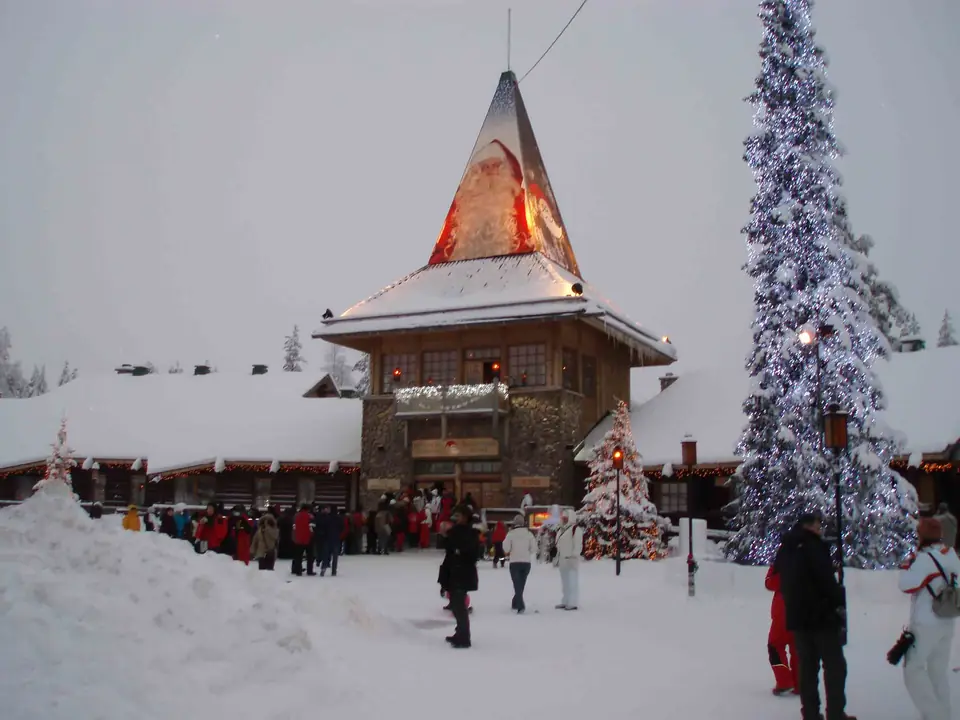
Santa Claus Main Post Office (Joulupukin Pääposti), at Tähtikuja 1, is a building of natural stone and aihki pine logs with elf postmen, children’s letters that visitors can read and its own postmark. In front rises the Elf Tower, the landmark that helps visitors get their bearings in the village. It is an official office of the Finnish post Posti, and since 1985 it has received some 17 million letters: in recent years more than 500,000 a year arrive from about 200 countries, and in 2014 most came from China, Italy and Poland.
The inevitable question is why they come here. From 1927 Finnish public radio placed Santa’s home at Korvatunturi, a fell by the Russian border, but in 1976 the government moved the postal service that handled the Christmas letters to Rovaniemi, several hundred kilometres away. Since 1997, a sample of each year’s letters has been kept at the Oulu branch of the National Archives.
Here the postboxes are not all alike. According to a living tradition of the office, the red postbox keeps the letters it receives and does not send them until Christmas, so a postcard written in midsummer reaches its destination in December with the special Arctic Circle postmark. The difference between one box and the other is explained in the audio guide right in front of them.
The white line that got left behind
Arctic Circle line
Summary of this stop
In the central square, a white line painted on the ground marks the spot of the obligatory photo: the crossing of the Arctic Circle. Beside it, a webcam has streamed live since 2009. But the line holds a surprise: it corresponds to the position the Arctic Circle had in 1865. The current circle, at 66°33′46″ north, lies further north, south of Rovaniemi Airport. Sources disagree on the distance between the line and the real circle, and the village’s official website still presents it as the place where the circle passes.
The reason is astronomical: the tilt of the Earth’s axis is decreasing within a cycle of about 41,000 years, and the Arctic Circle now drifts some 14.5 metres a year to the north. The magic line has been left behind while the real circle slips away.
Not even the 1950 cabin was built on the line. The exact point of the Arctic Circle on the road was then a bog where nothing could be built, so it was raised somewhat further south, about 100 metres according to the village and about 200 according to other sources, on land donated by Eemeli Karinen. What that bog means for the photo everyone takes home is revealed in the narration, standing on the line.
Under the pines, an air base
Pine woods behind the village buildings
Summary of this stop
Behind the tourist buildings, a strip of pine wood seems the calmest part of the site. Yet this land was part of a large Luftwaffe base during the Continuation War: after taking the Rovaniemi airfield in 1941, German troops extended their barracks, workshops and storehouses as far as the present Arctic Circle area. In the 2010s, remains of barracks could still be seen just behind the village, although some were covered over or destroyed as the facilities grew and today they may no longer be visible.
The wood also serves as a way of looking at the present. Santa Claus Village receives more than 600,000 visitors a year; at Christmas the influx equals 10 times the population of Rovaniemi, and in 2023 the city set a record with 1.2 million overnight stays. In September 2024 a residents’ group demonstrated against uncontrolled tourism growth and short-term rentals, while the city hall and the tourism industry stress the income it brings.
Between yesterday’s barracks and today’s debate there is a thread that the audio guide follows in this corner of the pine wood, where the calm of the forest hides more history than it seems.
The pendulum that controls the Earth’s spin
Santa Claus Office
Summary of this stop
The route ends at the Santa Claus Office (Joulupukin Kammari), where Santa has received visitors free of charge all year round since 1985; its record is from 2011, when more than 330,000 people met him. Before reaching his hall, visitors pass through a vaulted space with a giant pendulum that swings without pause. Its sign presents it as the “Regulator of the Earth’s rotation speed”: according to the lore of the place, the machinery with which Santa manages to deliver billions of gifts in so little time, and the magic that lets him be in Rovaniemi almost all year even though his home is at Korvatunturi.
Behind this office lies an earlier dream. In 1959 the commercial counsellor Niilo Tarvajärvi, just back from visiting Disneyland, devised “Joulumaa”, Christmas Land, as a Finnish replica of the American park. The first Joulumaa Oy was founded in December 1967 and went bankrupt in December 1970. The exact year the present village opened also differs between sources.
What is documented is the pull that came afterwards: between 1983 and March 2000 Concorde charter flights landed at Rovaniemi, and in 1984 the first one chartered to see Santa flew from Britain, with some 100 passengers. How that failed idea became the hall that now receives hundreds of thousands of people is the closing story the audio guide keeps for the last stop.