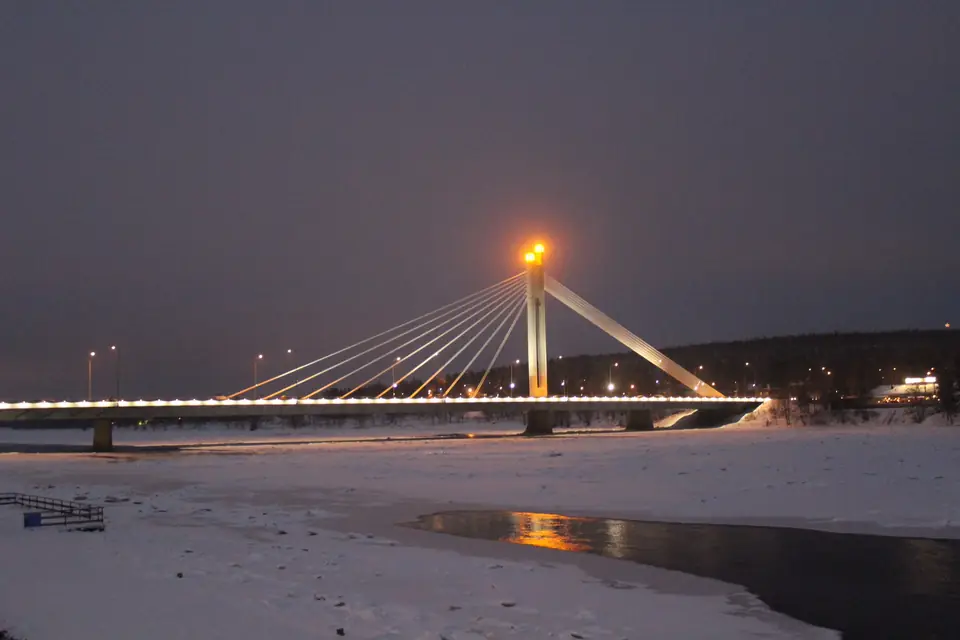
Cable-stayed bridge
Jätkänkynttilä Bridge Audio Guide
Two unequal pylons crowned by flames of light cross the Kemijoki in tribute to Lapland's lumberjacks: Finland's first cable-stayed road bridge, strung exactly where the post-war years had to put up a new bridge every spring.
- 20 min of audio
- 1989 cable-stayed bridge
The Jätkänkynttilä links the centre of Rovaniemi with the Ounasvaara hill, at the head of the Ounaskoski rapids. It was born from an invitation competition called in 1982 by the city and the Roads and Waterways Administration, to which four engineering firms submitted ten proposals. Finished in 1989, it was the first cable-stayed bridge for road traffic in Finland, a type the country had until then ruled out for economic and landscape reasons.
Its name began as an anonymous motto. The winning proposal was submitted as “Jätkänkynttilä”, the lumberjack's candle: the dry pine log sawn crosswise that burns from the inside and with which forestry workers warmed themselves and cooked in the woods. The bevelled tops of its two pylons imitate it, with one difference: its flame is electric. Light, not fire.
Highlights
- Pylon of two unequal legs — the taller one rises 47 metres above the deck
- Flames of light — bevelled tops that imitate the lumberjacks' log candle
- 126-metre main span — hung from eight pairs of fan-shaped stay cables
- Jätkänpatsas — the 1955 bronze lumberjack who wears a graduation cap every May Day
- Open water of the Kemijoki — resting place for thousands of migratory birds in spring
At night, from any point on the Rovaniemi riverbank, two flames can be seen hanging over the Kemijoki. They do not burn: they are the light that crowns the pylons of the Jätkänkynttilä, the lumberjack’s candle bridge, inaugurated in 1989 as Finland’s first cable-stayed road bridge. Its story begins much earlier, on a river down which logs had floated since the 1860s and which the city had to cross again, spring after spring, after the Second World War destroyed its bridges.
The story of the Jätkänkynttilä mixes engineering and forestry lore: a 1982 competition decided by more than price, a build with a Swedish contractor, Swiss cables and a German design audit, and an inauguration in which the rope was cut with a log-hewing axe. Its architecture comes down to a pylon of two concrete legs of different heights and a fan of stay cables that holds the main span; on the total length, sources disagree and range between 320 and 327 metres. What to see at the Jätkänkynttilä, and why these flames tell the story of a whole city, is best understood by crossing it on foot with the audio guide, researched stop by stop.
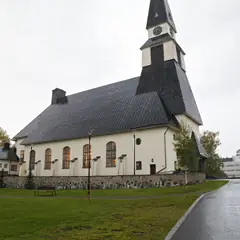
About 800 metres away stands Arktikum, with the models of the city before and after 1944, and on the site of the church that burned that autumn rises Rovaniemi Church.
The lumberjack who came before the bridge
Jätkänpuisto
Summary of this stop
The route starts at Jätkänpuisto, the park at the western end of the bridge. There, since 1955, stands the Jätkänpatsas, a lumberjack with the bark-peeling blade and the log of 1950s forestry work. It is the work of the sculptor Kalervo Kallio, son of President Kyösti Kallio, and was a gift from the company Kemijoki Oy. It arrived 34 years before the bridge it now watches over, and every May Day, vappu, it graduates again: the white student cap is placed on its head and the new graduates sing at its feet. In May 2026, to celebrate 20 years of Lordi’s Eurovision victory, the honest woodsman even woke up turned into a heavy-metal monster.
From here the bridge reads like a lumberjack’s tale. The anonymous motto that won the 1982 competition hid the office SuunnitteluKortes, of Oulu, with a team made up of Algot Kettunen, Esko Järvenpää, Pentti Pohjola and the draughtswoman Hilkka Kitinprami. That motto, “Jätkänkynttilä”, became the official name. The candle it evokes is a kelo log, a standing dry pine, sawn crosswise at the top; the Lusto forestry museum places it among the forestry workers of northern Finland, while an oral tradition attributes it to Swedish soldiers of the Thirty Years’ War. That is why some countries call it the “Swedish torch” and others the “Finnish candle”.
At the top, the ends of the two pylons are cut at a bevel like those candles and finish in an electric “fire”. What that light has to do with the men who worked in the woods is revealed by listening to the narration beside the bronze lumberjack.
A bridge that the thaw demanded every spring
Kemijoki under the deck
Summary of this stop
Now on the deck, the downstream footpath looks out over the Kemijoki, shortly after its confluence with the Ounasjoki. Below this exact spot there was another bridge, a much humbler one. After the river’s bridges were destroyed in the Second World War, between 1946 and 1951 a temporary trestle bridge was put up every spring, after the thaw. Some winters, the trains to Kemijärvi crossed the river on rails laid on the ice.
Down this same channel logs floated for more than a century. Log floating marked Rovaniemi’s summers until 1991, only two years after the bridge that commemorates it opened; since then timber travels by road and rail. The opening, on 28 September 1989, was a nod to the trade: a rope stretched from side to side was cut with a piilukirves, the broad log-hewing axe, once for each carriageway. It was done by the Transport Ministry’s permanent secretary Juhani Korpela and Mayor Matti Pelttari, with the Governor of Lapland Asko Oinas among those present.
The river, tamed by dams, does not always resign itself: in the flood of May 2015 the rapids roared again beside the bridge and kayakers surfed in the middle of town. What it was like to cross the Kemijoki before this deck existed is told in the audio guide from the railing.
The pylon that chose beauty over price
Two-legged pylon
Summary of this stop
At the foot of the pylon, the eye climbs two reinforced-concrete legs about 2.3 metres in diameter and of different heights. The taller reaches 47 metres above the deck. From it the 126-metre main span hangs in a fan, held by eight pairs of stay cables, while another eight parallel pairs run down to the abutment on the Ounasvaara side.
This pylon was a small revolution. Until then Finland had built only a few cable-stayed footbridges for pedestrians and cyclists, and the competition asked for a high-quality bridge in a landscape dominated by the Ounasvaara hill. The winning design cost more than a conventional one and was still built as proposed; Pekka Pulkkinen, an engineer at SuunnitteluKortes, places here the beginning of the idea that price should not be the only criterion for choosing a bridge in Finland. The work, begun in 1987, was international: Swedish contractor, Swiss cables, a German audit of the design and the support of the German engineering firm Leonhardt, Andrä und Partner.
This deck has also been a stage. On 4 June 2019 the final march of the national military parade crossed it with tanks and a self-propelled howitzer, before black edges of onlookers and under a downpour. What the Lapland sky did that day to the planned aircraft is revealed in the narration, at the foot of the pylons.
Water that does not freeze under the flames
Open water of the Kemijoki
Summary of this stop
Looking downstream, the Kemijoki shows its two faces. The stretch beside the bridge stays free of ice, and in spring it becomes a resting place for thousands of migratory birds, with rarities such as the glaucous gull, the common coot and the common shelduck. In winter, by contrast, the ice between the Jätkänkynttilä and the railway bridge is dangerous from end to end because of the strong current. In February 2026 the city asked that anyone seen on it be sent back to the shore, the same month a group of tourists on snowmobiles stopped one step from open water.
At the foot of the bridge, in Koskipuisto, the frozen river is not only something to look at. The winter swimmers of the association Ounasvaaran latu keep a hole open in the ice, and their volunteers alert one another by phone when a tourist wants to take a dip. That same corner is the traditional setting for the municipal New Year’s Eve fireworks: at the turn of 2022 to 2023, some 2,000 people watched them from the bank and the bridge itself jammed with people looking at the sky.
The route ends here, under the two flames that never burn. Why the water does not manage to close over at just this point, and what the swimmers found in the hole one New Year’s Day at almost 30 degrees below zero, is left for the narration beside the railing.