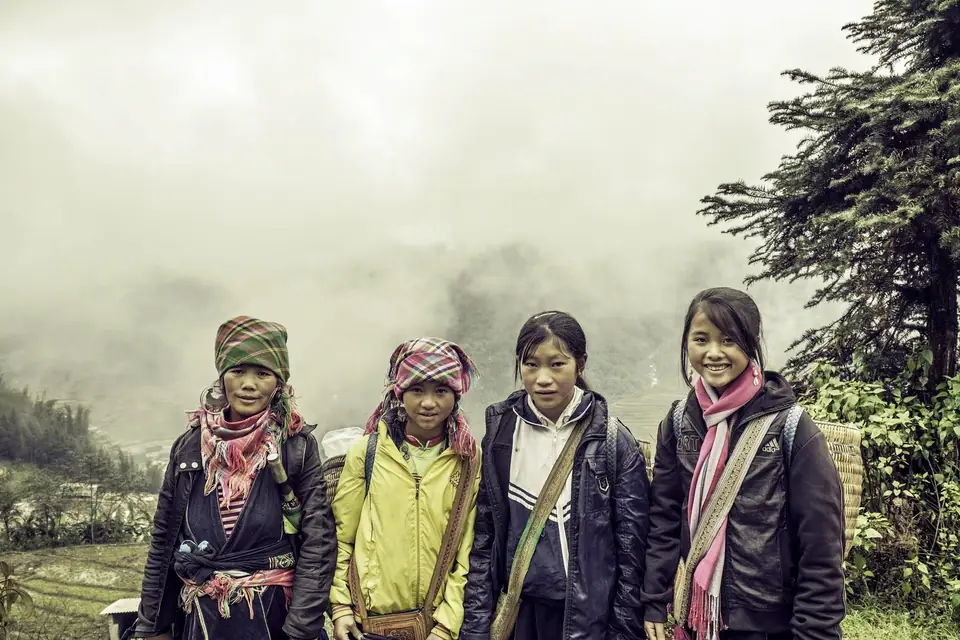
Black Hmong village
Cat Cat Village Audio Guide (Bản Cát Cát)
A 19th-century Hmong village at the bottom of a terraced valley, a waterfall named for fairies and a French power station that now serves as a stage. In Cát Cát, what is lived and what is performed share the same steps.
- 120 min of audio
- Hmong culture
- French colonial heritage
Cát Cát took shape in the mid-19th century as a Hmong village, and in the early 20th century the French chose it as a retreat for their officials. In 1925 they began a hydroelectric plant beside the Hoa stream that powered the telegraph and the French garrison of Sa Pa and that, after passing through the hands of Polish technicians, lit the town until 1993. Around it still stand the three-bay houses with pơ mu shingle roofs, raised on stone bases.
Since 2007 the tourist area has been run by a private company that pays craftswomen a wage to spin, weave and dye in view of visitors. The Vietnamese press presents it as a model of community tourism; some foreign observers speak of a fenced village with a ticket office, souvenirs brought in from outside and instruments that never sound. The visit plays out between those two readings.
Highlights
- Hmong pơ mu houses — three bays, three doors and a central one kept shut except for weddings, funerals and Tết
- Indigo workshop — leaves steeped for up to a week and patterns drawn with hot beeswax
- French hydroelectric plant — work begun in 1925, now a performance hall
- Steel power poles — one keeps a plaque dating it to 1925
- Tiên Sa waterfall — the 'descended fairy', between the Si and A Lứ suspension bridges
The story of Cat Cat Village fits into three successive trades: refuge, power plant and showcase. The Hmong settled this valley floor, beneath the Hoàng Liên Sơn range, in the mid-19th century. In the early 20th century the French colonial administration chose it as a retreat for its officials, and in 1925 it began building a hydroelectric plant beside the Hoa stream: cement and steel shipped from France by sea and carried up on shoulders over the mountain passes, to supply 50 kW to the telegraph and the garrison of Sa Pa.
The name itself is a small riddle. The most repeated version says Cát Cát is the French word “cascade” bent by local pronunciation; Giàng Seo Gà, former director of the district Cultural Centre, argues instead that the name is ancient and comes from the Hmong “ca ca”, “below the market”. There is no agreement on the plant either: the provincial press counts it among the first French hydroelectric stations in Indochina, while the chronology of the state utility EVN puts others in Cao Bằng ahead of it and places it among the northern ones built in 1927-1928.
What to see in Cat Cat, in short: a path of stone steps between shops and shingle-roofed houses, a workshop where flax is dyed with indigo over months, the old French machine house and the Tiên Sa waterfall with its suspension bridges. The audio guide covers those five stops in about 120 minutes, with documented narration that tells living custom apart from what is staged for tourists.
From Cát Cát set out, in 1984, the expedition that climbed Fansipan by the Hmong cardamom trail. On the far side of Sa Pa, in Muong Hoa Valley, the Hmong and Giáy rice terraces continue, and the other great French mark outside the town is the ruins of Ta Phin Monastery.
Stone steps toward the valley floor
Stone-stepped path
Summary of this stop
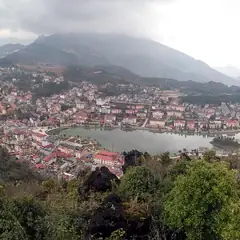
The visit begins at the top, where a paved path starts down toward the waterfall between houses and stalls selling indigo textiles, silver and souvenirs. Below, the rice terraces of the Mường Hoa valley step down the slopes. It is the first image of Cát Cát and also the most deceptive: part of what is sold at those stalls comes from outside the village.
Since 2007 the tourist area has been run by Công ty TNHH MTV Du lịch Cát Cát, founded by a woman who bought the business after an unprofitable spell under a state tourism company. That double nature, an inhabited village and a privately managed enclosure, explains much of what appears along the path. The clues for telling one from the other, in plain sight on the path itself, are unpacked in the narration from the very first step.
The door that opens only three times
Hmong house with pơ mu shingles
Summary of this stop
Traditional Hmong houses in Cát Cát have three bays, plank walls on stone bases and a roof of pơ mu wood shingles. Inside they hold an altar, a loft granary and a hearth. And they have three doors, although the central one stays closed: it opens only for weddings, funerals and Tết, the lunar New Year.
That door leads to one of the best-documented rites of the village, the funeral. Its telling begins with two shotgun blasts into the air, the signal everyone recognises as the announcement of a death, and goes on with a shaman, days of drum and khèn and gifts of rice, spirits and money measured with surprising precision. For one villager, Giàng A Chừ, the funeral serves above all to cheer the living. How that farewell ends, and what happens to someone who dies far from home, is told in front of the pơ mu house itself.
Flax, indigo and beeswax
Flax, indigo and wax workshop
Summary of this stop
In the workshop, Hmong women strip and splice flax fibre, weave on simple looms, dye in drums of indigo and draw patterns with hot beeswax. The process is slow: indigo leaves are steeped in water for three days to a week, crushed and mixed with lime to make the paste, and the flax is dyed many times in a cycle that can last months. The wax reserves the designs, which then show pale against the blue.
This space is recent. Around 2018 the food stalls beside the waterfall were removed and their place went to an area that recreates spinning, weaving, dyeing and wax drawing, with water wheels and bamboo bridges beside the stream. In 2023 Lù Thị Máy, almost 80 and considered the village’s best wax drawer, worked here daily, alongside the weaver Sùng Thị Vang, who had been on the company payroll for seven years.
The craft, however, goes beyond the workshop. According to local custom, every house has its loom and a Hmong girl marries in the dress she has woven herself. The role linen cloth plays at the end of life, and why it matters so much, is left to the narration beside the indigo drums.
From power plant to performance hall
Old French hydroelectric plant
Summary of this stop
Beside the waterfall stands the old French machine house, with remains of a turbine and generator. Its history is a chain of effort: cement and steel travelled by sea to Hải Phòng, by train to Lào Cai and from there on porters’ shoulders or horseback over the mountain passes; in October 1925 the French army mobilised porters and prisoners to build the dam. Along the path the steel power poles are still standing, rusted and mossy.
The plant stopped in 1953, when the generators were moved to Yên Bái to protect them; in 1960 Polish technicians from the Sa Pa Geophysical Station designed a new turbine and doubled its output, and after another upgrade in 1979 it lit two neighbourhoods in the town centre. It stopped generating in 1993, when the national grid arrived. The dam, the canal, the forebay and the steel pipe survive.
Today the interior serves as a stage for artistic shows aimed at tourists. In 2017 the researcher Seb Rumsby became curious about the qeej, the Hmong mouth organ hanging on one of its walls, and what he found by asking about it portrays like few things the debate over the authenticity of Cát Cát. The outcome of that inquiry is heard in front of the machine house.
Tiên Sa, the waterfall of the fairies
Tiên Sa waterfall
Summary of this stop
The waterfall drops in the middle of the village, where the Tiên Sa, Vàng and Bạc streams meet, and it is crossed by the Si and A Lứ suspension bridges, which serve as the entrance to the central area. Its name, Tiên Sa, means “descended fairy”. The legend told in Sa Pa says the fairies of the world above came down to bathe in this clear water, in the middle of the forest, and that something kept them here for good.
This corner is not quite what it was a few years ago either. In mid-July 2021, in the middle of the fourth COVID-19 wave, a flood swept away railings, stairs, the old-rose garden, the European garden and several stone works, with damage estimated at about 2 billion dong. Facing the water, the narration returns to the village’s name, between the French “cascade” and the Hmong, and tells what, according to the legend, kept the fairies from returning to the sky.