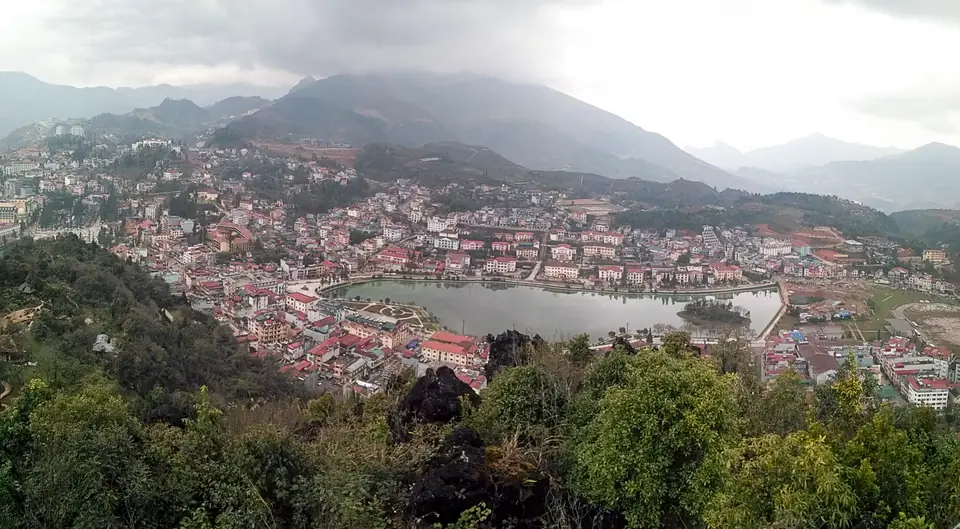
Viewpoint over Sa Pa
Ham Rong Mountain Audio Guide (Núi Hàm Rồng)
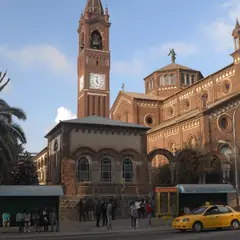
Behind Sa Pa's stone church, a mountain of crags outlines a dragon's head turned toward Fansipan. Below are flowers, orchids and a labyrinth of rocks; within, a love legend and a land dispute that ended with the grounds closed by force.
- 90 min of audio
- Mountain garden
- Dragon legend
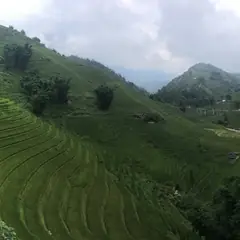
Hàm Rồng means 'dragon's jaw', and the name comes from the piled crags of the summit, which from afar form a raised head. The mountain rises southeast of the old town of Sa Pa, several hundred metres above it, and since 1996 it has gradually become a terraced garden: today the grounds, of about 150 hectares according to the most cited sources, are divided into the flower garden, the Thạch Lâm stone garden and the summit.
For years it was the town's standard visit: between 2014 and 2016 it was chosen by 70 to 75% of those who came to Sa Pa. And yet, at 7:00 on 12 December 2016 it closed its gates, when the province took back by force the land granted to a rubber company that had invested barely a tenth of what it promised.
Highlights
- Summit crags — the 'dragon's jaw' that names the mountain, turned toward Fansipan
- Orchid garden — almost 200 orchid species and more than 6,000 plants beside the stone stairway
- Thạch Lâm stone garden — a labyrinth of pillars and rock blocks among wild flowers
- Cổng Trời — the Heaven's Gate, a window between dark crags halfway to the summit
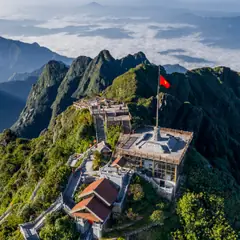
- Sân Mây esplanade — a 360° view over Sa Pa, the Hoàng Liên Sơn range and Fansipan
The story of Ham Rong Mountain can be told in three ways, and all three point to the same place. For the peoples of the mountains it is a petrified dragoness that still gazes toward Hoàng Liên Sơn. For Vietnamese tourism it was, for two decades, Sa Pa’s great draw: in the 2015 high season it received about 600,000 visitors, more than 15,000 a day. And for the administration it was an awkward file, that of an ecotourism project granted in 2009 that ended with the grounds closed to the public in December 2016.
Fame also came from abroad. In April 2015, the Huffington Post included Hàm Rồng among the 8 most impressive sunsets in the world, on the same list as the summit of Mauna Kea in Hawaii, Switzerland’s Torrenthorn or Mount Tamalpais in California, and warned that the entrance fee, about 70,000 dong, was worth paying at least once. Not even the height of the summit is settled: sources speak of about 1,700 m, of more than 1,800 m, of 1,836 m according to the organisers of the 2025 race and even of about 2,000 m, a figure that usually refers to the telecommunications station at the top.
What to see on Ham Rong Mountain, in short: a stairway of natural slabs that starts behind the stone church, a flower garden with an orchid house, the Thạch Lâm rock labyrinth, Heaven’s Gate and, above, the Sân Mây esplanade facing Fansipan. The audio guide covers those five stops in about 90 minutes, with documented narration that separates legend from what is verified. A warning the mountain has already given: in November 2025, night and thick fog made a young Japanese tourist lose the trail at the cardamom garden, and Sa Pa police had to go out to look for him. They found him safe and sound around 21:00.
The stairway starts behind the Sa Pa Stone Church; at the top, the Sân Mây esplanade looks straight at Fansipan, and its Heaven’s Gate shares a name with that of O Quy Ho Pass, on the other side of the range.
A dragon’s jaw behind the church
Stairway of natural slabs
Summary of this stop
The route starts at the foot of a stairway of natural slabs, flanked by lawn, that climbs the slope just behind the stone church. From here the mountain reads like an animal: above, the group of piled crags that, seen from the town, forms a raised dragon head. That silhouette gives it its name, Hàm Rồng, the “dragon’s jaw”.
The position explains much of its success. The mountain lies southeast of the old town of Sa Pa, which sits at about 1,500 m, and exceeds it by several hundred metres, with the summit facing Fansipan. That is why for years it was the excursion almost everyone made in Sa Pa: between 2014 and 2016, 70 to 75% of the town’s visitors climbed these slabs. Exactly where that stone head looks, and why it matters, is what the narration reveals at this first point.
Orchids above the hotel the war flattened
Vườn lan orchid garden
Summary of this stop
A little higher, the Vườn lan orchid garden spreads across houses and terraces beside the stone stairway. It gathers almost 200 orchid species and more than 6,000 plants, and is part of the terraced garden begun in 1996 to make use of the mountain’s natural and cultural value. From the terrace of Vườn lan 1, the stone church peeks out among the sa mu cypresses, with the lake and the town at its feet.
That lakeshore holds a dark chapter. In 1932, when Cha Pa was the fashionable summer resort of Hanoi colonial society, the Métropole hotel opened at the foot of Hàm Rồng, a luxury establishment with 50 rooms and ten suites. It lasted fifteen years: in February 1947 the Viet Minh attacked Cha Pa and destroyed military installations, villas and part of the hotels, among them the Métropole. What came after, in 1952, completely changes how you look at the town from among these flowers, and the audio guide tells it facing that same shore.
Thạch Lâm, the stone body of the dragoness
Thạch Lâm stone garden
Summary of this stop
The Thạch Lâm stone garden is the second of the three zones of the grounds, between the flower garden and the summit. It is a forest of pillars and rock blocks, with hundreds of stones and wild flowers, crossed by narrow corridors that work like a labyrinth.
Here the legend takes shape. According to a documented tradition, when sky and earth were so close that one could climb up by a ladder, a deeply devoted pair of dragons lived at the foot of Hoàng Liên. A great flood burst the Hùng Hồ vein and a torrent of water, mud and stones separated them: the male was swept away by the Mường Hoa and the female was trapped in a rock crevice. The tale has several endings, and in one of them the dragoness’s body becomes an entire mountain range. Which one is told among these rocks, and what remains of her on the mountain, is discovered in the narration right there.
Cổng Trời and the company that lost the mountain
Cổng Trời
Summary of this stop
Halfway to the summit, Cổng Trời, Heaven’s Gate, is a passage between dark crags that frames the sky and the valley like a natural window. The path that reaches here, widened and landscaped, has a real dispute behind it.
On 2 July 2009, Lào Cai province granted the Hàm Rồng ecotourism project, of 146.27 hectares and 496.629 billion dong, to Harutour, a subsidiary of the Vietnam Rubber Industry Group, with a commitment to finish in 2012. By the end of that year only 5.8% of the investment had been carried out, and in 2016 barely 10%, more than 36 months behind schedule. The company renovated the hotel and the stilt houses, widened the path, planted trees and flowers and built a new viewpoint toward Fansipan, little more. After two provincial decisions in 2016, the grounds stopped receiving visitors at 7:00 on 12 December of that year and Sa Pa district ordered ticket sales to stop. How that closure was lived at the town’s number-one attraction is part of what you hear beneath this arch.
Sân Mây, face to face with Fansipan
Sân Mây esplanade
Summary of this stop
The highest accessible point of the route is the Sân Mây esplanade, the “courtyard of the clouds”, with a 360° view over Sa Pa, the Hoàng Liên Sơn range and Fansipan. Many mornings it sits above a sea of mist. Here, on 1 May 2025, ended the uphill summit race, almost 2 km from the ethnic stilt houses at the foot of the mountain.
The summit is still a sacred place. For a long time, every Tết, the lunar New Year, the elders and clan heads of the Mông, Giáy, Xá Phó and Dao climb Hàm Rồng to remember the love of the pair of dragons and to ask for favourable rains and winds for the land. The Mông, moreover, tell their own version, in which Fansipan and this mountain would be dragons with very different fates.
Against that ritual comes another future. After years of neglect, with the change of manager and COVID, the grounds are recovering: over the 30 April to 1 May 2025 holiday they received more than 4,000 visitors, 30% more than in 2024. In 2021 the province chose as investor of the project “Hàm Rồng Mountain National Landscape” the consortium of the Fansipan cable car company and Đầu tư Tây Bắc, and the general plan of Sa Pa to 2040, approved in 2023, turns it into a botanical park of endemic species and provides for a cable car from the former stadium in the centre. What relationship Hàm Rồng and the roof of Indochina have in Mông legend is the closing the audio guide keeps for this esplanade.