French colonial architecture
Sa Pa Stone Church Audio Guide (Nhà thờ đá Sa Pa)
The French built it for their holidaymakers and then bombed the town around it. It stayed standing, and today its hymns are sung in Hmong.
- 30 min of audio
- Colonial architecture
The parish was born in 1902 with the Paris Foreign Missions, but the Sa Pa Stone Church, dedicated to Our Lady of the Rosary, was slow to arrive: work began in 1925 and was not finished until 1935, because the material had to be carried up to a mountain station at 1,500 metres. Walls, floors and tower are of cut stone blocks joined with sand, lime and cane molasses. It is a narrow nave, 7.6 by 39 metres, with its back to Hàm Rồng mountain and its door toward the sunrise.
Its history is that of a survivor. In March 1952 French aircraft almost completely flattened the Sa Pa the French themselves had built, and the church remained standing. It spent decades empty and without a priest of its own, until its restoration in 1995. Today it is filled by a congregation of more than 2,100 faithful, almost 90% Hmong, who pray the rosary in their own language.
Highlights
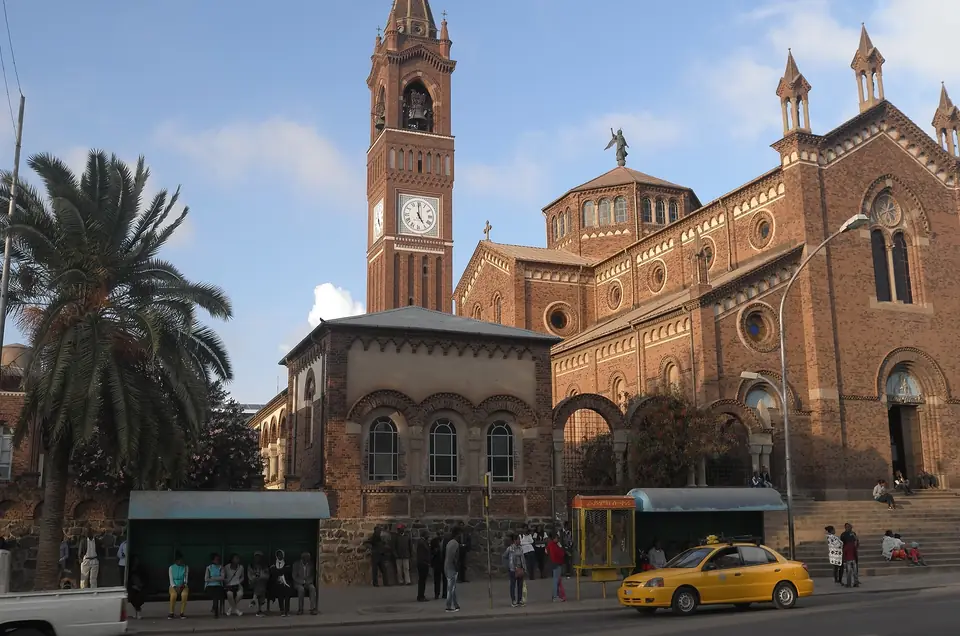
- Stone facade — pointed arches and an eastern portal, with its back to Hàm Rồng mountain
- Walls and fences — stone blocks joined with sand, lime and cane molasses
- Bell tower — a bronze bell cast in 1932, with its original inscription
- Nave windows — the life of Christ and the mysteries of the Rosary
- Front square — setting of the Saturday-night Hmong and Dao gathering
Between 1924 and 1940, the colonial administration in Hanoi turned a corner of northern Vietnam, at 1,500 metres of altitude, into its summer retreat: some 100 villas and, in the centre, a church. The French called it Chapa. Little of all that remains, and what remains has the texture of grey stone. The Sa Pa Stone Church, the Nhà thờ đá of the postcards, is the most recognisable building in the town, and also the most misunderstood: many take it for a colonial backdrop, when it is in fact a living parish and one of the few structures that withstood the war.
The history of the Sa Pa Stone Church begins in 1902, when priests of the Paris Foreign Missions founded the parish under Bishop Paul Ramond, whom the Vietnamese called Phaolô Lộc. The church was begun in 1925 and finished in 1935, although the date is far from unanimous: some media and travel sites move it back to 1895, before the parish even existed, others give 1926 and one confuses the end with the beginning. After came abandonment, a murdered parish priest, the bombing of 1952, the restoration of 1995 and a Hmong community that has filled the nave with songs in its language. The audio guide, documented and checked against historical sources, follows that survivor’s life in four stops, from the square to the nave.
Right behind the chevet rises Ham Rong Mountain, and on the edge of town the ruins of Ta Phin Monastery tell another chapter of the French Catholic presence in these mountains.
The square that was the heart of a holiday town
Church square and facade
Summary of this stop
The front esplanade is the best place to understand what to see at the Sa Pa Stone Church before approaching its walls. Nothing about its site is chance: the church leans with its back against the slope of Hàm Rồng mountain, which rises behind the chevet like a natural backrest, and its door faces east, toward the sunrise.
From here you can also make out its fellow survivors. The old Chu Cau mansion, now the Hoàng Liên Hotel, and the former district office, turned into a tourist information centre, form with the church the trio of French buildings still standing in the centre of Sa Pa. Three loose pieces of a mountain station that once had a hundred villas. Why precisely these three survived is one of the questions the narration answers on the spot.
Stone blocks, lime and molasses
Stone fence of the compound
Summary of this stop
The architecture of the Sa Pa Stone Church is explained by its nickname. Walls, floors and tower are cut stone blocks joined with a mortar of sand, lime and cane molasses, the same recipe that closes the compound’s fences, some 6,000 m². On the facade the blocks are more regular than at the back, and the work dragged on for over ten years because supplies came from very far away.
Behind that patience stands a character. Before the first stone was laid, the Breton François-Marie Savina, of the Paris Foreign Missions, worked with the Hmong of Lào Cai and lived until 1925 among several ethnic groups of northern Vietnam. He published a Miao-French dictionary in 1916 and in 1924 a Histoire des Miao, where he recounts that the Miao themselves, as the French then called the Hmong, asked him to be their king, and that he refused. Vietnamese historiography places him among the key figures in the arrival of Catholicism among the Hmong of Sa Pa: the man who could have been king preferred to be a lexicographer.
A bell that survived the bombs
Bell tower and bronze bell
Summary of this stop
Under the bell tower, visible from all four sides of the centre, hangs a bronze bell cast in 1932 that still keeps the inscription with the foundry and the date. Its measurements are also disputed: some sources give a tower of 18 metres and a bell of 300 kg; others, 20 metres and 500 kg.
The bell witnessed the worst years. Around 1947, or in 1948 according to other sources, Father Ydiart Alhor Jean, the last parish priest of the Paris Foreign Missions, was murdered; a disputed version holds that he was beheaded inside the church itself. The war emptied the town and the church, and in March 1952 French aircraft almost completely flattened the Sa Pa the French had built. The church was left standing. What came after, with believers who, it is said, lived their faith in secret for decades, takes on another weight when heard beneath this tower.
The nave where the rosary is prayed in Hmong
Nave and Rosary windows
Summary of this stop
After the bustle of the square, the narrow nave imposes recollection. Along the side walls, coloured windows show scenes from the life of Christ and the mysteries of the Rosary, to whom the church is dedicated. Badly damaged by the war, it was restored in 1995, after the re-establishment of Lào Cai province, and reopened for worship. In May 2006 Sa Pa regained a resident parish priest, after almost 60 years without a priest of its own.
Today the parish counts more than 2,100 faithful, almost 90% ethnic Hmong, spread between Sa Pa and the communities of Hầu Thào and Lao Chải, founded in 1927. The rosary is prayed in Hmong, the diocese has compiled a prayer book in Hmong script and at weekends children sing the hymns in their language. Outside, in the compound, the music also changed hands: in 2004 a Hmong couple from Tả Phìn, some 20 km away, came up every Saturday with a khèn and a jaw harp to sing beside the church, while the so-called love market, a name tourists gave to a custom that was annual, became a weekly gathering in the square. How that French nave and that mountain language sound together is the end of the route.