Roof of Indochina
Fansipan Audio Guide (Phan Xi Păng)
Vietnam's highest summit is now reached in about twenty minutes by cable car, but at the top wait a stainless-steel pyramid that marks a height four metres short, a copper Buddha that was never gilded and a ridge the Hmong call a dragon's horn.
- 120 min of audio
- High mountain
- Buddhist complex
Fansipan crowns the Hoàng Liên Sơn range at 3,147 m. Its rock formed between 250 and 260 million years ago, at the Permian-Triassic boundary, and Himalayan mountain-building later lifted it along with the whole range. For almost a century reaching the summit was a matter of days: French non-commissioned officers in 1905, expeditions with pyramids on their backs in the 1980s and Hmong guides cutting a path with machetes from 1988. In 2016 a Guinness-record cable car changed the scale of the journey, and in 2018 a Trần-style Buddhist complex was consecrated at about 3,000 m.
The figure engraved on the summit pyramid, 'FANSIPAN 3,143m', is no longer the official one. The French measured it in 1909 and it stood for 110 years, until a Vietnamese GNSS survey in 2019 added about 4 m. The object everyone photographs at the top, paid for by a travellers' forum and carried up on shoulders in the middle of a cold snap, has fallen short of the mountain it marks.
Highlights
- Fansipan cable car — two Guinness records: 6,292.5 m without stops and 1,410 m of vertical drop
- Great Amitabha Buddha — 21.5 m of copper plates assembled on the summit and left ungilded
- Path of the arhats — 18 bronze figures of 2.5 m between the pagoda and the great Buddha
- Kim Sơn Bảo Thắng Tự — a Trần-style pagoda with an 11-storey stone stupa
- Summit pyramid — 27 kg of stainless steel bolted to the rock, marked 3,143 m
The story of Fansipan is that of a mountain that has gradually drawn closer. In 1905 two French non-commissioned officers reached the summit about two months apart: Sergeant Denis, of the group of Captains Scherdlin and Benoit, climbed in three days and marked the highest point with three hunting bullets driven into a large rock in a triangle; around 1 October Sergeant Dollo, of Lieutenant Bourély’s geodetic mission, arrived after eight days of marching through fog. More than a century later, the same climb is covered in about twenty minutes by cable car.
The name is not settled either. The most accepted version derives it from Hủa Xi Pan, “the great stone slab in unstable balance”, after the silhouette of the summit, and from that would come Fansipan and Phan Xi Păng. Another reading translates it from Hmong as “mountain of the azaleas”, and a third links it to Phan Văn Sơn, a geographer-official of the Nguyễn dynasty who in 1905 accompanied the French in marking the border with China. Something similar happens with the nickname: “roof of Indochina” is accurate if you mean the former French Indochina (Vietnam, Laos and Cambodia); if you take the whole peninsula, the title belongs to Hkakabo Razi, in Myanmar.
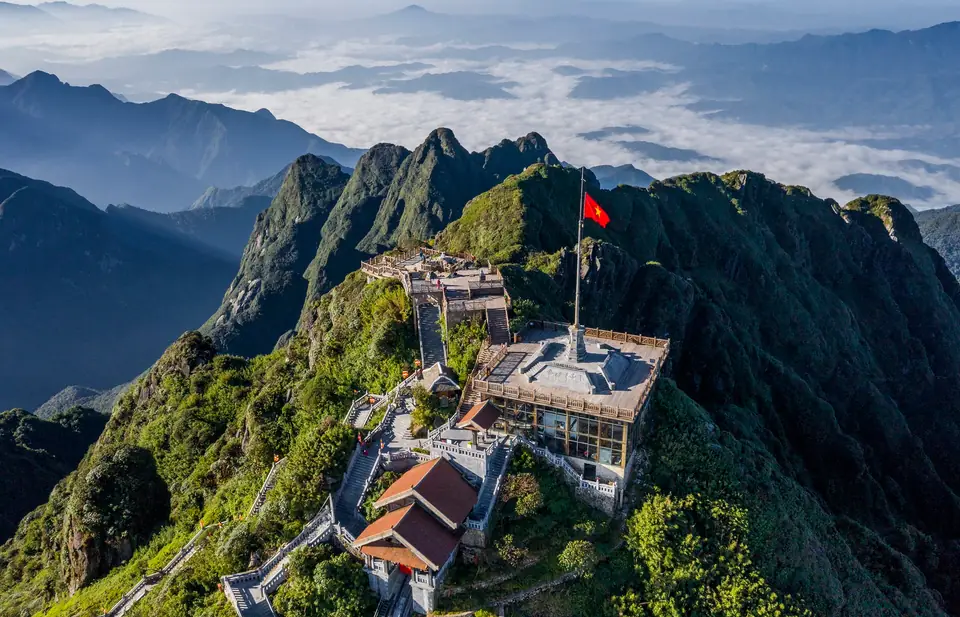
What to see at Fansipan, in short: a cable car that crosses the Mường Hoa valley above an untouched forest, a medieval-looking pagoda consecrated in 2018, a stairway of bronze arhats, a giant copper Buddha and, at the very top, a metal pyramid with an outdated figure. The audio guide covers those five stops in about 120 minutes, with documented narration that separates legend, testimony and verified fact.
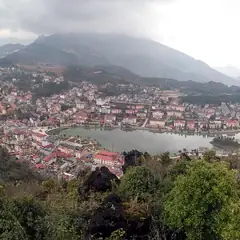
From the Sân Mây esplanade on Ham Rong Mountain the summit is seen head-on; the 1984 expedition set out from Cat Cat Village, and the terraces you cross in the cabin are those of Muong Hoa Valley.
Six kilometres of cable without felling a tree
Cable car cabin
Summary of this stop
The Fansipan cable car was built by Sun Group with Doppelmayr Garaventa from November 2013 and opened on 2 February 2016. It holds two Guinness records: it is the longest non-stop tri-cable car in the world, at 6,292.5 m, and the one with the greatest elevation difference between stations of its type, 1,410 m. Its cabins, with 30 to 35 places, climb in about 20 minutes what used to cost one or two days on foot, and from them you see the rice terraces and villages of the Mường Hoa valley beneath the four steel pylons, T1 to T4.
The record figure is what impresses, but the story lies in how the line was strung. The developer forbade felling the national park forest, and the winds of the Ô Quy Hồ pass ruled out helicopter and balloon. So workers passed a first 6 mm guide rope by hand, and crossing the ravine between tower T3 and the arrival station took them a month. The logistics cable ran from January 2015 and the four main pylons rose in the following three months. What happened in that jungle while the line was being laid out, with lost surveyors and races against poison, is left to the narration in the cabin itself.
Three days on foot turned into twenty minutes
Cable car arrival station
Summary of this stop
The terrace of the arrival station is the place to measure what the cable saved. In October 1984 Hà Văn Khuyên, an employee of the Sa Pa district Culture office, guided an expedition of 50 people, 17 of them foreign specialists from Poland, Hungary and Bulgaria. They left the village of Cát Cát by the Hmong cardamom trail, took three days and cemented a three-sided duralumin pyramid on the summit that a Hmong porter had carried up on his back. In 1988 Má A Chơ, son of the cardamom grower who had guided the reconnaissance of the summit, led at 18 the first group of tourists, some Russians, on a three-day, two-night climb cutting the path with a machete. In many Hmong families in Cát Cát, several generations have lived from accompanying travellers to the summit.
The cable changed that trade. In 2016, months after the opening, the Hmong guide Ma A Tro said at the summit that the porters of his village had lost their regular work and become construction labourers, and he denounced that the government had ignored the opposition to the cable car. Má A Chơ saw his groups dwindle and opened a homestay at the foot of the mountain, right under the line. Hà Văn Khuyên, who rode in the first cabin, argues instead that the project preserved the “soul” of the mountain and was the backbone of Sa Pa’s tourism take-off. And the forest you see from above has its dark side: it has also kept people who got lost a few hundred metres from the cable, stories the audio guide tells at this point.
A Trần temple born in 2018
Kim Sơn Bảo Thắng Tự pagoda
Summary of this stop
Kim Sơn Bảo Thắng Tự looks ancient and is not. Work began in late 2015, and on 30 January 2018, at 2 °C on the summit, the Central Committee of the Vietnam Buddhist Sangha consecrated the Fansipan spiritual complex before 500 worshippers. The pagoda is of wood and stone in Trần style, with restored old tiles, a main hall of jackfruit-wood images and an 11-storey solid-stone stupa inspired by the Phổ Minh tower. In the same complex stands the eight-eaved bell tower Vọng Lĩnh Cao Đài.
In a few years the new temple has gained living rites. At the great Buddhist festivals, such as that of Quan Âm on 1 and 2 November 2023, worshippers lit hundreds of lamps that formed a lotus of 12.5 by 9.8 m before Bảo An Thiền Tự, beside the station, and the next day, dressed in blue-grey, they processed around the great Buddha, descended the path of the arhats and finished by offering incense in this pagoda. From 22 to 24 March 2026, moreover, the courtyard of Bích Vân Thiền Tự hosted the fifth edition of the hầu đồng gathering, the possession rite of the Mother Goddesses worship, UNESCO Intangible Heritage since 2016. Which spirit the mediums danced there at 3,000 m is discovered by listening to the narration in the courtyard.
An ungilded Buddha before the dragon’s back
Great Amitabha Buddha
Summary of this stop
A stairway flanked by 18 bronze arhats of 2.5 m joins the pagoda to the great Amitabha Buddha. It stands 21.5 m and in 2018 was the largest bronze statue in Vietnam, but it did not come from a workshop: the team of the architect Hoàng Đạo Kính assembled it from thousands of 5 mm copper plates worked on the mountain itself, over an iron frame of almost 1,000 m³. It was left dark, ungilded, so it would not dominate the landscape, and it stands out against the ridge and the mist on a stone pedestal carved with lotus flowers.
Facing the statue stretches the Hoàng Liên Sơn ridge, with Lai Châu on one side and Lào Cai on the other when the mist opens, and with slopes of dwarf bamboo and rhododendrons above 2,800 m. For the Hmong of Sa Pa, who call the summit Huồ Sì Páng, “the stone slab”, that succession of peaks is something else: according to their tradition, giants who were opening land for their people chased a one-horned dragon, whose body became the range and whose horn is this peak. What became of the little dragon that woke late, and why it can be seen from the centre of Sa Pa, is revealed by the narration before the Buddha.
The stainless-steel pyramid that reads 3,143
Fansipan
Summary of this stop
The target of the summit photo is a stainless-steel pyramid 90 cm high on a triangular base of 60 cm, weighing 27 kg, bolted to the rock with its apex pointing north. On its three faces are engraved the emblem of the national flag and the legend “FANSIPAN 3,143m”. That is the height the French measured in 1909 and which was official for 110 years, until on 26 June 2019 the Vietnam Department of Surveying, Mapping and Geographic Information presented in Hanoi a new measurement by GNSS, levelling and local geoid: 3,147.3 m. The pyramid has fallen 4.3 m short.
Its origin is far from official. It was born on the travel forum Box Du lịch of Trái tim Việt Nam online: Lê Hồng Quang gathered 10 million dong in under a week and the metallurgical engineer Tuấn “moctui” ruled out titanium for fear of theft and chose S303 stainless steel. On 26 January 2008 it was handed over to the national park, and Tuấn and four park employees carried it for two days in a record cold snap. It is, according to sources, the fifth marker to crown the summit, although which was the first depends on whom you ask: some attribute it to Polish geologists around 1960, some to the international expedition of 1984 and some to Soviet engineers. How long it took to bolt it to the rock, and what has happened to its original finish over the years, is told in the narration beside the pyramid.