Roman theater
Amman Roman Theater Audio Guide
Forty-four rows carved into the slope of Jabal al-Jofeh for some 6,000 spectators: Jordan's largest ancient theater was the staircase of an imaginary pharaoh, a home and quarry for the Circassians who founded modern Amman, and today fills again with concerts.
- 45 min of audio
- Roman Philadelphia
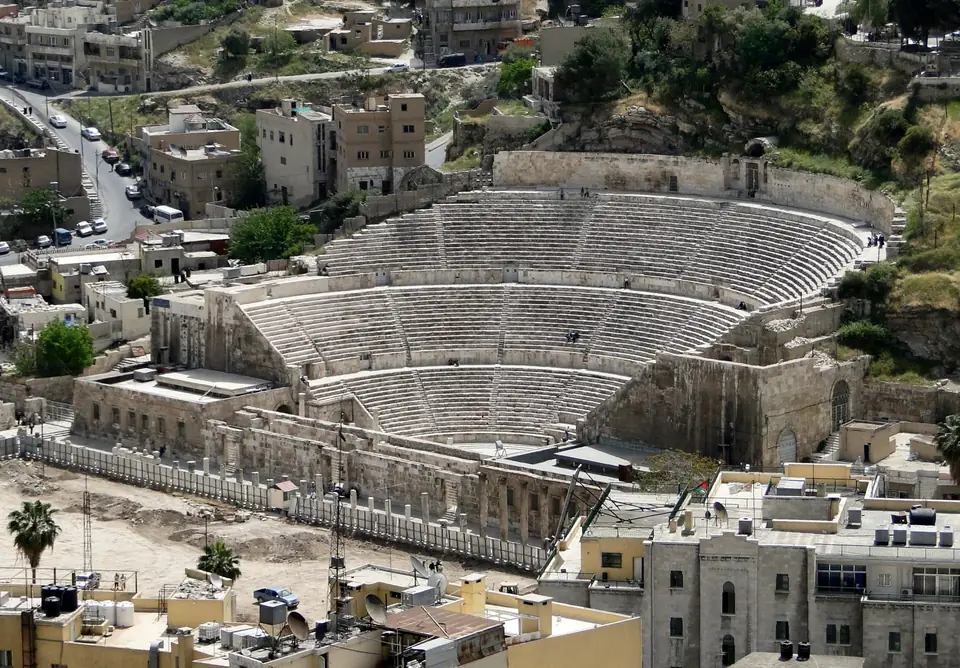
The Roman theater of Amman was built in the second century, when the city was called Philadelphia, and a Greek inscription on one of the column pedestals dedicates it to the emperor Antoninus Pius. Its cavea faces north, so the stage received the sun all day while almost the whole audience sat in shade. Opposite it, a row of Corinthian columns recalls the city's forum, and to one side the Odeon survives, a smaller auditorium for music, poetry and debates.
Before it was restored, the people of Amman did not see a theater here: they called the buried tiers “the Pharaoh's Staircase”. In 1877 the archaeologist Selah Merrill spent part of a night among owls, bats, donkeys and goats, and a year later the first Circassian refugees settled in its galleries and carried off its stones to build the houses that would be the embryo of the capital.
Highlights
- Cavea of 44 rows — carved into the slope of Jabal al-Jofeh for some 6,000 spectators, the largest ancient theater in Jordan
- Centre of the orchestra — an exact spot where a normal voice returns a piercing echo toward the tiers
- Niche shrine — a small temple at the top of the cavea, linked to a statue of Athena now in the Jordan Museum
- Forum colonnade of Philadelphia — remains of a 100 × 50 m square that ranked among the largest of the Empire
- Odeon and museums in the vaults — a 9-row auditorium, folklore, Bedouin jewellery and mosaics from Madaba and Jerash
In the second century, Amman was called Philadelphia and was a Roman city with a forum, a theater and a temple of Hercules on the hill opposite. Of that redevelopment its most imposing work still stands: a theater carved into the slope of Jabal al-Jofeh, with 44 rows in three sectors and room for some 6,000 spectators, more than the South Theater at Jerash, which holds between 4,000 and 5,000. A Greek inscription dedicates it to Antoninus Pius (138–161 AD), and the most repeated date is around 140, although other datings place it in the years of Marcus Aurelius, between 169 and 177, or more generally at the end of the second century.
The history of the Roman theater of Amman does not end with Rome. Its tiers were a ruin with no classical name, a “pharaoh’s staircase” for the locals, a refuge and quarry for the Circassians who arrived in 1878 and, since the restoration begun in 1957, a stage once more. What to see at the Roman theater of Amman, how its architecture works and who lived in it in each age is what the audio guide unpacks in four stops and 45 minutes, from the square to the last row.
Above, at the top of the hill, rise the columns of the Great Temple of the Amman Citadel, and across the square begin the souks of downtown Amman, beneath whose streets the baths of Roman Philadelphia still lie buried.
One of the Empire’s great squares, beneath a garden
Hashemite Plaza
Summary of this stop
The landscaped esplanade that opens in front of the theater, Hashemite Plaza, covers 20,000 square metres and was renovated in 2014. Beneath that urban-park look lay the forum of Philadelphia, a square of 100 by 50 metres that ranked among the largest of the Empire; the row of Corinthian columns and the stretches of Roman paving opposite the tiers are what remains of its porticoes. Who promoted it is unclear: one version attributes it to the emperor Commodus and others simply place it within the second-century redevelopment. On the east side of the square stands the Odeon, a second-century auditorium for about 500 people in 9 rows, devoted to music, poetry and debates and probably covered with a wooden roof.
The ground of the square held something far older. In 2010 an emergency excavation in front of the theater uncovered a colossal basalt statue of 2.10 metres and some 2 tonnes: a dead, deified Ammonite king, carved around 850–825 BC, almost a thousand years before the tiers. And the square was not always empty: from 1928 the Philadelphia Hotel stood here, the city’s first modern hotel, with a swimming pool, a tennis court and Amman’s first nightclub. How a single sentence from King Hussein, in 1986, was enough to wipe it off the map is the story with which the narration opens the route.
The Pharaoh’s Staircase and its neighbours
Museum vaults
Summary of this stop
In the side passages that flank the stage, the theater can be walked as what it was for centuries: an inhabited ruin. Popular tradition has it that, when the cavea lay under heaps of earth, dry grass and dung, the locals called the tiers “the Pharaoh’s Staircase”. In 1877 the American archaeologist Selah Merrill spent part of a night here, among fallen stones, owls, bats, peasants, donkeys and goats. A year later, in 1878, the first Circassian refugees sent by the Ottoman authorities, of the Shapsug tribe, settled in these galleries and around them, and carried the theater’s stones to the houses they built: the embryo of modern Amman.
What is seen today is largely the work of the twentieth century. The full restoration began in 1957, under the Department of Antiquities, to return the theater to performances, but it was done with non-original materials, so much of the present cavea is a partly inaccurate reconstruction. The vaults beneath the tiers, on both sides of the stage, house two small museums: the Folklore Museum, with mannequins of traditional trades, and the Museum of Popular Traditions, with costumes, Bedouin jewellery and mosaics brought from Madaba and Jerash. How the theater went from being a home for goats and Circassians to a restored stage is what the audio guide tells beside these vaults.
The echo at the centre of the orchestra
Centre of the orchestra
Summary of this stop
At the foot of the tiers opens the orchestra, a semicircle of 13 metres radius. At its exact centre, a normal voice directed toward the cavea acquires a piercing echo that disappears as soon as one steps away from that point. According to a popular legend, an offering was made to Dionysus, god of festivity and theater, at that very spot before each performance. From here the design of the whole is understood: the cavea faces north, so the stage receives sun all day while almost the whole audience stays in shade.
What is missing counts too. The stage building was some 100 metres wide and probably had three storeys, higher than the forum columns, and the wooden stage stood a metre and a half above the orchestra; today only the platform remains and the absence of that façade can be guessed at. The theater, however, has recovered its function: every August it hosts the Al-Balad Music Festival, as well as the Amman International Book Fair and the prize-giving of the Amman Marathon, and in August 2019 the American rapper Russ gave a concert here. Why the sound concentrates at precisely that point is what the narration explains on the spot.
The lowest-ranking seats, with the best views
Niche shrine
Summary of this stop
In the 44 rows, social rank fixed the seat. The lower rows were reserved for rulers and notables, while the city’s poor, foreigners, slaves and women were relegated to the upper sector. Above the last row opens a small shrine with niches; according to the most widespread version, it housed a statue of the goddess Athena now on display in the Jordan Museum, although another holds that its dedication is unknown and that only part of that statue turned up during the clearing.
From the top of the cavea the hill of the Citadel can be seen opposite, with the columns of the temple of Hercules. Legend has it that the first staircase of Amman was Roman: a flight of steps that climbed from the theater to Jabal al-Qal’a and that the locals gradually dismantled to build their houses. What can be glimpsed from the slaves’ row, and why that was the best place in the theater, is kept for the end of the route.