Hashemite memorial
King Abdullah I Mosque Audio Guide
A 35-metre blue dome resting on not a single column, ringed by the 99 names of God: the memorial that King Hussein raised in Abdali for the grandfather he saw fall beside him in Jerusalem.
- 40 min of audio
- Dome without columns
The King Abdullah I Mosque is the memorial to the founder of the Hashemite kingdom. King Hussein bin Talal laid the foundation stone on 5 June 1982 and conceived it as a complete Islamic cultural centre, after an architecture competition won by Jan Čejka. It was built in two phases, finished in 1986 and 1989, and is one of the few mosques in Amman that openly welcome non-Muslim visitors.
Abdullah I was shot dead on 20 July 1951 at the Al-Aqsa Mosque, as he went to Friday prayer with his grandson Hussein, then 15 years old. According to the account, a medal the grandfather had given him deflected the bullet that struck the boy. Three decades later, that grandson, by then king, commissioned this dome in his memory.
Highlights
- Blue mosaic dome — 35 metres in diameter and 31 high, visible from several hills of Amman
- Octagonal prayer hall — 1,615 m² for 3,000 worshippers, with no interior column
- The 99 names of God — Kufic calligraphy in blue marble around the drum of the dome
- Chosen verses — inscriptions in dialogue with the neighbouring Parliament and Coptic Patriarchate
- Islamic Museum — photographs, manuscripts and personal mementos of Abdullah I
In Abdali, between the Parliament, the Ministry of Education and the Coptic Orthodox Patriarchate, a dome of turquoise mosaic can be seen from several hills of Amman. It is the King Abdullah I Mosque, the memorial that King Hussein bin Talal dedicated to his grandfather, the founder of the Hashemite kingdom, assassinated in Jerusalem in 1951 with his grandson at his side. The foundation stone was laid in a grand ceremony on 5 June 1982, the 12th of Shaban 1402 of the Hijri calendar, and the project was born as a complete Islamic cultural centre: prayer hall, library, Quranic school, women’s prayer room and a small museum.
The authorship of the design has its nuance. The architecture competition was won by Jan Čejka, born in 1933 in Vysoké Mýto, in present-day Czechia, although some records attribute the project to the Jordanian Rasem Badran. Nor do the dates agree between sources, because the work was done in two phases: 1982-1986 and 1988-1989. What to see at the King Abdullah I Mosque, the history that explains its existence and the architecture of a dome that holds itself up is what the audio guide unpacks in four stops and forty minutes, from the marble courtyard to the museum’s wing of mementos.
The memorial remains alive: in Ramadan its Islamic Cultural Centre hosts Quran memorisation contests, and on 20 March 2025 the 32nd edition of the Hashemite International Competition for Memorisation and Recitation of the Holy Quran got under way here, with 54 participants from 51 countries.
The man it honours had built in 1924 the Grand Husseini Mosque of the centre, and his grandson Hussein spent his childhood on Rainbow Street, at the top of Jabal Amman.
A silhouette raised in two stages
King Abdullah I Mosque
Summary of this stop
Facing the blue dome, the complex looks of a piece, but it is not. The first phase ended on 6 January 1986 and left standing the courtyard, the hall and the main dome, the library, the Quranic school, the royal maqsura, the first minaret and the women’s prayer room. The second, from 1 February 1988 to 5 April 1989, added the great central chandelier, the lighting for television, the minbar, the wooden lattices, the carpets, the decorated plaster ceilings and, opposite what was already built, a second minaret and a new smaller dome.
That silhouette ended up in Jordanians’ pockets. Since 2 February 2003, the 20-dinar note of the fourth issue of the Central Bank of Jordan has carried on its front the portrait of King Hussein next to this mosque, and on the back the Dome of the Rock in Jerusalem. In 2023 a new 20-dinar note arrived that changed the mosque, and both circulate at once. Which dome took the place of this one, and why the changeover has something of a family inheritance, is told in the narration in front of the façade.
A courtyard that talks to its neighbours
Octagonal-paved courtyard
Summary of this stop
In the centre of the courtyard, the octagonal marble slabs trace with their joints lines that point toward the qibla. Above, on the stone walls around the drum of the dome, the 99 names of God are engraved in blue marble in Kufic calligraphy, a frieze that draws a play of shadows on the stone.
The inscriptions were not chosen at random. The Quranic verses inside and outside were selected in relation to the buildings that surround the mosque in Abdali: the Parliament, the Ministry of Education and the Coptic Orthodox Patriarchate. At the threshold another meaningful gesture awaits: abayas and headscarves are lent at the entrance, and shoes stay outside before stepping into the prayer hall. What each verse says to each neighbour is something the audio guide reads out from the courtyard.
A span of 35 metres without a single column
Octagonal prayer hall
Summary of this stop
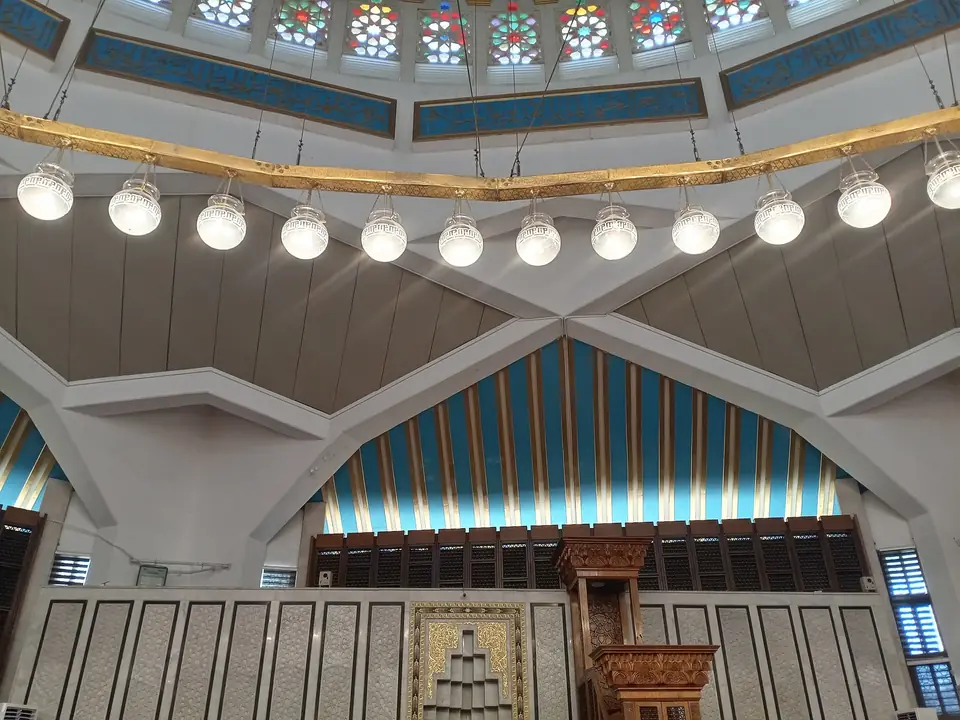
Beneath the great central chandelier opens a regular octagonal hall of 1,615 m², with room for 3,000 worshippers, covered entirely by a dome 35 metres in diameter and 31 high that rests only on the perimeter walls, with no interior column. It is no coincidence that a specialist signed it: Jan Čejka had earned a doctorate in Munich in 1978 with a thesis on vaults and arches in Islamic architecture and was a professor and later dean of the Faculty of Architecture in Amman between 1979 and 1982, just before work began.
A space like this has an enemy: echo. That is why, in the second phase, the interior of the hall was lined with an inner wooden dome. And the whole reads like a verse made space, “God is the light of the heavens and the earth”: the turquoise dome represents the firmament and the red carpet the fertile earth, with a pattern that aligns the rows of prayer toward Mecca. How the hall changes on understanding that reading is the moment the narration reserves for this point.
The medal that saved the grandson
Islamic Museum
Summary of this stop
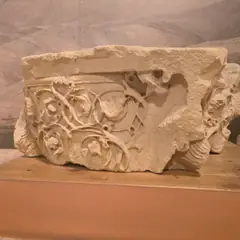
The complex’s Islamic Museum covers 150 m² across two wings: one with manuscripts, personal mementos and photographs of Abdullah I, and the other with Islamic archaeological pieces from Jordan, such as pottery, coins and stone reliefs, alongside models of their sites. The photographs of the founder king take on another weight on learning of his end: on 20 July 1951 he was shot dead at Al-Aqsa, as he went to Friday prayer with his grandson, Prince Hussein.
According to a documented tradition, Abdullah saw in that grandson, rather than in his sons, the future king, and took him as an interpreter to his meetings with foreign leaders. Shortly before that Friday he had given him a medal and, as the story goes, insisted he wear it on his uniform. The boy, aged 15, was also shot, but the bullet hit the medal and was deflected. This memorial also opens a chain of family mosques: in 2004-2005 Abdullah II built in memory of his father the King Hussein bin Talal Mosque, today the largest in Jordan. What the young Hussein did in the seconds that followed the shot is the episode with which the route closes.