Historic mosque
Grand Husseini Mosque Audio Guide
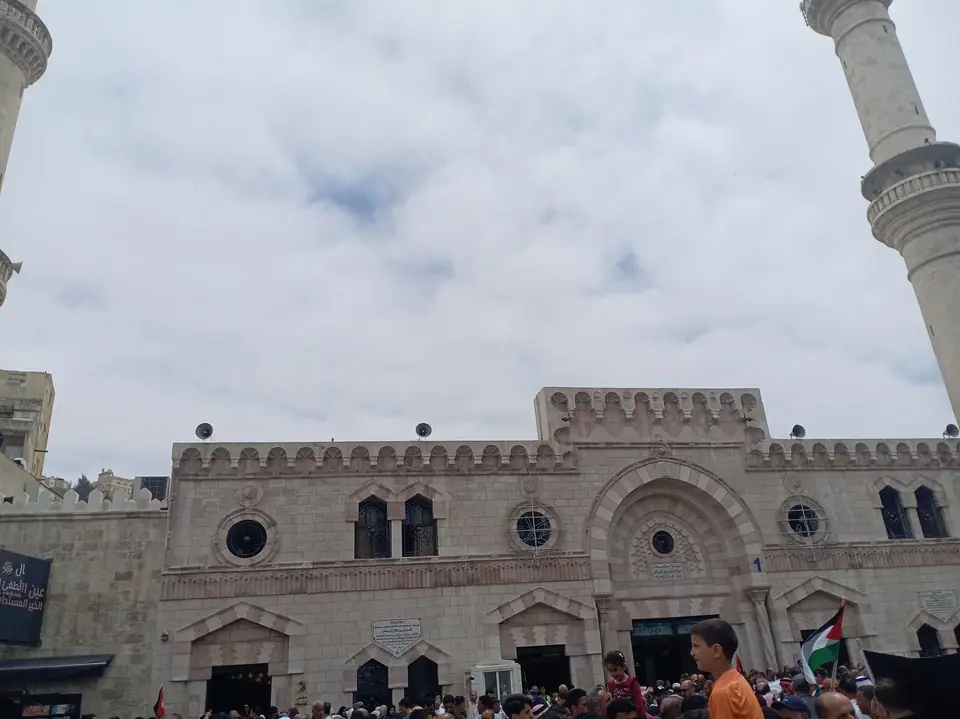
The Friday mosque of Al-Balad, in pink and white stone with two minarets, was built in 1924 on the site of what had been the largest Umayyad mosque in Jordan. Since 1928, its small square has been the starting point of Amman's protests.
- 25 min of audio
- Hashemite mosque of 1924
The Grand Husseini Mosque was one of the first buildings the government raised in Amman after the creation of the Emirate of Transjordan in 1921, alongside the Raghadan palace and a small prison. Emir Abdullah I had it built in 1924 over the old souk mosque and gave it the name of his father, Sharif Hussein bin Ali, leader of the Great Arab Revolt. Its ashlar façade alternating pink and white, over 20 metres high, was the public face of a newly minted capital.
The building has never stopped changing: an earthquake tore the stone finial off the eastern minaret in 1927, in the 1940s it gained a larger courtyard and a second minaret, a fire burned part of its library in 2019 and since 2024 a 50-tonne glass roof covers the inner courtyard. Outside, the square has seen everything from the protests against the Baghdad Pact to the Arab Spring.
Highlights
- Pink and white stone façade — over 20 metres of alternating ashlar, the face of Amman's Hashemite refounding
- Two twin minarets — the eastern one with a wooden finial after the 1927 earthquake, the western with a stone finial
- Protest square — starting point of the city's marches from 1928 to the Arab Spring
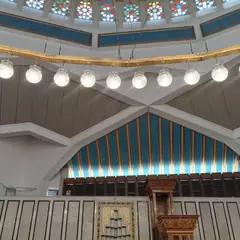
- 50-tonne glass roof — Islamic geometric decoration over the inner courtyard since 2024
- The vanished Umayyad mosque — the largest in Jordan, demolished in 1924 amid British protests
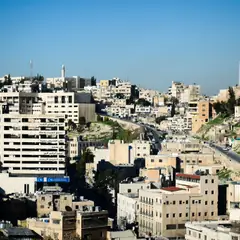
In the heart of Al-Balad, Amman’s old centre, the Grand Husseini Mosque closes off a small square ringed with shops, with the gold souk and the fruit-and-vegetable Souq al-Sukar a few steps away. Its history begins long before its façade of 1924: on the same plot, beside a Roman nymphaeum of ancient Philadelphia, stood the largest mosque of Umayyad times in present-day Jordan, itself built on a Byzantine basilica. The exact date of that first mosque is disputed: a 2026 archaeological and architectural study and official spokespeople trace it to the time of the caliph Umar, around 635, with a later Umayyad extension, whereas earlier historiography dates it to the Umayyad seventh century because of the round arches of its portals.
The present mosque is the work of Emir Abdullah I, who built it as the seal of the new Hashemite capital. Sources do not agree on the year work began, which varies between 1921 and 1924, although the most repeated date is 1924, with the building finished in 1927. Since then it has been extended in the 1940s, thoroughly renovated in 1986 and 1987 and, after the fire of July 2019, received a new minbar and wood-and-mosaic façades made by teams from Al-Balqa Applied University.
What to see at the Grand Husseini Mosque goes beyond stone. For decades the voice of Sheikh Kamel Al-Lala rang out here in Ramadan, his chants before dawn and dusk the theme tune of the holy month for many Jordanians; in the 1970s and 1980s Egyptian reciters such as Abdel Basit Abdel Samad and Mohamed Siddiq al-Minshawi came; and from 1969 Sheikh Ahmad Mustafa al-Khudari, known as Jordan’s great preacher, received queries in an office in one of the porticoes for more than half a century. The audio guide covers that history in four stops and twenty-five minutes, without leaving the square.
The mosque is the centre of gravity of Al-Balad, the district of souks that surrounds it. The founder’s grandson, King Hussein, dedicated to Abdullah I another house of worship in Abdali, the King Abdullah I Mosque.
The souk that has surrounded the mosque for a thousand years
Grand Husseini Mosque
Summary of this stop
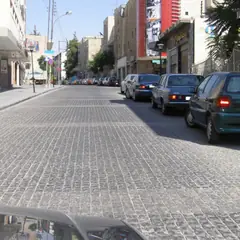
At the mouth of King Talal Street, the bustle of the market gives the first key to the place. In the tenth century the geographer Al-Maqdisi described in Amman, at the end of the market, a beautiful mosque with a nave paved in mosaics. It was the mosque of ordinary people, beside the valley’s markets, while another Umayyad mosque, high on the Citadel, served the prince and his retinue. Amman was then the capital of the Balqa region, and that is why its souk mosque was the largest of the Umayyad period in present-day Jordan.
A thousand years later, the relationship between mosque and market remains intact. When the Circassians repopulated Amman in the 1880s, they emptied the prayer hall of the old mosque and rebuilt its roof, and in 1881 Claude Reignier Conder photographed it for the Palestine Exploration Fund, still standing. What those photographs show of the vanished building is told in the narration, in front of the shops that now occupy its surroundings.
The façade that stands where an Umayyad wall once did
Pink and white stone façade
Summary of this stop
In the centre of the square rises the façade of pink and white ashlar, but the most interesting thing about this spot is what is no longer there. Here stood the north wall of the Umayyad mosque, with its arched portals, photographed in 1867 and demolished in 1924 on the orders of Emir Abdullah I. The new mosque bore the name of his father, Sharif Hussein bin Ali, who happened to be visiting Amman that very year.
The demolition, which also took away the remains of a wall of a Byzantine basilica, pitted the emir against the British resident St John Philby. The two appealed to the high commissioner Herbert Samuel, who sent the director of Antiquities of Palestine, John Garstang, from Jerusalem; he ruled that the wall was worth little because it had already been destroyed several times, and Philby ended up leaving Transjordan to work with Ibn Saud. That “basilica affair” had a lasting consequence, the creation of the Emirate’s Department of Antiquities, and what lay behind it is still debated: the defence of a Byzantine wall or, in another reading, a contest of colonial authority in which one spoke the language of heritage and the other the language of religion.
Among the rubble there also appeared an inscription in Kufic script crediting the work to a commander named Hassan bin Ibrahim, dated to the Abbasid or Fatimid period. His name appears in no other source, and the story of that faceless builder is left for the audio guide.
The square where Amman goes out to protest
Mosque square
Summary of this stop
At the foot of the façade, the small esplanade is the political stage of the city. Since 1928, when protest was made here against the Anglo-Jordanian treaty of that year, the mosque square has been the gathering point for national protests: speeches are heard and marches set off, often toward the nearby King Faisal Street. Through it passed the protests against the Baghdad Pact in 1955, the celebration of Algerian independence in 1962, the protests over price rises in 1989, the solidarity marches with Iraq in 1990, those of 1996 against austerity and the Arab Spring of 2011.
The novelist Abdul Rahman Munif wrote that the balcony of a doctor’s surgery, built against the mosque, served as a rostrum for rousing crowds, and the Communist leader Issa Madanat called it the place one went to protest in Amman. On Friday 18 November 2011, more than a thousand Islamist and leftist demonstrators and youth groups came out of this door after prayer and walked nearly a kilometre to city hall. What their banners demanded and how that march fits into a century of the square is one of the moments of the route.
A wooden finial, a glass roof
Arched portal and minarets
Summary of this stop
Beneath the portal of round arches, the two minarets tell the life of the building. The eastern one, the only part built at first with cement mortar, lost its stone finial in the Jericho earthquake of 1927 and has had a wooden one ever since; the western one, of two tiers, came with the mid-twentieth-century extension and keeps its stone finial. The date of that second minaret, the 1940s or 1952, varies by source.
Looking in through the entrance, the most recent novelty can be seen: after snow damaged the outer arcade in 2021, King Abdullah II ordered the inner courtyard to be covered, and in 2024 a 50-tonne glass roof was finished, with Islamic geometric decoration and glazed sides with openings for ventilation. In Ramadan, when the interior fills, worshippers also pray on the floor of the square, and on the night of the 27th, Laylat al-Qadr, the mosque stays open from dusk to dawn.
The upper floor holds another episode of that history of prayer. At the end of the 1930s a group of women began to pray tarawih there, the night prayer of Ramadan, with the permission of the ulema of Amman. Who opened that custom and what it said about the Emirate’s small capital is the detail with which the route closes.