Souk district
Downtown Amman Audio Guide (Al-Balad)
At the bottom of Amman's valley, the Al-Balad souks crowd above a stream buried under the asphalt and Roman baths covered with sand: a district built by Circassians, Uzbeks from Bukhara and pastry makers from Nablus, where the city still comes out to celebrate, to protest and to queue for kunafa.
- 60 min of audio
- Historic souks and cafés
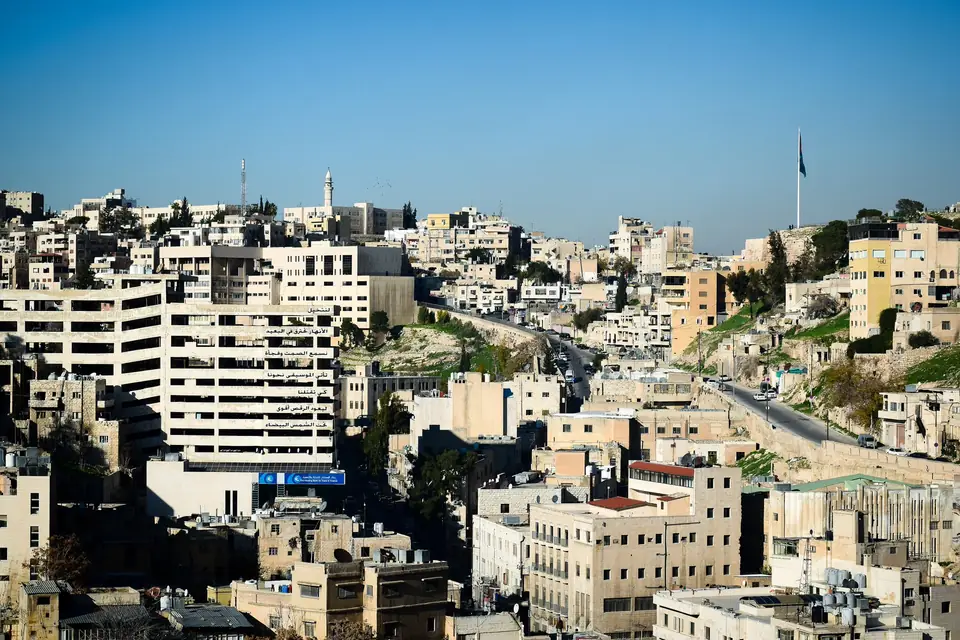
Al-Balad, Amman's historic centre, fills the valley once run by the Seil, the stream that earned the city the nickname “city of waters”. In Roman Philadelphia it split the valley into two banks; modern Amman was born here in 1878 with the arrival of the Circassians, and the Hejaz Railway station, opened in 1904, turned this valley floor into the city's commercial centre, joined to the hills by long stone stairways.
Between 1964 and 1971 the municipality covered the Seil's channel with concrete, and over it today runs Quraysh Street, which everyone calls Saqf al-Seil, “the roof of the stream”. The water has not gone: in February 2019 a flash flood inundated the souks, and a year later, while digging a flood collector beneath Al-Hashemi Street, Roman baths of the second century appeared, were photographed and were buried again.
Highlights
- Quraysh Street — the “roof of the stream”, following the curve of the Seil, covered in concrete between 1964 and 1971
- Bukharan souk — a covered market of the 1940s, founded by Uzbeks from Bukhara and a Circassian landowner
- King Faisal Street — 250 metres of royal speeches, parades and cafés that served as an informal parliament
- Habibah Alley — the original kunafa shop since 1951, with a street of its own since 2025
- Second-century Roman baths — found in 2020 beneath Al-Hashemi Street and buried again with sand
Amman was, before anything else, a valley with water. Along its floor ran the Seil, a stream that rose at Ras al-Ein and flowed some 6 kilometres northeast until it emptied into the Zarqa river at Ayn Ghazal; in the twelfth century the geographer Yaqut al-Hamawi described it as a great, abundant river, with wild beasts and thickets of reeds. Roman Philadelphia spread across its two banks, and in 1878 the Circassians settled among the ruins and caves around the Roman Theater before climbing up to build on the slopes. With the Hejaz Railway station, in 1904, merchants from all over the Levant arrived, and the valley floor became the commercial heart of the city.
That heart is Al-Balad, the historic centre of Amman: the oldest markets for vegetables, clothes and second-hand clothes, much of the used-furniture trade, hundreds of street vendors who at peak hours number in the thousands and, above all on Fridays, a market for Asian migrant workers. What to see in downtown Amman, how it took shape and why each souk was built by people who came from elsewhere is what the audio guide tells in five stops and sixty minutes, from Roman baths nobody can see to the kunafa counter with the longest queue in the city.
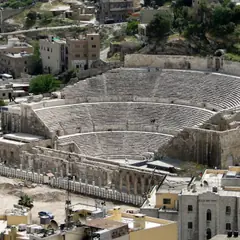
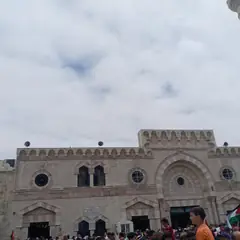
Beside the souks rise the tiers of the Roman Theater and, in the very heart of the district, the Grand Husseini Mosque. The Seil rose at Ras al-Ein, the spring district where the Jordan Museum now stands.
Second-century baths beneath a drain
Hashemite Plaza
Summary of this stop
At the edge of Hashemite Plaza, Al-Hashemi Street looks like mere asphalt, a few steps from the Roman Theater and the nymphaeum. In Roman Philadelphia, the Seil split the valley in two: on the north bank ran the decumanus, a colonnaded east-west street now vanished; on the south stood the forum, the theater, the odeon, the nymphaeum and a bathhouse. To tame the floods that came down from the hills, the Romans built vaults, arches and underground channels, several of them damaged in the twentieth century.
At the end of 2020, while digging a storm-water collector beneath this street, the Greater Amman Municipality came upon Roman baths of the second century: brick furnaces to heat the water, two headless statues of white marble from the quarries of Thasos and Umayyad walls reused as housing. Antiquities weighed moving them, diverting the drainage or integrating them into the old city; the municipality warned that delaying the channel could bring new floods. In January 2021 they were documented and buried again with silica-rich sand, a decision justified by lack of funds during the pandemic. What that absence says about the rest of the valley is left for the narration, on the same spot.
The street that covers a river
Quraysh St
Summary of this stop
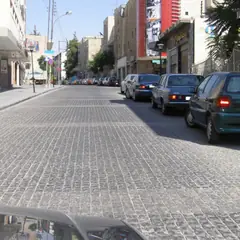
Quraysh Street, beside the Husseini mosque, is not straight: it follows the curve of the old stream. The Seil, fed by springs and by rain, gave Amman its nickname “city of waters”. Between 1964 and 1971 the municipality covered its channel with concrete, for about 3 million dinars, citing the unhealthiness of the water, the winter floods that damaged shops and houses and the need to open roadways for downtown traffic. Hence the name by which everyone knows the street: Saqf al-Seil, “the roof of the stream”.
On 27 and 28 February 2019 the water reminded everyone that it is still underneath. A flash flood inundated the downtown souks, and a blanket seller lost more than 10,000 dinars in the first flooding of his shop in 30 years. Merchants blamed the municipality for a drainage system unable to absorb the rain; the municipality set up a committee to establish responsibility and granted two years’ exemption from fees, which those affected found insufficient. On Friday 8 March, thousands of Ammanis came down to shop downtown with the #OffToDownTown campaign, born on Facebook, and how that day went is told by the audio guide at street level.
Ribbons, daggers and heirloom shotguns
Entrance to the Bukharan souk
Summary of this stop
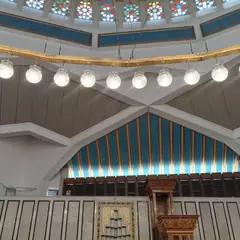
On King Talal Street, opposite the Husseini mosque, opens the Bukharan souk: ribbons of every colour piled from floor to ceiling, beads, wedding ornaments and daggers. It was created by Uzbek merchants from Bukhara who, a century ago, fled the Bolshevik assault, passed through Palestine and ended up in Jordan, where many registered under the surname Bukhari. They sold on bare earth in front of the mosque until, in the early 1940s, Fawzi Al Mufti, a Circassian landowner, built a covered market opposite. The Circassians had arrived in 1878 and came to own most of the land in the valley: two minorities persecuted by Russia together built one of Amman’s oldest markets.
In 2022 the souk had about 20 shops, and only four or five were still in the hands of Bukhari families. At the entrance, the self-taught calligrapher Ahmad Abdulghani, son of one of the original merchants, engraves names on key rings for 3 dollars, and the owner of a shaving-supplies shop counts on his son, the third generation, reaching the market’s centenary in 2042. Further down the street, behind glass, appear hunting shotguns and antique pistols: the arms souk, which began in the early 1930s beside the mosque and today sells only with a licence from the Ministry of the Interior. Which visitors of the 1980s one of its families remembers is one of the episodes reserved for this stop.
Speeches, cafés and a book kiosk
King Faisal St
Summary of this stop
King Faisal Street is about 250 metres long and 25 wide, more square than street. It began as “City Hall Street”, facing the first municipal building of 1909, and in the 1950s took the name of Faisal I of Iraq. From the terrace of the old city hall Abdullah I and later King Hussein spoke to Jordanians; the street was hung with arches of victory for parades, saw the cortege of Sharif Hussein pass in 1931 and celebrated Jordan’s independence in 1946. It still holds the first post office, of 1924, now the Duke’s Diwan cultural centre, and the original Arab Bank headquarters, from the 1950s; from it one enters the gold souk.
Upstairs, above jewellers and hookah lounges, were the cafés that from the 1920s worked as an informal parliament. In the Hamdan café, on the second floor of today’s gold souk, two national opposition congresses were held; one was led by Hussein al-Tarawneh in 1928, against the British mandate and the Zionist movement. In the 1950s and 1960s each party had its café, and from the terrace of the Arab League one the leaders harangued the mosque square. At street level, Hassan Al Beer, “Abu Ali”, ran the Arab Culture Kiosk: he read most of the books before selling them and argued politics with the customer before recommending one. What became of those cafés after 1967 is revealed by the narration right there.
Nablus kunafa and a shop without a door
Habibah kunafa alley
Summary of this stop
The alley leading to the Arab Bank building was known for decades as “Dakhlet Habibah”. There in 1951 Mahmoud Habibah, “Abu Hani”, who had already made kunafa in Nablus, opened the first branch of his pastry shop; it is still open, with a permanent queue at the counter and people eating standing up, and his son Hani took the brand around Amman and as far as Riyadh. In February 2025 the Greater Amman Municipality officially renamed the passage Mahmoud Habibah Street. The house led the pastry shops’ rejection of the orange colouring of the crust, which the Ministry of Health ended up banning in pastries, and it sells both the traditional thick-crust kunafa and the more recent fine-crust one.
Nearby, the Hashem restaurant has served falafel, hummus and fuul on paper and plastic chairs since the 1950s, with recipes its founder, the Palestinian Hashem Turk, brought from the family business in Jaffa. It opens 24 hours, seven days a week, and has gone decades without closing: the poor and the rich sit together there, the tourist and the returning emigrant. Around 2008 King Abdullah II turned up unannounced one midnight in Ramadan, and in 2011 the Friday protesters came to eat there after the rallies. What its manager saw from inside one night in 1970, and why the place stayed open, closes the route.