Historic street
Rainbow Street Audio Guide
Officially it is called Abu Bakr al-Siddiq and its nickname comes from no rainbow but from a cinema that still screens films. Downhill from the First Circle, the street where King Hussein grew up was saved from the wrecking ball by its own decline.
- 45 min of audio
- Stone houses and viewpoints
Rainbow Street runs down from the First Circle roundabout along the crest of Jabal Amman, between stone houses of the 1920s to 1950s. In the 1960s and early 1970s it was one of Amman's most elegant shopping areas, with clothes shops, a patisserie, a bookshop, a furniture store and a supermarket, and at its entrance around 1960 rose the Jordan Insurance Building, the city's first modern office block.
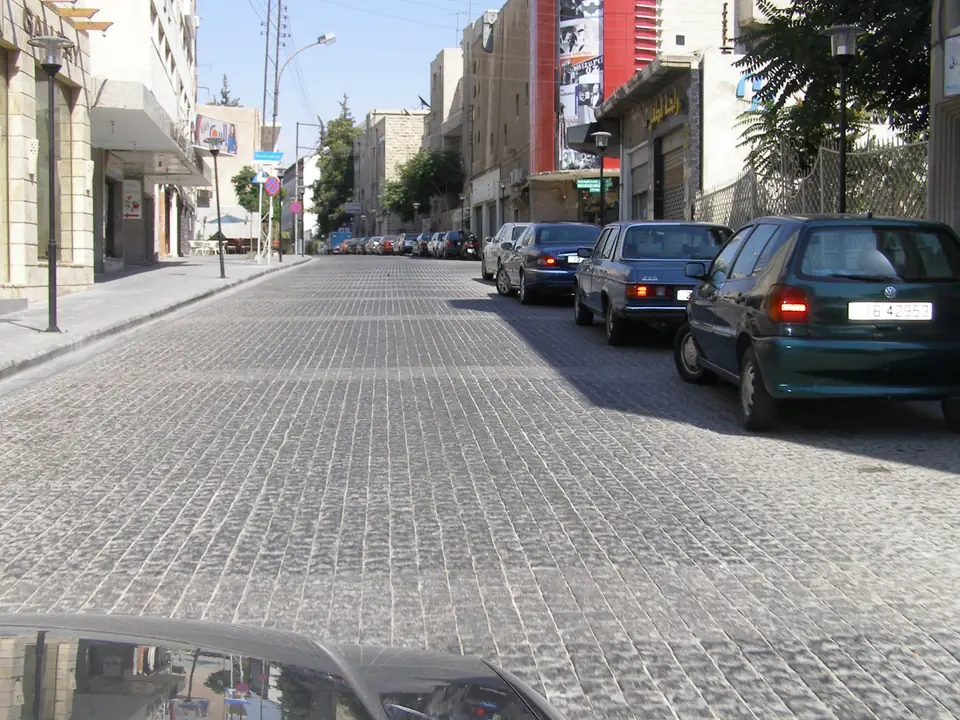
When well-off families moved to other districts, the street lost its customers and, with them, the interest of the bulldozers that transformed Jabal al-Hussein and Shmeisani. That neglect saved its houses. The municipal renovation of 2006–2008 brought it back to life with pavements, cobbles and viewpoints, and also with night-time traffic jams that by 2011 reached the Third Circle and drove many residents away.
Highlights
- Rainbow Theater — the old cinema that gave the street its name and still shows independent films
- Jordan Insurance Building — nine storeys around 1960, Amman's first modern office block
- Viewpoint on the JARA rooftop — a view of Jabal al-Weibdeh, the centre and the Citadel
- King Talal's house — the rented home where the future King Hussein spent much of his childhood
- Al-Mufti House and Villa Mango — ivy, a columned porch and pink stone brought from Jerusalem
On maps it appears as Abu Bakr al-Siddiq, but in Amman everyone calls it Rainbow Street. Whoever arrives expecting coloured façades finds something else: a street that descends from the First Circle along the crest of Jabal Amman, with stone houses built between the 1920s and the 1950s, a neighbourhood cinema and balconies open to the Citadel. Between 1939 and 1951 the family of Crown Prince Talal lived here, as tenants; a Circassian prime minister lived in another of its houses from the 1930s until 1989, and in the 1960s its shop windows were among the most elegant in the capital.
The history of Rainbow Street is that of a providential neglect. From the 1970s to the mid-1990s the wealthy families left and trade moved to the new districts; nobody was in a hurry to tear down what remained. The rediscovery came house by house, at the hands of individuals and NGOs, and culminated in a municipal renovation that filled the street with cafés and crowds, to the point of drawing Brad Pitt and Angelina Jolie, who bought ice cream with their children at a shop in the area, and King Abdullah II and Queen Rania, who dined at the Sufra restaurant. What to see on Rainbow Street, why its architecture survived and who pays for its success today is what the audio guide tells in five stops and forty-five minutes of downhill walking.
From its viewpoint the hill of the Amman Citadel dominates across the valley. The boy who grew up on this street, the future King Hussein, would years later raise in Abdali the King Abdullah I Mosque in memory of his grandfather.
Nine storeys of modernity at the First Circle
1st Circle
Summary of this stop
The street opens opposite the First Circle roundabout with a block that was once a source of pride: the Jordan Insurance Building, nine storeys and raised around 1960, the first modern office building in Amman. It closes off the roundabout and works as the front cover of everything that lies behind. Beside it, a former empty lot has become a public garden stepped on several levels, the first of the nodes with which the street was redesigned.
That building announced what the street was then. In the 1960s and early 1970s, Rainbow Street was one of the city’s most elegant shopping areas, with luxury shops that included clothes shops, a patisserie, a bookshop, a furniture store and an urban supermarket. What it was like to walk down that pavement in its golden age is the scene with which the narration begins.
The cinema that baptised the street
Rainbow Theater
Summary of this stop
On the right-hand side, going down toward the east, appears the hall that explains the nickname. Many visitors believe the rainbow name comes from painted façades, decorations or graffiti, and that the street lives up to it; the belief is popular, but the nickname comes from the Rainbow Cinema. Most sources attribute the name to the cinema alone, although a 2004 article by the CSBE shares it between the cinema and a grocery shop on the street.
The hall is not a memory: it still screens films as the Rainbow Theater, with independent cinema. From 19 to 21 November 2023 it hosted the Palestinian Film Days, organised with the Royal Film Commission, and in May 2026 it premiered three short documentaries shot by young people from the Syrian refugee camp at Zaatari. For some Ammani women, however, the “Rinbo Cinema” is above all a school memory, and the audio guide recovers in front of the façade that of one of them: a gang of classmates and an Egyptian star on the screen.
A view that attracted traffic jams
JARA rooftop viewpoint
Summary of this stop
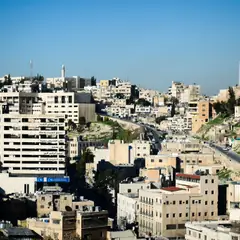
Halfway between the First Circle and the end of the street rises the main viewpoint, built on the roof of an old house preserved as the seat of the Jabal Amman Residents’ Association, JARA. From there the view takes in Jabal al-Weibdeh, the centre and the Citadel. It is part of the project with which the Turath studio, of Rami Daher, redesigned the street for the Greater Amman Municipality around eight urban nodes: continuous pavements without high kerbs, cobbles instead of asphalt in several stretches, unified signage and an almost one-way traffic system. Turath dates the work to 2006–2008; AFP gave it in 2012 as completed two years earlier and put the municipal investment at 7 million dollars.
The success cut both ways. Around 2011 the night-time jams to enter the street reached the Third Circle, several kilometres away, and residential life had suffered: neighbours were beginning to leave because of the noise, the traffic and the crowds. The balance is disputed: Turath speaks of an inclusive space and of former residents returning, while the CSBE described a neighbourhood under siege. And in 2020 the opposite reversal came, when the pandemic left the street deserted with its shutters down. What the owner of a much-loved Jabal Amman restaurant said then can be heard on this very balcony.
A king’s childhood in a rented house
King Talal's house
Summary of this stop
Beside the street stands a stone house of the early 1930s, the house of Ilyas ‘Azar. It had earlier been rented by the Briton Alec Kirkbride, and from 1939 to 1951 Crown Prince Talal and his wife Zein al-Sharaf lived in it, also as tenants. There the future King Hussein spent much of his childhood and his siblings Muhammad, Hassan and Basma were born.
After Talal left, the house was split into two dwellings and a row of shops was attached facing Rainbow Street. The Greater Amman Municipality bought it in the 1990s and rehabilitated it in 2019 as a cultural centre, removing those shops, so that its façade is clean again. The neighbouring side street holds another story of local initiative: in August 2005, JARA, created a year earlier, turned Fawzi Malouf Street into the neighbourhood’s first Friday street market, the origin of Souk Jara. How that neighbours’ idea was born is told in the narration at this stop.
The houses neglect saved
Al-Mufti House and Villa Mango
Summary of this stop
At the junction with Mango Street the road shows its oldest houses. Al-Mufti House, from the late 1920s, was built by the Circassian Umar Hikmat; Sa’id al-Mufti, several times prime minister between 1950 and 1956, lived in it from the 1930s until his death in 1989 and added in the 1950s the porch of pink stone columns. A stepped ivy-covered wall and a leafy garden hide it, and its façade looks not onto the street but across the valley. Opposite, Villa Mango, of smooth pink stone with wraparound balconies, was built in the late 1940s for the brothers Kamal and Ali Mango as two dwellings, one for each, with stone brought from Jerusalem; according to the account, members of the family still live in it.
These houses still stand because of the flight of the rich: from the 1970s, the decline of Jabal Amman avoided the demolitions that transformed other districts. The revival also began in old houses, with the Bani Hamida carpet shop in 1989, the Jordan River Foundation showroom in 1994 and, soon after, Books@Café, opened in 1997 in a group of neighbouring houses as an internet café and bookshop. At its door a sign still hangs that says “Hate-free zone”, and the story of who hung it and why closes the route.