Old Jewish quarter
Chefchaouen Mellah Audio Guide
A quarter called “New” with 16th-century houses, a gate that cost a pelting of stones to cross and neighbours who in 1920 still spoke medieval Castilian: by tradition, Chefchaouen’s blue began here.
- 30 min of audio
- Sephardic Jewish quarter
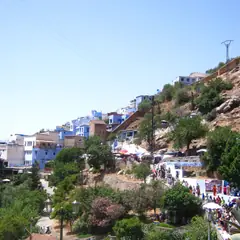
The Mellah is the old Jewish quarter of Chefchaouen and occupies the southern quarter of the medina, between the kasbah wall and Bab el Aïn, the main entrance to the old town. Spanish and Portuguese Jews settled in the city after its founding in 1471, and around 1760 Sultan Mohammed ben Abdallah ordered their families to move inside the medina, where they built ochre-limewashed houses with small balconies, tiled roofs and Andalusian-type courtyards.
Today no Jews live in Chefchaouen and no synagogue remains in the quarter, but the Mellah still speaks of them: in the name of Bab el-Mellah, in a basket-weaving workshop inherited from a Jewish master and in the blue of the walls, which tradition credits to the families who mixed indigo into the lime to set their quarter apart from the green of Islam.
Highlights
- Mellah el-Jedid — the “New Mellah”, with 16th-century buildings
- Bab el-Mellah — the gate locals still call by its name
- Limewashed houses — small balconies, tiled roofs and Andalusian courtyards
- Origin of the blue — indigo in the lime around 1760, according to tradition
- Basket and packsaddle workshop — a trade inherited from a Jewish craftsman
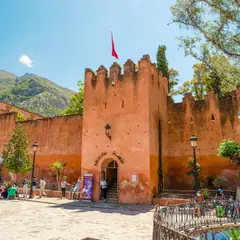
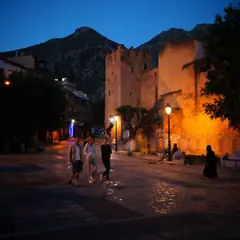
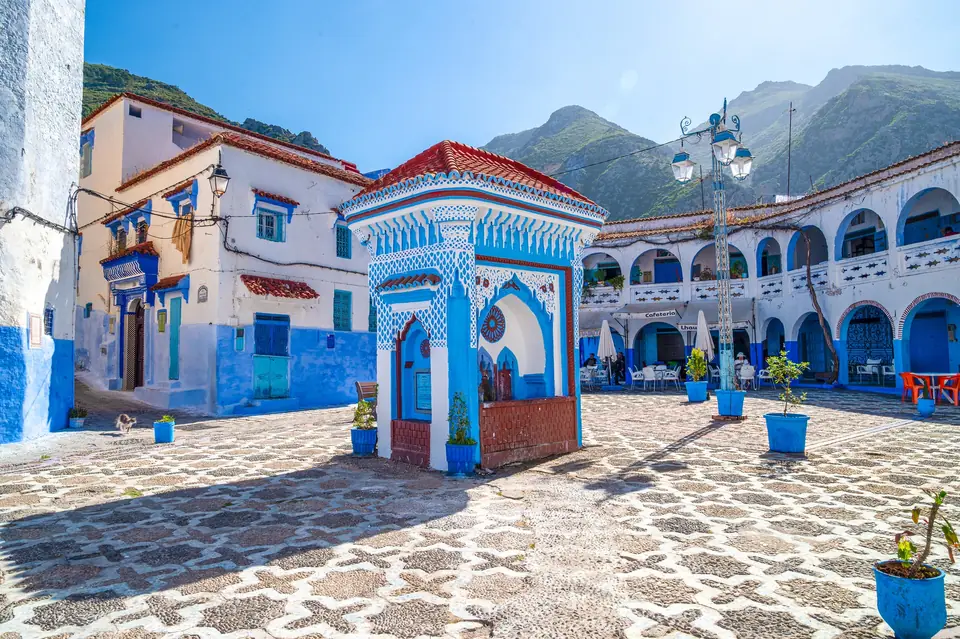
Between the kasbah’s rammed-earth wall and the small arch of Bab el Aïn stretches a labyrinth of sloping alleys, limewashed in ochre, white and blue. It is the Mellah, the old Jewish quarter of Chefchaouen. After the city’s founding in 1471 by Ali ibn Rashid, Spanish and Portuguese Jews settled in it alongside Andalusian Muslims and Moriscos, and around 1760 Sultan Mohammed ben Abdallah ordered the Jewish families to move inside the medina. The quarter walked today was born there, and it keeps a paradoxical name: Mellah el-Jedid, the “New Mellah”, even though it holds the oldest buildings in the place.
The story of the Mellah is that of a small but decisive community. In 1883 there were about ten families; in 1918, 22 families, some 200 people, in a city of around 7,000 inhabitants, although other sources give them a far greater weight. They spoke Haketia, the Judeo-Spanish of northern Morocco, and tradition credits them with the colour that now defines the city. The origin of the blue is still disputed: some trace it back to the Sephardim of the 15th century, others place it in the 1930s and others hold that it was imposed in the 1970s to attract tourists.
What to see in the Mellah is not a matter of monuments: no synagogue is left, and the quarter is recognised by its name, its layout and its houses. That is why it is best understood on foot. The audio guide walks it in thirty minutes and four stops, from Bab el Aïn to the craftsmen’s stalls, telling at street level who lived here and how they left.
The quarter tucks in beside the Kasbah, and very close by El-Haouta Square repeats the same blue around a neighbourhood fountain.
A New Mellah with 16th-century houses
Bab El Ain
Summary of this stop
The route starts at the arch of Bab el Aïn, the main entrance to the medina and the southern edge of the quarter. From this edge the geography of the old Jewish quarter makes sense: the southern quarter of the old town, wedged between this gate and the kasbah wall, which closes the other end.
Here the first paradox arises. The oldest buildings in the Mellah date from the 16th century, yet the quarter is still called “New” because there was an earlier mellah, older still, outside the walls, of unknown date. The move inside the medina is dated to around 1760, by order of the sultan, and how those dates fit together is one of the questions the narration untangles right at this arch.
The gate that cost a pelting of stones to cross
Bab el-Mellah
Summary of this stop
A few steps on appears Bab el-Mellah, the “gate of the Mellah”. No big sign announces it: in August 2008 the researcher Chris Silver found it by asking the neighbours, who still point to it by its name. A resident then assured him that its leaves are the original ones, and the adjoining wall shows, vertically, old stone below and new concrete above, how the quarter changes.
This gate was a border and an enclosure. In July 1883 the explorer Charles de Foucauld entered Chefchaouen, a city forbidden to Christians, disguised as a rabbi, and stayed barely an hour. It was enough to note that the city had between 3,000 and 4,000 inhabitants and that its ten or so Jewish families were obliged to live inside the mellah, exposed to stoning if they left it. What the disguise itself cost him along the way is an episode the audio guide tells in front of the gate.
Medieval Castilian among blue walls
Limewashed houses with small balconies
Summary of this stop
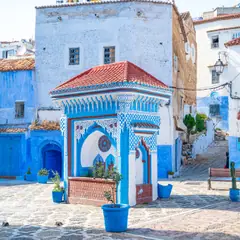
Along the quarter’s alleys follow the houses built by the Jewish families after the move: limewashed façades, small balconies, tiled roofs and Andalusian-type courtyards. Some are painted blue all over, others white and others only up to half height, and in the quarter more than one explanation circulates for this, some of them humorous.
Behind those doors an unexpected language was spoken. When Spanish troops entered the city in October 1920, they found its Jews speaking a medieval Castilian, Haketia. According to tradition, it was also here, around 1760, that neighbours added indigo to the lime to set their quarter apart from the traditional green of Islam, and so the blue of Chefchaouen would have been born. Legend also tells a more romantic version, tied to an impossible love, which the narration saves for these alleys.
The basket-maker who inherited the Jewish workshop
Basket and packsaddle workshop
Summary of this stop
The walk ends among the stalls of basketry and packsaddles for donkeys. In one of them works Abdullah, who weaves the baskets for the saddles with the trade he learned as an apprentice to a Jewish craftsman; when he emigrated to Israel, his master left him the business with all its tools.
It is the best measure of an absence. Chefchaouen’s last Jewish family emigrated to Israel in 1968, although some elder in the quarter placed the departure earlier, with the Spaniards’ exit in 1956. Today no Jews live in the city: what remains are the traces of the Mellah and the cemetery, to the south-east, outside the medina, on a hillside with dozens of unmarked graves. And yet there are those who still come back, a story of neighbours that the audio guide reserves for the end.