Andalusian medina
El-Haouta Square Audio Guide
An enclosed little square in the blue medina, with a four-sided fountain that still gives the neighbourhood water to drink and, beneath the café tables, the memory of a fish market where nothing was sold without the inspector’s approval.
- 25 min of audio
- Andalusian fountain
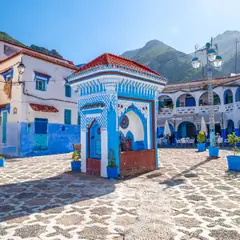
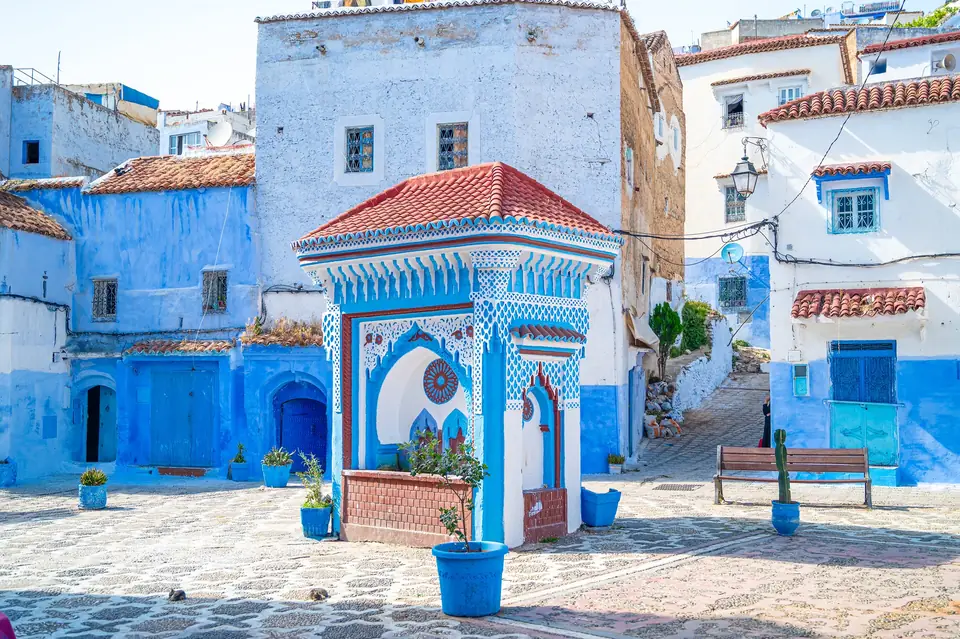
El-Haouta Square is one of the most recognisable little squares in the Chefchaouen medina: a small enclosure ringed by whitewashed façades with arches and iron grilles, a patterned cobbled floor and, in the centre, a square-plan Andalusian sabil with bluish lime walls and a brown tiled roof. A hundred metres away lies the Souika, the city’s second-oldest residential quarter, settled by Andalusian families who came with Moulay Ali ben Rachid.
Where there are now benches, cups and neighbours filling jugs, an enclosed fish market once operated, with masonry counters and a tile-and-timber roof, to which country people came down every Monday and Thursday. The fishmongers’ cries deafened customers; once the market vanished, the silence stayed and its memory faded.
Highlights
- Central sabil — a four-sided Andalusian fountain, bluish lime and brown tile, still in use
- Former fish market — masonry counters and a tile-and-timber roof under the muhtasib’s watch
- Enclosed square — façades with arches and iron grilles and a patterned cobbled floor
- Granadan houses — bent entrance hall, open courtyard and limewashed façades
- Rif peaks — the two “horns” that, by popular tradition, give Chaouen its name
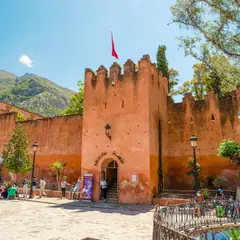
Few squares sum up Chefchaouen in so little space. El-Haouta Square is almost an open-air room: façades of white and blue lime closing it in, patterned cobbles, café tables and, in the centre, a sabil that still supplies the neighbourhood with drinking water. All around beats the medina the Andalusians built: the Souika, a hundred metres away, was the second inhabited core after the kasbah, and in 1492, after the fall of Granada, the Rif el-Andalus quarter was laid out for the second wave of émigrés, with two- and three-storey houses wedged into the slope. The Lebanese writer Amin al-Rihani saw in this white city crowned with fortifications the message of the Alhambra, inside and out.
The story of El-Haouta Square also touches the questions every visitor asks. The blue of Chefchaouen has several explanations that do not agree: one credits the Jewish families that Sultan Mohammed III ordered settled in the medina around 1760 and who added indigo to the lime; others take it back to the 15th century, to the 1930s or even to the 1970s, as a tourist draw. And legend has it that the founder, Ali ben Rachid, laid out the whitewashed city so that his wife, a Christian from Vejer de la Frontera converted under the name Lalla Zahra, would not miss her white village. What is certain is that the city lived very closed off: until 1920, when Spanish troops arrived, only three Westerners had set foot in it, and one of them, Charles de Foucauld, spent barely an hour there in 1883, disguised as a rabbi.
What to see at El-Haouta Square, and what hides beneath its calm of coffee and water, is what the audio guide tells in three stops and twenty-five minutes, without leaving this small enclosure and its surroundings.
A few steps away are Uta el-Hammam Square, the great flat ground of the medina, and the Mellah, where by tradition the blue began; the city’s other great water point, the spring of Ras el-Ma, wells up at the foot of the eastern wall.
A blue sabil in the enclosed square
El-Haouta Square
Summary of this stop
In the centre stands an Andalusian structure on a square plan, with walls limewashed in a lime that leans towards blue and topped on all four sides by brown tiles. It is no ornament: it is the sabil, the neighbourhood’s drinking fountain, and locals still fill their jugs at it among the café tables.
The square’s name has its own story. “Hawta” is usually translated as “surrounded” or “enclosed”, and the square lives up to it: it is small and shut in by façades with arches and iron grilles. But the Arabic word that names it admits a second reading that the terrain itself lets you check, and the narration raises it right there, beside the fountain.
Where the muhtasib inspected the fish
Former fish market
Summary of this stop
The space now taken by café tables long held a fish market: an enclosure with a fence and masonry counters, roofed with tiles and timber. No fish could be sold without first passing the muhtasib, the municipal market inspector, in charge of watching what reached the counters.
The market had a double rhythm. Townspeople came every day, and people from the surrounding countryside came down every Monday and Thursday. The fishmongers hawked their wares at the top of their voices, so loudly they deafened customers in order to draw them in. When the market disappeared the square changed character, and what was lost with that bustle is what the audio guide reconstructs on the same ground.
Granadan houses beneath the horns of the Rif
Whitewashed façades and Rif peaks
Summary of this stop
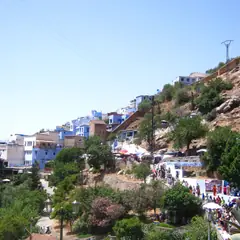
At the mouth of the Akbat Mechaat slope, which climbs towards the Bab Souk mosque, the whitewashed façades tell where the city comes from. The Granadan families settled in Chefchaouen built houses of stone, brick, tile, wood, earth and lime, with a bent entrance hall that hides the interior from the street, an open courtyard and white outer façades, without the decorative richness of Granada’s noble houses.
That whiteness was renewed through a ritual. Before Eid al-Adha, Ashura, the Mawlid and Ramadan, medina families practised “al-awacher”: they whitewashed houses and alley floors with white lime brought in solid blocks from the al-Qalaa hamlet, dissolved in water for painting. Today the whole city needs a fresh coat of blue every two years, and is repainted in phases with powder pigment mixed with water, often with a traditional brush of dry grass tied in a bundle.
Above the rooftops the peaks of the Rif appear. On the benches of this square it is usually explained that “Chauen” comes from a Berber word meaning “horns”, after the two peaks that dominate the city, although there is not even agreement on which ones they are. What the “Chef” of the name adds, and why it should be taken with caution, is left for the end of the tour.