Historic spring
Ras el-Ma Spring Audio Guide
The spring that decided where Chefchaouen would rise in 1471 still fills its taps, drives the water of its washing places and, in drought years, leaves the city watching a riverbed of stones.
- 30 min of audio
- Water and mills since 1471
Ras el-Ma is the karst spring that wells up east of the medina, outside the old wall and beside the Bab Onsar gate. When Ali ibn Rashid founded Chefchaouen in 1471 around his Kasbah, this was its mainstay and its only source of drinking and irrigation water, a role it keeps today. The water, which flows out of the limestone mass of the western Rif, once surfaced in the open and is now enclosed in a simple stone hut.
The same current that gives the city its drinking water drove the mills on both its banks for centuries and still fills the washing places where local women scrub carpets. A few steps away, Moroccan visitors dress up as Rif mountain folk to have their photo taken by the water and take home a bottle of good luck. And in early 2025 all that murmur went quiet: for almost a month, Ras el-Ma was a bed of dry stones.
Highlights
- Spring hut — water from the Rif limestone that has supplied the city since 1471
- Falls and channels — about 5 million cubic metres a year, dry for almost a month in 2025
- Washing places on both banks — washboards, stone basins and the carpet slab
- Rif Sebanine oven — bread baked with wood since the 16th century
- Old mill and bridge — downstream of the spring, the bridge possibly 19th century
- East bank — the blue medina face on and the path to the Spanish Mosque
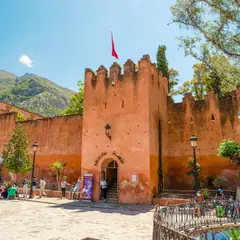
Chefchaouen exists because water wells up here. In 1471, Ali ibn Rashid founded the city around his Kasbah and rested it on the spring of Ras el-Ma, which was its only source of drinking and irrigation water and still plays that role today. The water flows out of the limestone mass of the western Rif, east of the medina, outside the old wall and beside the Bab Onsar gate; it is one of the three great springs of the region, along with those of Mago and Chrafate. Managed today by the National Office of Drinking Water (ONEP), the spring still irrigates the farms along its course and is the neighbours’ traditional picnic spot.
The story of Ras el-Ma is not limited to the point where the water surfaces. It starts in the Sebbanine quarter, among olive mills and an oven that still bakes bread, and continues along the falls and channels at the foot of the wall, the washing places on both banks and an old mill, up to the bridge from which the blue medina is seen. What to see at Ras el-Ma and why that route explains the whole city is what the audio guide unpacks stop by stop, in thirty minutes of walking.
It is also a fragile place. It supplies on average some 5 million cubic metres a year, but in early 2025 drought left it dry for almost a month, and in rainless years the whole city watches its riverbed holding its breath.
Beside the spring, the path that leaves through Bab el-Ansar crosses the river and climbs to the Spanish Mosque, the sunset viewpoint; inside the medina, the sabil of El-Haouta Square still gives the neighbourhood water to drink, and out in the heart of the Rif, 30 km away, water takes charge again at the Akchour Waterfalls.
A 16th-century wood-fired oven on the way to the water
Rif Sebanine wood-fired oven
Summary of this stop
The road down towards the spring already tells its story. The Sebbanine quarter gathers traditional mills once used to grind olives and an old oven beside the bridge over the stream they call Oued el-Fouara here. A quarter of mills could only exist with water beside it, and it had it a few steps away.
In the silversmiths’ quarter, next to Ras el-Ma, stands the “Rif Sebanine” wood-fired oven, built under the emir Mohammed ben Rachid in the 16th century. Its façade is worn, but it still bakes and sells bread, and it is one of the few left of the 18 traditional ovens registered in the medina. Its exact age, mind you, shifts depending on who tells it: the same source that places it in the mid-16th century credits it with an antiquity that does not fit those dates.
What role a neighbourhood oven played in the daily life of the medina, and why this one has survived when so many others closed, is what the audio guide tells right there, with the smell of woodsmoke in the background.
The stone hut that guards the source
Ras El Maa
Summary of this stop
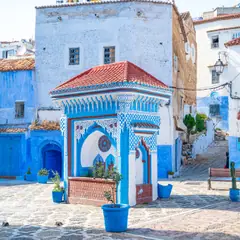
Facing the spring, the first thing that appears is a simple, almost modest stone structure. It encloses the point where the water surfaces, which for centuries welled up in the open. Behind that hut lies the reason Chefchaouen was founded on this spot in 1471: the Rif limestone water the city needed to drink and irrigate, and which still fills its taps.
Ras el-Ma shares regional prominence with the springs of Mago and Chrafate, but none is as bound to the medina as this one, at the foot of its eastern wall. Even its exact location causes confusion: the same name is used for the visitable outflow and for others that feed it up the mountain, and descriptions place it sometimes in the city and sometimes kilometres away.
The story of this spring, which went from bubbling up in the open air to being kept among stones, explains Chefchaouen’s architecture of water better than any monument. The audio guide goes through it in front of the hut.
The waterfalls that dried up in 2025
Channels and small falls of Ras el-Ma
Summary of this stop
Below the wall, the water comes down through channels and small stepped cascades between rocks. Its murmur seems inexhaustible, but the flow varies greatly from year to year. In early 2025, a prolonged drought left Ras el-Ma a bed of dry stones for almost a month, until in March rains of more than 200 mm in a few days brought water back to the spring.
The scene repeated, with another happy ending, in January 2026: after months of drought, rain and snowmelt from the neighbouring mountains refilled the channels and opened new outflows along the banks. On average, Ras el-Ma supplies some 5 million cubic metres of water a year, which flow down towards the Oued Siflaou and, with no dam to store them, end up in the Mediterranean.
Not even the stream has a single name: it appears as oued Ras el-Maa, as Oued el Kebir or as Oued el-Fouara. What it means for the city to see its spring fall silent is what the narration raises beside the falls.
Carpets, washboards and lucky bottles
Ras el-Ma washing places
Summary of this stop
Here the water works. Its current drove the hydraulic mills that dotted both banks, and downstream an old mill and a bridge joining the two sides survive, possibly dating from the 19th century, although some credit certain bridges on the stream with an antiquity going back to the founding. Beside the medina’s north-eastern gate, where the water leaves the mountain, the women of Chefchaouen come to wash clothes.
According to accounts from 2013, two washing places were then in use, one on each bank, with washboards and stone basins, fed by channels that divert the water after it has turned the flour mills; carpets are soaked in the stream and scrubbed on a large slab. Clothes or blankets are often hung out on the railings.
A few metres away another custom coexists. Among Moroccan tourists there is a widespread popular belief that drinking the water of Ras el-Ma brings luck: local women rent out traditional Rif costumes for a few minutes, visitors have their photo taken by the water and fill their bottles before leaving, while others, in their straw hats, sell water to passers-by. The audio guide tells this contrast between work and ritual at the washing place itself.
The blue medina seen from the far bank
Medina wall from the east bank
Summary of this stop
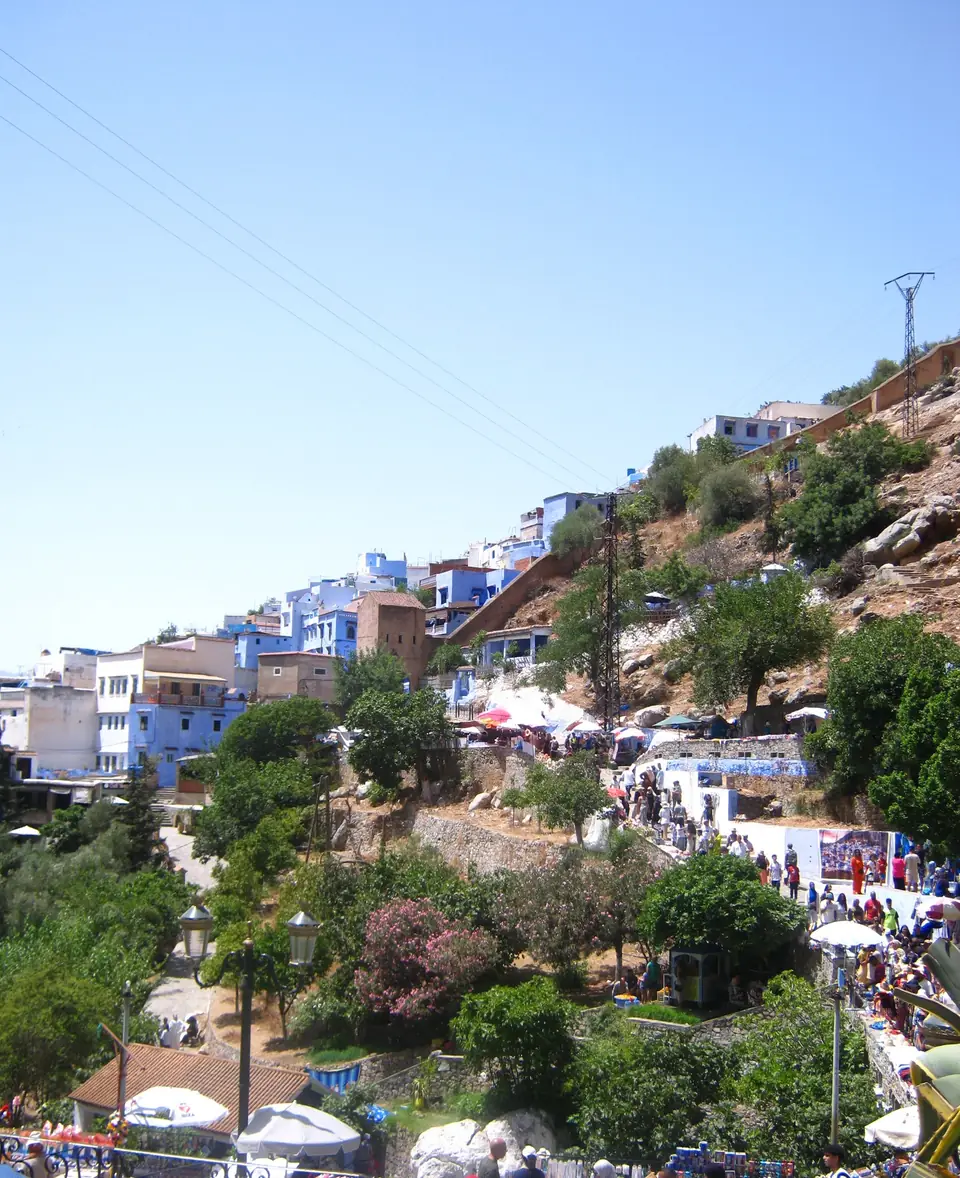
Past the bridge, the path along the east bank offers the overall view: the stretch of wall and the blue houses of the medina opposite, the cafés and lemon-juice stalls beside the spring, and the water that keeps irrigating the farms downriver. It is the traditional picnic spot of Chefchaouen’s residents.
Many explanations circulate about the city’s blue, but the locals have their own: they say the walls represent the Ras el-Ma spring, their source of life, from which everyone drinks. Seen from this bank, the idea takes on a meaning that the narration develops right there.
From here also starts the path that climbs the slope to the Bouzafar mosque, the so-called Spanish Mosque, visible high on the hill and from which the medina is overlooked. The tour ends right where that climb begins.