Heart of the medina
Uta el-Hammam Square Audio Guide
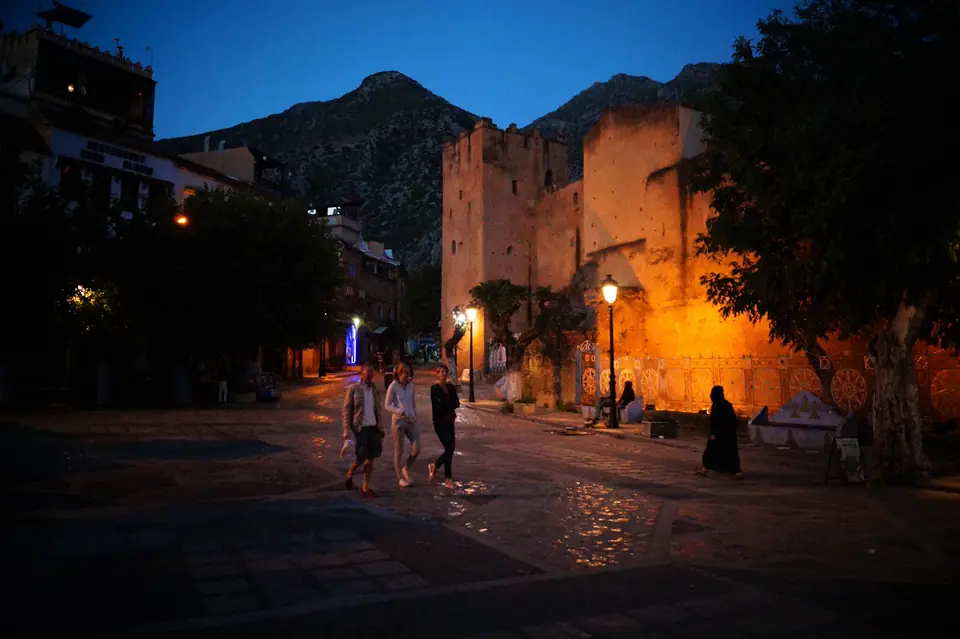
The only flat ground in a medina made of slopes: a 16th-century souk turned café lounge, where the kasbah’s earthen wall and the octagonal minaret of the Great Mosque face each other.
- 30 min of audio
- 16th-century souk
Uta el-Hammam is the oldest square in Chefchaouen and the point from which the whole network of medina lanes sets out. It was probably laid out in the 16th century on the initiative of Moulay Muhammad, son of the city’s founder, Ali ibn Rashid, as the site of a weekly souk for townspeople and people from the surroundings. At some 3,000 m², it is the only flat space in the medina: every other street is reached by going up or down.
Beneath its calm of terraces and mint tea hides a much less peaceful history. Here allegiance was sworn to the sultan and his decrees were read out in public; in 1924 the Spanish garrison left the city around the square by night, and in 1925 an American pilot bombing Chefchaouen wrote that from the air he could see the great square with its fountain running.
Highlights
- Octagonal minaret of the Great Mosque — late 17th century, with blind arches and zellij panels
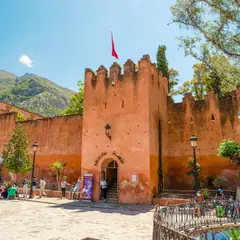
- Kasbah rammed-earth wall — a stretch of reddish earth with towers closing one side of the square
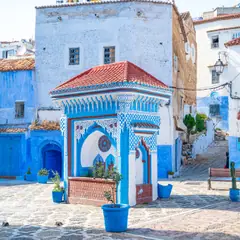
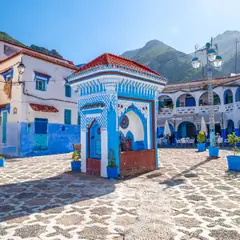
- Four-sided fountain — blind-arch niches and a green tiled roof where a dome once stood
- Great funduq — the largest of the city’s four caravanserais, behind a tall horseshoe arch
- Red-tiled roof — the prayer hall breaks with the green tiles of so many Moroccan mosques
- Only flat ground in the medina — some 3,000 m² of pebble paving
In a city where every street goes up or down, Uta el-Hammam is the exception: some 3,000 m² of pebble paving, the only flat ground in the medina of Chefchaouen. It is no accident of the terrain. The square was probably laid out in the 16th century on the initiative of Moulay Muhammad, son of Ali ibn Rashid, the city’s founder, to host a weekly souk of farm produce and crafts, and the network of blue lanes still starts from it. On one side, the reddish earthen wall of the kasbah; opposite, the octagonal minaret of the Great Mosque; and around it, the Nasiriya zawiya and the zawiyas of the Qadiriya and Raissouni shurafa.
The story of Uta el-Hammam Square is that of a market that was also the stage of the sultan’s power, spoils of war in the Rif and the target of one of the first aerial bombings of civilians. Today cafés occupy the place of the old shops and the square seems made only for afternoon tea. What to see at Uta el-Hammam, how to read the architecture of its mosque and why its calm is a conquest and not an inheritance is what the audio guide tells in four stops and thirty minutes of walking.
The square opens before the wall of the Kasbah, and a few steps away, through the medina’s lanes, El-Haouta Square shows another scale of the city, gathered around its fountain.
A bathhouse, some doves and the only flat ground
Portal of the great funduq
Summary of this stop
The north-west corner holds the two pieces that explain the square. The hammam, the public bath, stood there, and according to the most widespread explanation it gave Uta el-Hammam its name. It is not the only one: another version derives it from the doves (hamam) that settled in the square to peck the grain from the warehouses and cereal shops. Uta, meanwhile, is interpreted as a hollow or flat courtyard, and that is the feature nobody disputes.
Beside that same corner rises a tall portal with a great pointed horseshoe arch. It is the entrance to the largest of Chefchaouen’s four funduqs, the caravanserai built to house merchants and travellers: a courtyard ringed by multi-storey galleries where those who came to the souk from the mountains slept. What this corner reveals about the deliberate origin of the square is discovered in the narration, right there.
A minaret a century younger than its mosque
Great Mosque of Chefchaouen
Summary of this stop
The Great Mosque, the main and oldest mosque of Chefchaouen, was completed in 969 AH (1561-1562) under the rule of Muhammad, son of Moulay Ali ibn Rashid, although its date is disputed and other sources push it back to the 15th century. Its minaret, however, dates from the late 17th century, more than a century later than the mosque, and follows the model of the towers raised under Ali Errifi, governor of Tangier under Sultan Moulay Ismail, such as those of the Kasbah Mosque in Tangier and the Great Mosque of Asilah.
The octagonal shaft is decorated in three registers of blind arches—round, polylobed and lambrequin—with square zellij panels at the top, details in red ochre and a whitewashed crown. Below, the red-tiled skirts of the eight-aisled prayer hall appear, against the green tile of so many Moroccan mosques. The interior is not open to non-Muslims, but the stairway and the 20th-century portal can be seen from the square. As the Friday mosque, it was where the governors of Chefchaouen swore allegiance to the sultan and his decrees were read out in public; it also had a madrasa with a dormitory for students of fiqh.
In November 1924 the city around this tower lived through one of its strangest nights, when the Spanish garrison abandoned it in silence and, days later, the Rifians marched in. It is said that someone left it guarded in a very particular way, and the audio guide tells it at the foot of the minaret.
The fountain a pilot saw from the air
Four-sided fountain
Summary of this stop
In the centre of the square, a four-sided fountain shows a blind-arch niche on each face. It was crowned by a dome, replaced by a small green-tiled roof when it was redecorated and repainted. It seems the most modest element of the square, and yet it is the one that appears in one of its darkest episodes.
On 17 September 1925, in the midst of the Rif War, a squadron of American volunteers in the service of France bombed Chefchaouen, the holy city of the Jebala, which had never been attacked from the air; the victims were mostly civilians. One of the pilots, Paul Ayres Rockwell, later wrote that from the plane he looked down on the shrines, the six mosques and “the great square with its fountain running”, and that he hoped none of it would be harmed. What that bombing set off on the other side of the Atlantic is heard beside the fountain.
From weekly souk to endless nights
Row of café terraces
Summary of this stop
On the side opposite the mosque and the kasbah, the row of terraces with parasols occupies the site of the old souk shops, where country people sold their harvest and crafts. The square is still ringed by zawiyas, which make it a space for religious and cultural gatherings, and its surroundings have undergone a major restoration: the fourth and final phase of the medina’s Architecture Charter, driven by the Tetouan Urban Agency, restored the buildings along the Outa Hammam–Bab al-Ain axis and refurbished the surrounding squares.
Every summer, as the sun goes down, the quiet square of the morning turns into an open-air stage: street musicians, impromptu dancers and young singers fill it until well into the night, while families drink mint tea on the terraces and the evenings stretch on until dawn. Visitors already compare it to Marrakech’s Jemaa el-Fna, and an anecdote from the square itself shows how far its business has changed; the narration keeps it for the end of the tour.