Sunset viewpoint
Spanish Mosque Audio Guide (Bouzafar Mosque)
A white mosque that a Spanish officer planted on the opposite hill to win over Chefchaouen, a city that did not pray in it for decades and that now climbs up every evening to watch the blue medina from there.
- 75 min of audio
- Viewpoint over the medina
The Spanish Mosque, which locals call Bouzafar, was built after the second Spanish occupation of Chefchaouen, in 1926, towards the end of the 1920s, on the orders of Commander Osvaldo Capaz, the city’s military chief. Capaz, who spoke Arabic and had spent years undercover in Morocco, wanted to show with it that Spain had not come to take their Islam away. The result is a building unique among Chefchaouen’s mosques: a church body with a mosque head, high on a hill some 2 km from the city.
The gesture did not convince. Locals boycotted the mosque from its construction and did not pray in it a single rak’a: some took it for a church and others believed it had been built to spy. For decades only the call to prayer sounded over an empty hall, until, after the 2007 restoration, it was the neighbours themselves who signed to keep it a Muslim place of worship.
Highlights
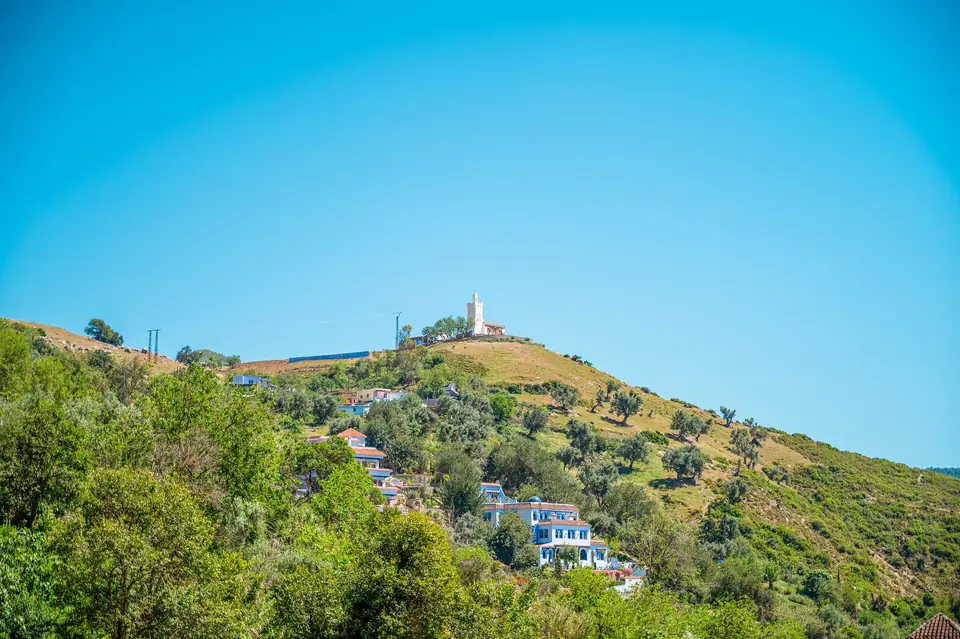
- Minaret on the hill — the silhouette recognisable from all over the medina
- Church body, mosque head — a form unique among Chefchaouen’s mosques
- The Bouzafar nickname — “the man with the big moustache” in Moroccan dialect
- Decades of boycott — locals never once prayed in it
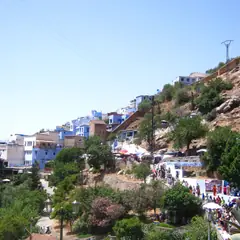
- Panorama of the blue city — the tiered medina and the Rif peaks at sunset
From the medina of Chefchaouen a small white minaret can be made out on the eastern hillside, cut against the mountain. It is the Spanish Mosque, the most photographed viewpoint of the blue city and, at the same time, one of its most uncomfortable buildings. Chefchaouen changed hands three times in a few years: General Dámaso Berenguer occupied it in October 1920, it was part of Abd el-Krim’s Republic of the Rif between 1924 and 1926 and it was retaken by the Spanish army in 1926. After that second occupation, towards the end of the 1920s, Commander Osvaldo Capaz had this mosque built on the hill opposite. There is no exact documentary date, and one source even places it earlier, but most versions agree on that period.
The story of the Spanish Mosque is that of a political gesture the city rejected in silence. Capaz wanted to win over his new neighbours; they did not set foot in the prayer hall for decades, and the hill became a place for picnics, games and strolls while the building fell into ruin. Today, restored, it is a mosque again and, as the sun sets, dozens of visitors scramble up its steps to photograph the medina. What to see at the Spanish Mosque, what its architecture says and who the man who ordered it was is what the audio guide unpacks in four stops and seventy-five minutes of climbing and strolling, with a narration researched and checked against historical sources.
To get up, the path crosses the river beside the spring of Ras el-Ma; from the top the whole medina is in view, from the Kasbah to the blue rooftops, and anyone wanting more of the Rif has, some 30 km away, the Akchour Waterfalls.
A minaret nicknamed for a moustache
Access stairway
Summary of this stop
The mosque stands in the El Labbar quarter, on a hill about 2 km above the city. The path leaves through Bab el-Ansar, crosses the Ras el Maa river by a bridge beside the spring and climbs among agaves and prickly pears to the stairway leading to the foot of the minaret. The legs feel every metre of elevation, and that distance is also part of the story: the mosque ended up far from the medina, in plain view of everyone but outside its daily life.
The curious thing is that in Chefchaouen almost nobody calls it Spanish. Its popular name is Bouzafar, which in Moroccan dialect means “the man with the big moustache”, and it is also known as Abu al-Asafir, “the one of the birds”. Whose moustache it was is disputed: some attribute it to Capaz himself, some speak of an anonymous Spanish engineer who directed the works and others point to the land’s former owner, a merchant between Ceuta and Chefchaouen. The audio guide goes through the three versions at the foot of the stairway, and also why one of them has a serious detractor.
Church body, mosque head
Spanish Mosque
Summary of this stop
At the foot of the minaret, the building can be read like a political move. The small whitewashed volume of the prayer hall lacks the proportions of the medina’s mosques: locals compared it to a church or a hermitage, and the formula that has stuck, “church body and mosque head”, describes an architectural form unique in Chefchaouen. Above it rises the tower, the silhouette recognisable from all over the city.
The man who ordered it was no ordinary officer. Osvaldo Fernando Capaz, a captain of the native Police in 1922, spoke Arabic, had lived undercover in Morocco for years and was known for having built other mosques; here he raised this one and two others outside the city to show that Spain was not coming against Islam. His fame rested on a way of conquering almost without firing a shot, on the Gomara coast in 1926 and in Ifni in 1934, although that fame has a less heroic side: according to some versions, many of those submissions were bought rather than won. Nor is there agreement on the building’s intention, which some read as a gesture of goodwill, others as bait to draw the resistance to the hill and others as the project of a hermitage. The narration raises that doubt in front of the façade.
Muezzins calling to an empty hall
Prayer hall door
Summary of this stop
The door of the prayer hall opens at prayer times and leads into a small interior. For decades there was nobody on the other side: Muslim neighbours boycotted the mosque from its construction and did not pray in it a single rak’a, some because they took it for a church and others because they believed it had been built for espionage. Only the call to prayer was given, taken in irregular turns by the faqih Zannan and the faqih Sharif Alami Ghazoumi, on the payroll of the Moroccan habous administration.
The hill, by contrast, was never empty. While the building fell apart, on Fridays neighbours came up for picnics and lads to smoke kif in its shade, and villagers with their flocks passed along the path on their way to the city; in the 1980s, children from the medina climbed up to play football and games with dialect names now almost forgotten. After decades of neglect, most sources credit the town council with the 2007 restoration, with the path asphalted and benches all around, although one guide speaks of a later renovation funded by Spain.
Then came the twist. Some proposed turning it into a museum or cultural centre, and it was the neighbours who signed a petition for it to remain a mosque. In 2024 the five daily prayers were held there, except the Friday noon prayer, which the building cannot accommodate. What walkers say about this door and non-Muslim visitors is left for the audio guide, on the very threshold.
The city Capaz took in 1926
Panorama of the blue medina
Summary of this stop
From the benches of the esplanade the whole medina is seen face on, tiered up the slope, and behind it the Rif peaks. It is the city that changed hands three times between 1920 and 1926, and which Commander Capaz entered on 10 August 1926, at the head of a native harka of about a thousand men, after subduing ten Gomara tribes in two months and confiscating almost 3,000 rifles.
It is also where the sunset crowd gathers, when the light drops over the blue walls and the esplanade fills with cameras. Few of those waiting here for sundown know the end of the man who ordered the mosque built behind them. It was an end far from Morocco, tied to the war between Spaniards, and the audio guide tells it at this last stop, with the whole city in front.