History museum
Da Nang Museum Audio Guide (Bảo tàng Đà Nẵng)
A three-storey neoclassical block facing the Hàn River, the last survivor of French Tourane. Every power that passed through Da Nang wanted it for itself, and in 1975 it fell without a shot, with the tea still warm in the mayor's office. Since 2025 it has been the museum that tells the city's history.
- 75 min of audio
- French colonial architecture
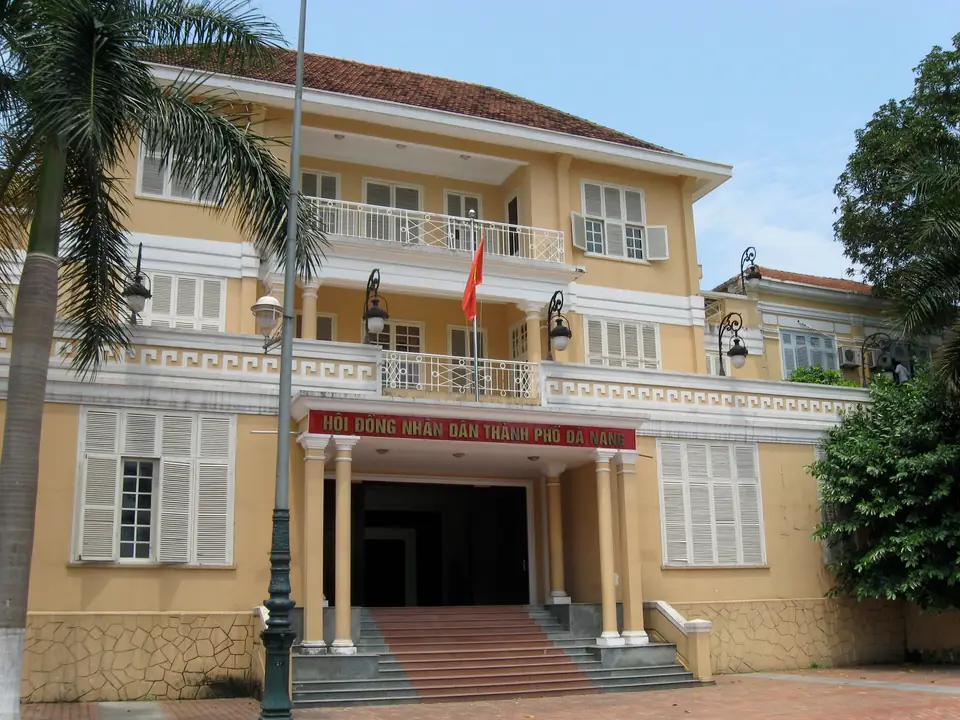
The Da Nang Museum has occupied since 2025 the former Tòa Đốc lý, at 42 Bạch Đằng: the seat of the successive Đốc lý, the municipal administrators of the French concession of Tourane. Its central neoclassical block, designed by a French architect and with its facade turned towards the river, dates from between 1898 and 1900; in the 1960s a three-storey wing of similar style was added on each side. From 1950 it was the Đà Nẵng City Hall, and it remained the seat of the city government until 2014.
Along the whole riverside promenade no other period building is left: the rest were demolished to put up hotels and apartment blocks. And the museum came here through an irony: its previous home, opened in 2011 inside the Điện Hải citadel, encroached on the very monument it wanted to tell about, and in 2020 the city decided to move it some 500 metres, to this building.
Highlights
- Neoclassical facade of 1898-1900 — the last old building on the Bạch Đằng promenade
- Stele and lion at the main door — the 1937 protest and the 1945 flag
- New wing by studioMilou — slender columns and lattices evoking the region's looms
- 1975 liberation floor — the seat of power taken without a shot
- Honda motorbike of 29 March 1975 — the one that carried the urban commando to the door
The history of the Da Nang Museum begins with a building that changed hands more often than it changed name. The French concession of Tourane was born of King Đồng Khánh’s ordinance of 1 October 1888, ratified on 3 October, with 5 villages and some 10,000 hectares, and the Tòa Đốc lý headed the list of priority buildings of its administrative centre, on the northern stretch of the Quai Courbet, today’s Bạch Đằng Street. Since then it has passed through the hands of the colonial administration, the Trần Trọng Kim government, the Revolutionary People’s Committee of 1945, France again, the State of Vietnam and, after 1975, the province of Quảng Nam-Đà Nẵng, the city People’s Committee from 1997 and the People’s Council from 2014, when the municipal government moved to the Administrative Centre.
The museum, founded in 1989, settled here after a forced move. The conversion began on 4 June 2021, with 504.9 billion dong over 8,686 m², and was designed by Jean-François Milou (studioMilou, Singapore), winner of the competition: facade and roof intact, the building repainted in its original colour, the railing removed and a new wing towards Trần Phú Street. The inauguration was on 28 March 2025, on the eve of the 50th anniversary of the city’s liberation (one source places it on the 29th, the anniversary day), with almost 3,000 documents and objects chosen from 27,000 and spread across 9 major themes. On the day of reopening to the public, 1 April, 3,000 people came in, and the museum later set a cap of 500 visitors a day; from 29 April to 1 May, with the Bạch Đằng stretch closed to traffic, the facade served as a screen for the 3D mapping show “Câu chuyện Đà Nẵng – The Story of Da Nang”, the first outdoor show of its kind in the city.
What to see at the Da Nang Museum is divided between the riverside promenade and the interior: the neoclassical facade, the stele at the historic door, the architecture of the new wing, through which the public now enters (31 Trần Phú, with a reception robot and information kiosks in 10 languages), the floor devoted to 1975 and the room that tells the history of the building itself. The audio guide walks it in five stops, with narration researched and fact-checked against historical sources that keeps for each point what the walls do not tell at a glance.
Along the same Bạch Đằng promenade, upriver, are Han Market, about seven hundred metres away, and the Museum of Cham Sculpture, which holds the legacy of the kingdom of Champa in another building from the French period.
The last old building on Bạch Đằng
Bảo tàng Đà Nẵng
Summary of this stop
From the riverside promenade, the central block is recognised at once: symmetrical, three storeys, with its facade turned towards the Hàn, the original tile roof and the paint returned to its first colour. What makes it unique is what surrounds it. The buildings at 42-44 Bạch Đằng are the last old vestige of the whole street, which was the backbone of Tourane on the riverbank; everything else from the period was demolished to make room for hotels and apartment blocks. Wedged between towers, the former palace of colonial power is all that remains of that bank.
Its origin has more gaps than it seems. The dates of 1898 to 1900 and the authorship of “a French architect” are repeated as firm facts, but that architect has no name, and as late as 2011 no document detailing the work had appeared. Another chronology, from 1889 to 1900, also circulates, which would bring the start of works forward by almost a decade.
The little that is known of the construction comes from the memory of the elders. According to that tradition, the contractor who built the Tòa Đốc lý and other major works of French Tourane was a Vietnamese, Võ Văn Giá, known as Nghè Giá. How such a photographed building came to have no papers to explain it is the question with which the narration begins in front of the facade.
A stele for a building with many owners
Stele and lion at the main door
Summary of this stop
Beside the main door, next to a guardian lion, a stone stele fixes two moments when this threshold was a stage. In February 1937, thousands of people gathered in front of the building to demand civil and democratic rights from a representative of the French government; on 26 August 1945, the red flag with the yellow star flew from its roof.
In that year of 1945 the building changed hands twice in two months. In July it was the office of the mayor of Tourane appointed by the Trần Trọng Kim government; on 26 August it became the seat of the Provisional Revolutionary People’s Committee of a city that, during its first year after the August Revolution, was called Thái Phiên. With the French reoccupation of early 1947 it became the Tòa Đốc lý of Tourane again, until on 3 January 1950 France handed the concession to the State of Vietnam and the building was renamed Tòa Thị chính, Đà Nẵng City Hall.
The chronicles of the Buddhist crisis in central Vietnam keep a darker episode. In the spring of 1966, the mayor openly sided with the Struggle Movement and with the I Corps soldiers who disobeyed Saigon; on 3 April, Prime Minister Nguyễn Cao Kỳ declared the city under communist control and publicly made his threat: “Either they shoot the mayor of Đà Nẵng or the government falls.” What happened to the City Hall when, in May, troops arrived from the capital, and why the war here was also a war among South Vietnamese, is what the audio guide reveals beside the stele.
Three skins and an evicted museum
New wing of columns and lattices
Summary of this stop
The building is read in layers. In the centre, the block of 1900; on each side, the two three-storey wings added in the 1960s, which imitate its style and gave it the present front on Bạch Đằng; and behind, towards Trần Phú, the studioMilou volume, with slender pillars and lattice screens that filter the light over a quiet courtyard and evoke the region’s textile tradition. It is also the public entrance: today one enters at 31 Trần Phú, not through the historic door on the river.
The museum’s arrival in this building has its irony. In 2011 it opened a site inside the Điện Hải citadel, built in 1813 and a fort of the resistance of 1858-1860, but that site encroached on the monument itself. In 2020 the city decided to take it out of there and move it some 500 metres, to the former Tòa Đốc lý.
Jean-François Milou’s project won the competition with a restrained idea: keep facade and roof, recover the original colour, remove the railing and concentrate the new architecture in the rear wing. How the three skins of the building read from this courtyard, and what each says about who ruled the city, is what the narration reserves for this stop.
Warm tea in an empty office
1975 liberation floor
Summary of this stop
The third floor recreates 29 March 1975 and the final campaign of the war. According to the urban commando’s account, around 9 in the morning the commando chief Phạm Kiều Đa reached the door on a Honda motorbike driven by Trần Phú, found the building empty and checked the stairs by hand for mines up to the third floor. In the mayor’s office, on the second, he found on the table a teapot with the tea still warm. The seat was taken without a shot being fired.
At 11:30, a group from Hoàng Xuân Mai’s team made its way past the obstacles to the roof and raised the flag of the National Liberation Front of South Vietnam over the City Hall, the signal of the fall of Đà Nẵng; the campaign ended that afternoon, after 32 hours. Not all versions agree: a 2010 chronicle attributes the capture to the 9th Regiment of the 304th Division of the regular army, and places it at 1 pm.
Among the donations the museum has received are the motorbike of that morning, handed over by the family of Kiều Thanh Tân (a Honda Dame according to the Vietnamese press and the commando’s account, a Honda SS50 according to the English-language press), and the ao dai of Nguyễn Thị Bình, the woman who signed the 1973 Paris Accords. What the commando found floor by floor, up to the roof, is the thread with which the audio guide walks this room.
The city hall that tells its own story
Tòa thị chính Đà Nẵng room
Summary of this stop
Of the museum’s 9 major themes, one is devoted to the container itself: the Tòa thị chính Đà Nẵng room reviews the life of a building that did not stop being a seat of power after 1975. It was that of the province of Quảng Nam-Đà Nẵng, a period in which it was renovated, in 1994, keeping its French aesthetic; of the city People’s Committee from the split of 1997; and of the People’s Council when, in June 2014, the municipal government moved to the Administrative Centre.
The anniversary of the liberation is now celebrated within its walls. On 29 March 2026, the 51st anniversary, admission was free from 8 am to 5 pm, and during the 28th and 29th visitors could decorate wooden keyrings with the national flag or make coffee and avocado smoothies in the shape of the red flag with the yellow star, the same one raised on this roof.
How a building that was the trophy of every power that passed through the city ended up devoted to telling whom it belonged to is the idea with which the narration closes the tour.