12 national treasures
Museum of Cham Sculpture Audio Guide (Bảo tàng Điêu khắc Chăm)
Altars, gods and dragons from temples of the kingdom of Champa that no longer exist survive in a colonial building beside the Hàn River, arranged by the place where they were found. Da Nang's Museum of Cham Sculpture holds the largest collection of Cham sculpture in the world.
- 75 min of audio
- Cham sculpture in sandstone and bronze
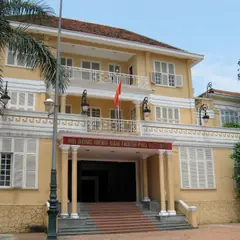
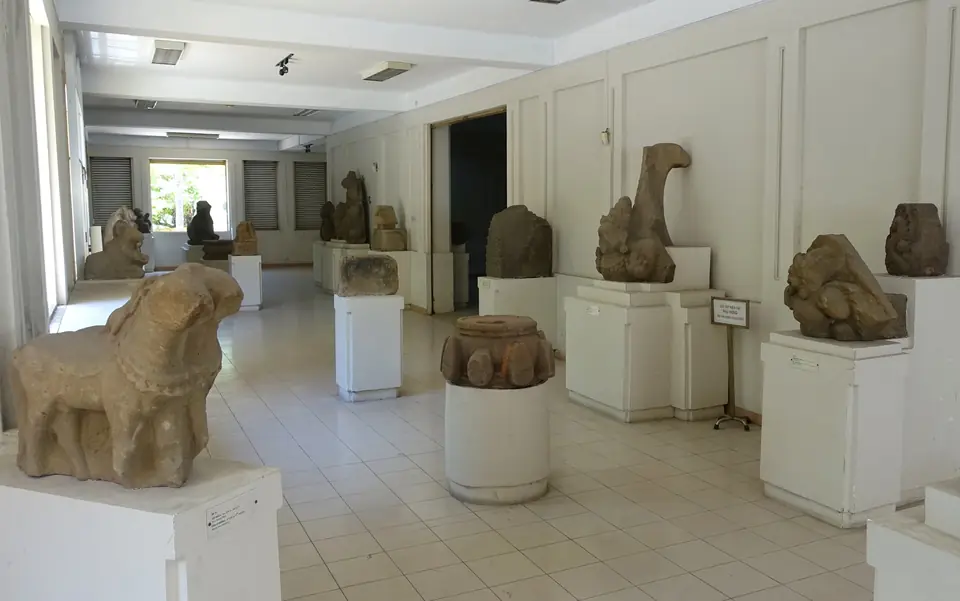
Da Nang's Museum of Cham Sculpture, Bảo tàng Điêu khắc Chăm to the locals, was born between 1915 and 1919 on the old "sculpture garden" of Tourane, beside the Hàn River, when the École française d'Extrême-Orient paid out of its own funds for a building for pieces that were wearing away in the open air. Its facade incorporates elements of Cham towers following drawings by Henri Parmentier, and since 1936 the rooms have been arranged by site: Mỹ Sơn, Trà Kiệu, Đồng Dương and Tháp Mẫm. Today it displays 433 objects and holds 12 national treasures of Vietnam.
Almost every piece has survived by a narrow margin. The museum was looted in 1946 and some sculptures reached Laos; many spent decades fixed with cement to the walls. And the bronze Tara of Đồng Dương, which some villagers took to be gold, had her fingers and the attributes in her hands broken off to test them at a jeweller's: the lotus and the conch did not return to her hands until 2025, after an Indian president asked about them.
Highlights
- Trà Kiệu altar — 61 figures in relief and three different readings
- Mỹ Sơn E1 altar — a miniature Cham tower from around the 7th century
- Bronze Tara of Đồng Dương — the lotus and the conch, back in her hands
- Tháp Mẫm dragon — half of a pair whose twin is in Paris
- Facade of 1915-1919 — details copied from Cham towers
Before it was a museum, this was a garden. In 1892 the French resident Charles Lemire moved 50 Cham sculptures to the Tourane Garden, the same plot beside the Hàn River that the Da Nang Museum of Cham Sculpture occupies today, and in 1893 he asked the colonial authorities for a building to protect them. He never saw it: the first pavilion went up in 1915, three years after his death, paid for by the École française d’Extrême-Orient (EFEO) out of its own funds and designed by Henri Parmentier. Not even the founding date is unanimous: some sources give 1915, when works began; others 1916, when they ended, and others April 1919, when the Musée de Tourane opened. The number of pieces in that first collection varies, depending on who counts, between 160 and 236.
The history of Bảo tàng Điêu khắc Chăm is that of stones that survived by a narrow margin. The excavations at Trà Kiệu and Tháp Mẫm forced it to be extended in the 1930s; in 1946, with the Franco-Vietnamese war, it was looted, and during the Vietnam War an armed guard protected it. After the renovation of 2016-2017 it displays 433 objects in 1,755 m² of rooms named after excavation sites, and twelve of its pieces are National Treasures of Vietnam. The press often presents it as the oldest museum in the country; other sources prefer to call it one of the oldest and compare it with the Louis Finot Museum in Hanoi, whose building dates from 1926.
What to see at the Museum of Cham Sculpture comes down to five names: the garden and the ochre facade, the Trà Kiệu altar with its 61 figures, the miniature tower of Mỹ Sơn E1, the bronze Tara of Đồng Dương and the Tháp Mẫm dragon. The audio guide walks the collection in five stops, from the entrance garden to the Tháp Mẫm room, with narration researched and fact-checked against historical sources that keeps for each room what the sandstone does not tell at a glance.
The museum is about five hundred metres from the west end of the Dragon Bridge. Downriver, the Da Nang Museum continues the story of the city from French Tourane, and outside the display cases the carved stone carries on in the cave shrines of the Marble Mountains.
The garden where the gods waited for a roof
Bảo tàng Điêu khắc Chăm Đà Nẵng
Summary of this stop
The tour starts outside, at number 2 on 2 Tháng 9 Street, facing the original building with its ochre walls. Its ornaments are not a whim: the French architects Delaval and Auclair incorporated elements of Cham towers following Parmentier’s drawings, so that the facade imitates the temples from which the pieces it holds inside come. Works finished in 1916, but the First World War delayed the opening of the Musée de Tourane until April 1919.
Among trees and frangipanis, several sandstone sculptures still stand in the open air, as a reminder of the “sculpture garden” that preceded the museum on this same mound. That garden was precisely what made a roof necessary: the collections of Lemire and Camille Paris, exposed to the elements, were deteriorating because visitors touched them, and when the colonial government refused to provide a building, the EFEO decided to pay for it. According to residents of the old village of Nại Hiên Tây, where there was an old Cham well, the Giếng Bộng, the extension of around 1935 had another price: peasant families are said to have had to leave their homes, without compensation, to make room for the side wings.
From the gate the west end of the Dragon Bridge also peeks out, lowered to level 0, the level of the roadway, so that the deck would not hide the building. Why a museum born to protect stones began as a garden where anyone could touch them is the idea with which the narration opens the visit.
An altar of 61 figures and three stories
Trà Kiệu altar
Summary of this stop
The Trà Kiệu room explains the principle that organises the whole museum. The EFEO excavations at Trà Kiệu (1927-1928) and Tháp Mẫm (1934) filled the building until two side wings had to be added, and on 11 March 1936 it reopened as the Musée Henri Parmentier, with rooms organised by site: Mỹ Sơn, Trà Kiệu, Đồng Dương and Tháp Mẫm. That criterion still governs the tour. Who presided over that reopening is another matter: one version cites Emperor Bảo Đại, another only colonial authorities and EFEO scholars, and another stresses the presence of Parmentier himself.
In the centre stands the star piece: a square sandstone pedestal, a National Treasure since 2012, with 61 figures in relief spread over its four faces. Its date changes with the source, from the 7th century to the 7th-8th centuries or to the 10th century, and so does its subject. In 1930 Jean Przyluski saw in it the legend of the founding of the kingdom of Funan; a year later George Cœdès refuted him and proposed episodes of Krishna, who cures the hunchback Trivakra and breaks King Kamsa’s bow. Later the Vietnamese researcher Trần Kỳ Phương read it as the Ramayana: Rama breaking the divine bow at the court of King Janaka to win the hand of Sita, the embassy to King Dasaratha, the wedding and, on the fourth face, apsaras dancing to celebrate it.
From the same site comes another national treasure, declared in 2024, that takes up the dance: a 10th-century sandstone relief with two apsaras in the tribhanga posture. What the great altar really tells has no settled answer, and the audio guide lays out the debate in front of the block, so that each visitor can walk round it and judge for themselves whether they see the birth of a kingdom, Krishna or the wedding of Rama and Sita.
A miniature Cham tower and Ganesha’s belly
Mỹ Sơn E1 altar
Summary of this stop
In the Mỹ Sơn room, the altar of tower E1, from around the 7th century, is a complete piece of architecture at reduced scale: several sandstone blocks fitted together reproduce a Cham tower with stairways, arches, floral motifs and sacred creatures, and on the plinth are carved ascetics in the forest and a flute player. In 2012 it was among the first 30 objects declared National Treasures of Vietnam, together with the Trà Kiệu altar and the Tara of Đồng Dương.
Around it are gathered other pieces from the same sanctuary: the tympanum of the arch of tower E1, with Brahma being born from Vishnu’s navel, brought to the museum in 1935, and the statue of Ganesha of the 7th century found in 1903 at tower E5. The collection also includes a dancing Shiva of the 10th century, found in 1890 in the village of Phong Lệ, within what is now Đà Nẵng, and declared a national treasure in 2024.
Ganesha’s round belly holds a neighbourhood story. For decades the locals called the building the “Musée Chàm”, and one resident tells that his grandmother, raised beside a Cham tower and fearful of its spirits, warned him not to pick up any money he found on the ground when walking past, for fear of the spells she attributed to the Cham remedy sellers. How that boy ended up touching Ganesha, and what his grandmother answered, is the episode the narration keeps for this room.
The goddess they thought was gold
Bronze Tara of Đồng Dương
Summary of this stop
The Đồng Dương room gathers the art of a great Buddhist monastery. Its altar of 24 sandstone blocks, from the late 9th century, comes from the main tower and is guarded by dvarapala guardians with severe faces and thick lips. Henri Parmentier published it describing the postures of its figures without saying what they told; Jean Boisselier, in “La Statuaire du Champa” (1963), compared its panels with the reliefs of Borobudur and read in them the life of the Buddha, from the birth of Prince Siddhartha in the garden of Lumbini to Mara’s daughters trying to pull him from his meditation. The museum also holds the largest sandstone Buddha of Cham sculpture, which turned up broken in the 1902 excavation; according to the documentation of the find, two heads came out alongside the body, and the one it wears today is a cast copy of the one kept in the National Museum of Vietnamese History in Hanoi.
The protagonist, however, is a bronze female figure almost 1.15 metres tall, with a bare torso, a pleated sarong and a high bun with a small Buddha. She appeared in 1978 (some sources say 1979), when villagers of Đồng Dương were digging Cham bricks for the cooperative’s rice-drying yard; believing her to be gold, they broke off fingers and the attributes of the hands to test them at a jeweller’s. It was bronze, and the statue ended up in the museum. Her name is not settled either: “Tara” was proposed by Jean Boisselier some five years after the find, and a 2020 study defends it on the strength of the Buddha Amoghasiddhi under the serpent Mucalinda in her bun, while others identify her with Laksmindra-Lokesvara, the deity to whom Indravarman II dedicated the monastery according to the Đồng Dương stele.
In November 2018, visiting the museum, the president of India, Ram Nath Kovind, noticed the break marks on her hands and asked about the missing pieces. The guide accompanying him knew that the lotus and the conch were still in the commune of Bình Định Bắc, kept by the village since 1978; they passed to the Quảng Nam Museum in 2019 and to the Museum of Cham Sculpture on 9 December 2023, and since mid-November 2025 they have been mounted provisionally in her hands, with the fracture lines in view. How a question asked aloud ended up giving the statue back what had been torn from it is the story the audio guide tells in front of her.
The dragon that lost its twin
Tháp Mẫm dragon
Summary of this stop
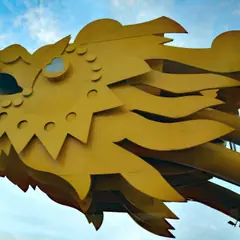
The last room travels south, to Tháp Mẫm, a hill within the old Cham capital of Vijaya, in Bình Định. In the 1934 excavation, the EFEO collected there 58 tonnes of sculptures and decorative stone pieces, so many that they gave their name to a whole style. From the 12th-13th centuries come its two national treasures: the Gajasimha, with an elephant’s head and a lion’s body, and a sandstone dragon-makara about 1.58 metres long, lying down, with its hind legs raised behind and a collar of bells. Dragons were placed in pairs at the entrance of towers, and according to the excavation documentation, this one’s companion is displayed in the Musée Guimet in Paris.
The room also sums up the fate of the museum itself. In 1946, as the Franco-Vietnamese war spread, it was looted and lost its archive and many pieces; by 1948 150 objects had been recovered, some arriving from as far as Laos. In the following war, through the efforts of the Musée Guimet, the same one that keeps the dragon’s twin, the building had a permanent armed guard and came through undamaged; by then, since 1963, the South Vietnamese administration had renamed it the Đà Nẵng Museum.
There remained a quieter enemy: between 1915 and 1936 many sculptures were fixed with cement to walls or plinths, which damaged their condition, and it was not until the 2016-2017 renovation that they were reinstalled in rooms named after excavation sites. What separates this dragon from its pair in Paris, and why so many stones in these rooms survived by so little, is the story with which the narration closes the tour.