Cave shrines and pagodas
Marble Mountains Audio Guide (Ngũ Hành Sơn)
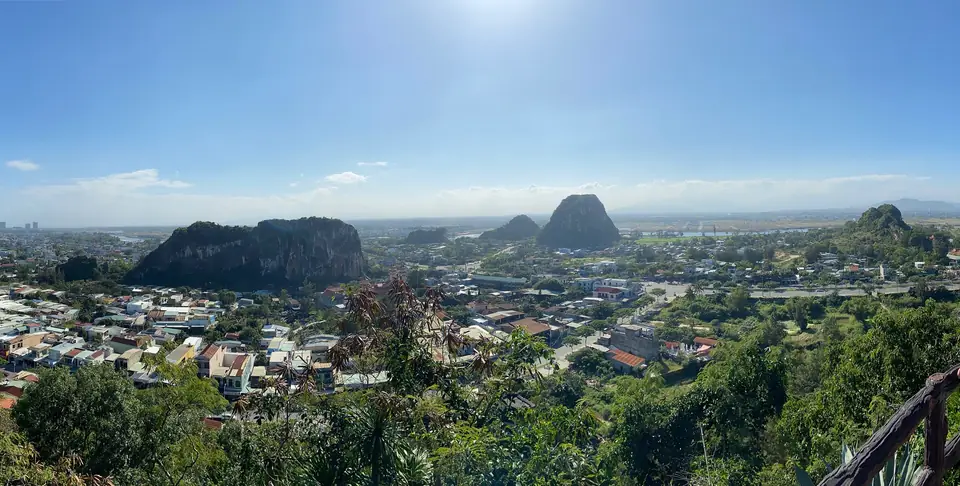
Six outcrops of marble and limestone that were once islands now rise from the sand between Đà Nẵng and Hội An. Inside they are riddled with cave shrines where an emperor carved his calligraphy, Japanese merchants left their names in 1640 and the guerrillas set up an operating theatre.
- 120 min of audio
- Buddhist caves and pagodas
The Marble Mountains, Ngũ Hành Sơn, the "mountains of the five elements", appear under that name in a treatise of 1806, and a map of 1686 already recorded the massif as Non Nước. In 1837 Emperor Minh Mạng fixed the name of each peak by edict and had it carved into the rock. On Thủy Sơn, the largest of them all, pagodas, imperial stairways and caves are spread out, whose 78 rock inscriptions entered UNESCO's Memory of the World Asia-Pacific register in 2022.
The five mountains of the five elements are, in fact, six peaks. And the same outcrop that holds Buddhist altars and the calligraphy of the Nguyễn kings had at its foot, from 1965, a US Marine helicopter base, and guerrillas and the wounded came to hide in its caves. Of the 78 inscriptions recognised by UNESCO, only 52 are still legible.
Highlights
- 1640 stele in Hoa Nghiêm Cave — 53 donors, among them Japanese and Chinese merchants of Hội An
- Huyền Không Cave — a vault with natural skylights, a guerrilla refuge and surgical post in 1968
- Ma nhai rock inscriptions — 78 texts in UNESCO's Memory of the World register
- Gate 1 stairway — 156 steps laid out on Minh Mạng's orders in 1825
- Âm Phủ Cave — the "underworld" where five guerrillas held out through a whole day of siege
Before they were mountains they were islands. The Marble Mountains, Ngũ Hành Sơn to the Vietnamese, are six outcrops of marble and limestone that rise from the sand between Đà Nẵng and Hội An, and their history is written, literally, in the stone. The name “mountains of the five elements” already appears in 1806 in Lê Quang Định’s Hoàng Việt nhất thống dư địa chí; before that, the 1686 map Thiên Nam tứ chí lộ đồ thư recorded the massif as “Non Nước Sơn tam đỉnh”, a popular name that is still alive on the beach and in the stonecutters’ village at the foot. In 1837, the 18th year of his reign, Emperor Minh Mạng fixed by edict the name of each peak (Thủy, Mộc, Kim, Thổ and the double Hỏa) and had it carved into the rock. The press usually credits him with the naming, although the 1806 treatise suggests the edict rather confirmed names that already existed.
The history of the Marble Mountains is also that of their own stone. Since the reign of Gia Long, a law reserved the monopoly of Ngũ Hành Sơn marble for the State. In colonial times, the French set up at the foot of Mộc Sơn, the Mountain of Wood, a large factory with a railway line hundreds of metres long that crushed the rock to pave roads in Đà Nẵng and Hội An, and its slopes were left bitten “like a ruined wall”. Extraction was banned in 1990, and the rock still commands respect: in September 2011, a block of almost 100 tonnes broke away from more than 50 metres up on Mộc Sơn and crushed the homes of two families. On neighbouring Kim Sơn, the venerable Thích Pháp Nhãn found in 1956 a stalactite shaped like a human-sized Quan Thế Âm, the origin of a festival that in 1999 joined the 15 national folk festivals; and on Hỏa Sơn, according to a documented tradition, Princess Ngọc Lan, Minh Mạng’s sister, refused to return to the palace with a poem that made the king give up.
What to see at the Marble Mountains fits on a single mountain, Thủy Sơn, the largest of the group: an imperial stairway, the national Tam Thai Pagoda, cave shrines bathed in overhead light, viewpoints with stone steles and, at the end, the darkness of Âm Phủ, which has its own entrance and a separate ticket, like the modern lift at gate 1. The audio guide walks it in five stops, from the foot of the stairway to the “underworld”, with narration researched and fact-checked against historical sources that reads these rocks as a book in which emperors, merchants, monks and guerrillas wrote their names, and from which some pages are fading.
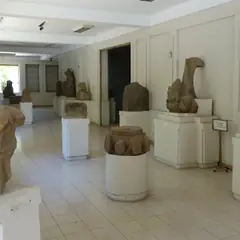
To the north, the coast leads to My Khe Beach, the former China Beach, and in central Da Nang the Museum of Cham Sculpture completes the journey through the region’s carved stone with the altars and gods of the temples of Champa.
A stonecutters’ village without a quarry
Gate 1 stairway
Summary of this stop
The tour begins below, at the foot of the gate 1 stairway, among the streets that surround the mountains. Rows of stone statues (Buddhas, lions, Cham figures, portraits) line the yards of the Non Nước workshops, the stonecutters’ village that arose around the 17th century, when Huỳnh Bá Quát arrived from Thanh Hóa. Their craft has been national intangible cultural heritage since 2014, but a paradox lies at its centre: since 1990, when Quảng Nam–Đà Nẵng province banned the extraction of stone from the mountains, the workshops have worked with stone brought from other regions. The village lives off marble in the shadow of a marble it can no longer touch.
The 156-step stairway that climbs from the southwest to Tam Thai Pagoda was the first mark of an emperor taken with this outcrop. Minh Mạng visited Thủy Sơn three times, in 1825, 1827 and 1837, and two months after the first visit ordered two stone stairways built to the summit: this one, now gate 1, and the eastern one, now gate 2, which climbs in 108 steps to Linh Ứng Pagoda, facing the sea, beside the Xá Lợi tower, about 28 metres tall. That same year he gave Tam Thai its name and the rank of national pagoda.
At the foot of Thủy Sơn there also stood the “nhà lục giác”, a hexagonal pavilion where kings and mandarins rested before climbing. It lost its tiles after 1975 and ended up demolished, and today it survives only in an old photograph kept at Tam Thai. What is missing at this point says as much as what is still standing, and the narration begins precisely with that absence.
A national pagoda born of a vow
Chùa Tam Thai
Summary of this stop
At the top, the courtyard of Tam Thai Pagoda greets visitors with a statue of Maitreya, frangipanis and bonsai. Its rank of “quốc tự”, national pagoda, has behind it a legend that local tradition repeats: fleeing the Tây Sơn, Lord Nguyễn Ánh, the future Emperor Gia Long, took refuge on an island and vowed to give thanks to Heaven and Buddha if fresh water sprang up. The water sprang up, and on returning to the mainland he came upon these mountains and some monks preaching inside a cave. He then made a second vow: if he won, he would raise a pagoda there. His son kept the promise, hence the saying that still circulates in the area: “Gia Long phát nguyện, Minh Mạng lập chùa”, Gia Long made the vow, Minh Mạng built the pagoda.
What can be seen today is not the pagoda of the kings. Tam Thai was made of reeds and leaves in the late 16th century, rebuilt in brick and tile on Minh Mạng’s orders, collapsed in a storm in 1901 and was rebuilt six years later with donations from the faithful. In 1995 it was redone in concrete, and in 2010 the monks’ residence took over the site of the old imperial rest palace, the hành cung.
According to a documented tradition, about four hundred years ago a painting left this pagoda, “Thác kiến Quán Thế Âm”, Quan Âm contemplating the waterfall, as a gift from the king of Annam to the red-seal ship of the Chaya, a family of Japanese merchants who came to Hội An. The original is still in Japan, in Jomyo Temple, in the Nagoya region. How and when part of that story returned to this mountain is the episode the audio guide keeps for the courtyard.
Japanese names and an operating theatre in the rock
Động Huyền Không
Summary of this stop
To the right of Tam Thai the path to the caves opens. On the wall of Hoa Nghiêm, to the left of the statue of Quan Âm, the stele “Phổ Đà Sơn Linh Trung Phật” is carved directly into the rock, raised by the monk Huệ Đạo Minh in 1640. In Hán characters it lists 53 donors, among them Japanese and Chinese merchants settled in Hội An, who contributed thousands of quan, tens of taels of silver and hundreds of cân of copper to build Bình An Pagoda on Thủy Sơn. How many of those names are Japanese is disputed: Lê Trí Viễn’s translation counts eight, and other sources speak of at least ten families.
Further in opens Huyền Không, a great chamber shaped like an inverted bell where light enters through natural skylights. High up, a Thích Ca Buddha carved in 1960 by the master stonecutter Nguyễn Chất; to the right, the Trang Nghiêm shrine, of 1825, with the altar of Ông Tơ and Bà Nguyệt, to whom people pray for a partner. Thiên Y A Na, the goddess of Cham origin, is also venerated here, a remnant of a sacred use older than Vietnamese Buddhism. According to local tradition, disputes used to be settled before her altar with an oath of rooster’s blood, and childless women drank the water that drips from the stalactites.
The same vault has a much less serene memory. Huyền Không was a clandestine base of the local guerrillas during the war against France; later, US and South Vietnamese forces used it as a commando training ground and barracks, and in 1968 the Liberation Army drove them out and turned it into a surgical post and hiding place for the wounded. At dawn on 23 August of that year, Captain Phan Hiệp fought a battle here that changed his name. What it became, and what remains in the cave of that time of oaths and miraculous springs, is what the narration tells beneath the skylights.
Five elements, six peaks and fading letters
Vọng Giang Đài stele
Summary of this stop
The small pavilion of the Vọng Giang Đài, the river viewpoint, holds a stone stele measuring 1 × 2 metres with the characters of its name, dated to the 18th year of Minh Mạng; its twin is the Vọng Hải Đài, the sea viewpoint. From the heights of Thủy Sơn the peaks can be counted, and the count holds a surprise: the five mountains of the five elements are six, because Hỏa Sơn, the one of fire, is double. The edict of 1837 distinguished Dương Hỏa and Âm Hỏa, and on the west slope of Hỏa Sơn, facing Kim Sơn, the large characters “Dương Hỏa Sơn” are still carved with the date “Minh Mạng year 18, month 7”.
A local legend has its own explanation for the number. An old fisherman lived alone in a hut on the sand when a dragon came out of the sea in the middle of a storm and dropped a huge egg; the golden turtle Kim Quy buried it and gave the old man one of its claws to warn him of dangers. The egg grew until it filled the hut, and when it finally split, its shell fragments became marble mountains. What came out of it, and in which cave the old man awoke, is part of the story.
These rocks are also an archive. On 26 November 2022, in Andong (South Korea), UNESCO’s Asia-Pacific regional Memory of the World committee inscribed the 78 “ma nhai” rock inscriptions of Ngũ Hành Sơn, 76 in Hán characters and 2 in Nôm, the work of Nguyễn kings, mandarins and monks between the first half of the 17th century and the 1960s; some sources raise the collection to 90. It was the first international recognition of a heritage site of Đà Nẵng. But only 52 are still legible: the rest have eroded, been buried under layers of paint and cement, cracked or had additions in the Vietnamese alphabet that distort the characters. In Tàng Chơn Cave alone there are about twenty, several barely visible without a torch. What the ones that can still be read say is the thread of this stop.
Five men besieged in the underworld
Động Âm Phủ
Summary of this stop
On the south side, with its own entrance and a separate ticket, Âm Phủ Cave, the one of the “underworld”, is walked towards a growing darkness, until near the centre an opening lets the sky show. Outside, on the strip of beach between China Beach and the mountains, US Marines completed the Marble Mountain Air Facility in August 1965, a helicopter base with a 610-metre runway. On the night of 27 to 28 October of that same year, some 90 Vietcong guerrillas attacked it with Bangalore torpedoes and grenades and destroyed 19 helicopters.
Beneath that opening one of the tensest episodes of the war in the massif took place. Before dawn on 24 December 1968, five men of the Đội quyết tử, the “suicide squad” of Quảng Đà front 4, took refuge in Âm Phủ on returning from scouting the Nước Mặn air base. Surrounded, they held out the whole day firing at the soldiers who came down on ropes through the hole in the ceiling, and left at night. Since then they have been known as the “5 dũng sĩ Ngũ Hành Sơn”, the five brave men of Ngũ Hành Sơn.
The cave also carries an older popular belief. Legend has it that Minh Mạng wanted to know how far the passage going down to the bottom of the earth reached and ordered twelve soldiers to descend with torches; all their flames went out, and all had to turn back. What the emperor then did with a piece of fruit, and where it is said to have appeared the next day, is the story with which the audio guide closes the tour, in the dark.