Emblem of the new Da Nang
Dragon Bridge Audio Guide (Cầu Rồng)
A steel dragon modelled on the Lý dynasty crosses the Hàn River towards the sea, and at weekends, at nine at night, it spits fire and water over the city. The Dragon Bridge is the signature of the Da Nang that was born in 2013.
- 30 min of audio
- Steel bridge shaped like a dragon
The Dragon Bridge, Cầu Rồng in Vietnamese, opened to traffic on 29 March 2013, the 38th anniversary of the Liberation of Da Nang, to link the international airport with the centre and with the beaches of Mỹ Khê and Non Nước. It is a steel arch of five main spans and 666.6 metres, with a 37.5-metre deck for six lanes that in 2013 had the widest cross-section in Vietnam, and over it undulates a dragon flying towards the East Sea.
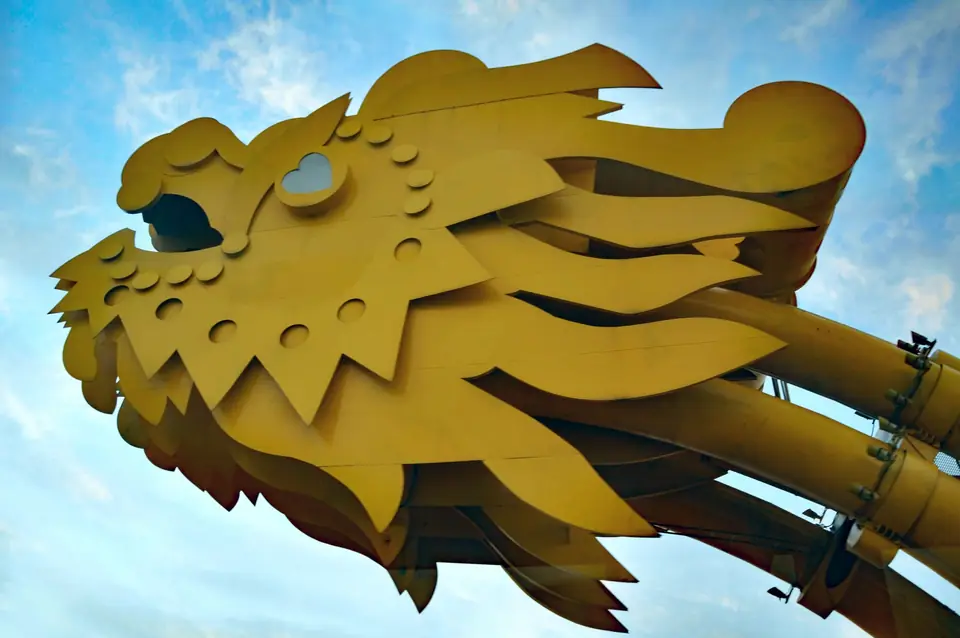
The head, 10 metres high and weighing 37 tonnes, is not there just for the photo: three nights a week it launches first fire and then a cloud of steam driven by compressed air. And a rumour goes round the city: whoever ends up soaked beneath the dragon will soon find love.
Highlights
- Dragon's head — 10 metres of steel that spit fire and water
- 9 pm show — fire and steam from Friday to Sunday
- Undulating back — over 560 metres of steel tube above the Hàn River
- LED lighting — over 2,500 lights, award-winning in 2014
- Marble dragon-carp — 7.5 metres carved in Non Nước
The history of the Dragon Bridge begins with a competition. At the end of 2005, the Da Nang People’s Committee invited eight consultancies, four Vietnamese, two Japanese, one German and one American, which submitted seventeen proposals; in October 2007 the one from the American consortium of Louis Berger and Ammann & Whitney won. The sources do not share out the credit equally, and one specifies that the idea, the form and the technique came from the United States, but the detailed and construction designs were signed by Vietnamese contractors. Work began on 19 July 2009 on the east bank of the Hàn, the same day the nearby Thuận Phước Bridge was inaugurated, with Prime Minister Nguyễn Tấn Dũng at the ceremony.
The architecture of the Dragon Bridge is measured in record figures: 666.6 metres of steel arch, a central span of 200 metres, six lanes and a dragon whose body is a steel tube of more than 560 metres. Even the sources do not entirely agree on them: the dragon’s weight is given as almost 9,000 tonnes or as 8,164, and the length of the undulating arch changes from one document to another. What is indisputable is the result: a bridge that links the airport with the centre and with the sea, and that three nights a week stops the traffic so the dragon can spit fire.
What to see at the Dragon Bridge is covered on foot, from tail to head, along the pavement and beneath the steel back, ending on the east bank facing the marble carp from which the weekend show is best seen. The audio guide tells it in four stops, with narration researched and fact-checked against historical sources that keeps for each point what the steel does not say at a glance.
On the west bank, the bridge starts about five hundred metres from the Museum of Cham Sculpture and less than a kilometre from Han Market; on the east, the road it opened towards the sea ends, in less than two kilometres, at My Khe Beach.
A flower tail with a Vietnamese signature
Dragon's tail
Summary of this stop
The tour starts at the west end, on the Bạch Đằng Street promenade, where the dragon ends in a tip of 9.5 metres and 30 tonnes beside a pedestrian rest area. Its shape is vegetal, and that is where the first nuance begins: the artist Phạm Văn Hạng, who designed the head and tail on commission, describes it as a bouquet of flowers, while part of the Vietnamese press reads it as a stylised lotus flower.
The bouquet is not a decorative whim. Phạm Văn Hạng conceived it, like the heart-shaped eyes of the head, as an image of the hospitality of the people of Da Nang: a gesture of welcome crowning a structure that had won an international competition among seventeen proposals.
From the tail, the yellow back disappears towards the river and the head lies far off, looking at the sea. Why a bridge designed across the Pacific ended up with such a local greeting at its end is the idea with which the narration opens the walk.
The night the dragon didn’t spit
Central span over the Hàn River
Summary of this stop
In the centre of the deck, over the river, the bridge shows its scale. The central span measures 200 metres and leaves seven metres of clearance for the tourist boats that pass beneath; the roadway, 37.5 metres wide, shares out six lanes with a six-metre median and pavements on both sides, a cross-section that in 2013 was the widest in Vietnam. It was all finished against the clock: during Tết 2013, more than a thousand engineers and workers stayed on site to finish it on 29 March, the 38th anniversary of the entry of North Vietnamese forces into Da Nang in 1975, the same day the new Trần Thị Lý Bridge opened.
The inauguration had an unexpected ending. According to the account of that night, thousands of people jammed the bridge for three hours waiting for the fire, the police could not clear the roadway and the project director, Phạm Trường Sơn, postponed the show for safety: the dragon spat neither fire nor water. A photo published years later in the same outlet, with a caption that speaks of fire at the ceremony, keeps the doubt alive.
Today that roadway is emptied before each show, and someone has to do it. Lê Hùng Thạnh has worked on Da Nang’s bridges since 2000; after more than ten years as a patrolman he moved to the operations team and often takes the night shift that diverts traffic before the fire. What his colleagues face when they climb to the top of the dragon is the episode the narration keeps for this stretch.
Fire, steam and a prize-winning soaking
Dragon's head
Summary of this stop
At the east end, towards Trần Hưng Đạo Street and the sea, the head waits: 10 metres high, 15 long and 37 tonnes of steel modelled on the stone dragon of the Lý dynasty. From here the whole can be understood, a dragon crossing the Hàn flying towards the East Sea, with a body that, in section, is five steel tubes 1.2 metres in diameter.
Since 29 July 2022, on Fridays, Saturdays and Sundays and on major holidays, at 21:00, traffic is diverted and the head springs into action. The show lasts about five minutes: two of fire and three of water, which comes out pushed by compressed air as a cloud of steam and not as a jet, with 20 cubic metres of water and 41 kWh per discharge. In the test of 6 March 2013 the dragon launched nine fireballs three to four metres in diameter that reached between 10 and 15 metres, and each show night burns 54 to 81 litres of fuel.
Beneath the head, the unwritten rule is that whoever stands there ends up drenched. It is said that in April 2021 a young man, Lưu Công Trần, came in a raincoat on a dry, hot night, and that his photos went round Facebook among memories of first soakings. What rumour about love accompanies the drenched, and why someone joked that the one in the raincoat must already have a partner, is revealed by the audio guide beside the dragon.
A marble carp that wanted to be a dragon
Tượng Cá Chép Hóa Rồng
Summary of this stop
On the east bank, beside the bridge, since April 2015 stands the statue “Cá chép hóa rồng”, the carp that turns into a dragon: 7.5 metres and almost 200 tonnes, five blocks of white marble carved in three months by Nguyễn Hùng and thirty craftsmen from the stonecutting village of Non Nước. The legend says that a carp with a pearl in its mouth defeated many other animals, crossed three gigantic waves and became a dragon, an image of success, good luck and courage; that is why its head spouts water, like the dragon able to bring rain to end a drought. Some consider it a copy of Singapore’s Merlion, although the myth of the carp is far older than the lion-fish, raised in 1972.
From here the steel dragon can be seen whole, with its steel back of more than 560 metres and its lights trembling on the water. In 2013 Da Nang submitted to Guinness its candidacy as the longest steel dragon, although no certificate appears in the sources consulted. Every night it is lit by more than 2,500 LED luminaires that change colour according to the occasion: Trần Văn Thanh’s lighting design, of ASA Studios, received in 2014 a Special Citation from the International Association of Lighting Designers, the first for a Vietnamese design.
The city also knows how to switch it off. On 20 March 2020, with COVID-19 already in Da Nang, the dragon fell silent, and its return, on 12 February 2022, drew thousands of people an hour before the show. And on Lunar New Year’s Eve the script changes. What the dragon does on the most festive night of the year, when one might expect more fire than ever, is the twist with which the narration closes the tour.