Fort land front
Clock Tower Audio Guide (Galle Fort Clock Tower)
It looks as old as the wall, but it is a British addition of 1883: a thank-you in granite to a doctor who was still alive and who, six years later, stood up to stop the fort from being pulled down.
- 25 min of audio
- 1883 British tower
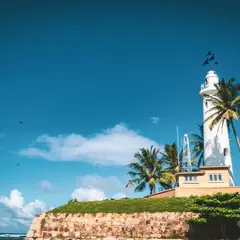
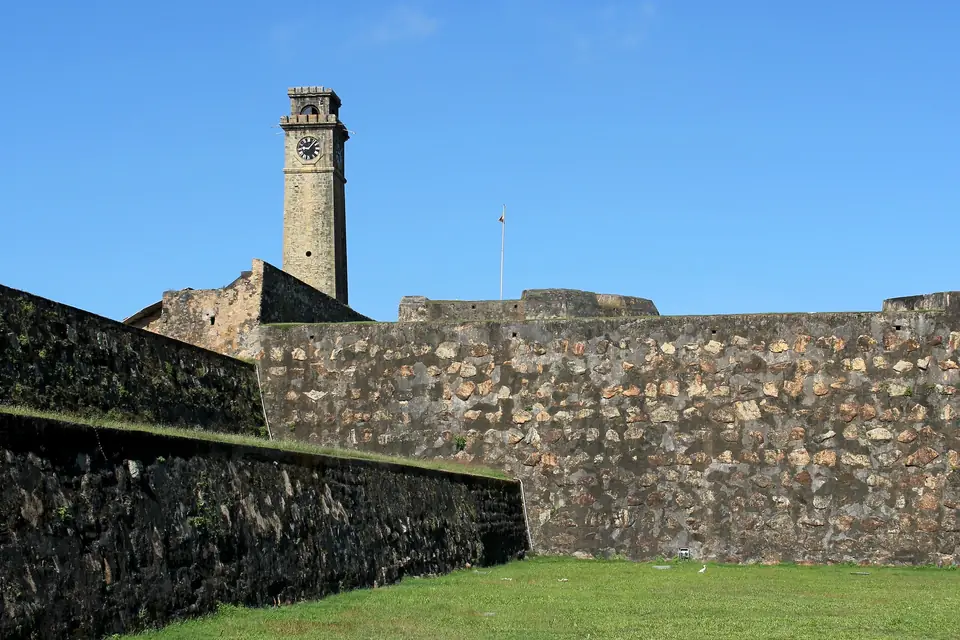
Galle Clock Tower was built in 1883 on the Moon bastion, the centre of the land front, the most heavily fortified stretch of the enclosure because it faces inland. It stands some 25.3 m tall, the equivalent of four storeys, occupies the site of the old guardroom and is made of squared granite blocks brought from England. The plaque dedicates it to Peter Daniel Anthonisz, a doctor born in Galle, in testimony of his skill and benevolence in relieving human suffering; hence it is also known as the Anthonisz Memorial Clock Tower.
The formula “to the perpetual memory” is misleading: the man honoured returned to Galle as chief medical officer that very year, 1883, and lived another twenty years. In 1889 he led the opposition to the Government’s plan to demolish the walls, which he said protected against the monsoon tides. In 2004, on the other side of that wall, the tsunami flattened the new town, and from this bastion you can see the cricket ground where English schoolboys waited on a balcony for the sea to recede.
Highlights
- Clock tower — some 25.3 m of English granite, with a dial on each face
- 1883 plaque — dedicated during his lifetime to Dr Peter Daniel Anthonisz
- Main Gate — the British arch of 1873 cut into the wall where there used to be a moat
- Moon bastion — Conceição to the Portuguese, Maan from 1667, with 19 cannons around 1760
- Clock repaired by the Navy — set running again on 16 July 2009
Many people assume Galle’s clock tower is Dutch, because it stands inside a Dutch fort and its stone looks to be of the same age as the wall. It is not. It is a British addition of the last quarter of the 19th century, built in 1883 on the Moon bastion, beside the Main Gate through which almost everyone now enters the fort. According to the plaque and several sources, it was paid for by the townspeople through public subscription and the clock was a gift from a grateful patient; other sources attribute the whole work to that same benefactor, and some even link it to Queen Victoria’s jubilee or date it to 1882. What is not disputed is the name engraved on it: that of Dr Peter Daniel Anthonisz.
The square that opens before the tower has its own history. According to tradition, here, beside the old Dutch bell tower, Commander Fretz handed over the garrison’s keys on 23 February 1796 to Captain Lachlan Macquarie on a silver tray, without a shot fired and in tears. The story of Galle Clock Tower, documented and checked against historical sources, is walked in four stops and 25 minutes with the audio guide, from the entrance arch to the edge of the bastion.
The wall that its honoree defended from demolition is walked in full on the Galle Fort Walls route, and some 300 m away waits the Dutch Reformed Church, with its tombstone floor.
An arch opened by elephants
Galle Fort Main Gate
Summary of this stop
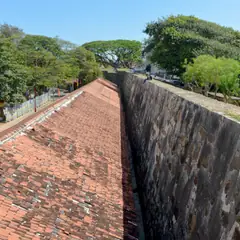
The route begins in front of the Main Gate, before the thickest mass of wall in the fort. The land front was born as a Portuguese wall with a moat; the Dutch extended it and in 1667 divided it into three separate bastions, Star, Moon and Sun. It was the side facing the land, the only one by which an army could arrive, and that is why it is the most fortified of the whole enclosure.
The arch the visitor crosses today is not part of that design. The British opened it in 1873, when Galle had become the administrative centre of southern Ceylon: they cut the wall between the Moon and Sun bastions and filled in the moat, of which not a trace of water remains.
According to tradition, the original entrance was a tunnel under the Sun bastion, with a peephole for pouring boiling oil on attackers, and to open the British gate the moat was filled and the wall was pierced with the strength of elephants. How that hidden entrance can still be recognised is one of the details the narration reserves for this spot.
A plaque in memory of a living man
Galle Fort Clock Tower
Summary of this stop
At the foot of the tower the contrast is immediate: smooth, squared granite brought from England against the rough coral of the bastions. The plaque, dated MDCCCLXXXIII, dedicates the monument “to the perpetual memory” of Peter Daniel Anthonisz, born in Galle, in testimony of his skill and benevolence in relieving human suffering.
That formula has confused even recent press, which gives him up for dead too soon. In fact, Anthonisz returned to Galle as chief medical officer in 1883, the same year as the tower, and died on 12 June 1903. Son of the chief clerk of the customs house and eldest of ten siblings, he is remembered as a bachelor who never found time to marry.
Among his patients was Governor Sir William Gregory, who went so far as to say in public that he would not be there but for the doctor’s skill and resolve. What happened in Galle on the day of his funeral, and where he rests today, a few minutes from the tower, closes this stop.
Three dials, three times and a rope pendulum
Clock dials
Summary of this stop
From the lawn of the Moon bastion the clock’s dials can be seen, one on each face. The clock was the exclusive gift of Mudaliyar Samson de Abrew Rajapakse of Kosgoda, a grateful patient of Anthonisz, and the tower was raised on a design by John Henry Gues Landon. Its British machinery cost £25 sterling.
Its life has not been calm. During the cricket Test between Sri Lanka and Pakistan, from 4 to 7 July 2009, the cameras focused on the tower from the stadium with the clock stopped: three of its dials showed three different times. The council was planning to replace them with digital clocks when the engineers of the Sri Lanka Navy stepped in, made the missing wheels and bars and set it running on 16 July 2009 for 12,000 rupees.
According to a documented tradition, the mechanism lacked brass parts that someone had taken on the pretext of repairing it, and the sailors provisionally hung the pendulum with ropes. Around 2017 lightning struck the tower, which was restored with a new lightning rod. Whether the clock still keeps time today is something sources do not agree on, and what happened when television focused on it again weeks after that embarrassment is the best part of the episode.
The doctor who would not let the wall be pulled down
Moon Bastion
Summary of this stop
The north edge of the Moon bastion is the final viewpoint. This bulwark was Conceição to the Portuguese, “Middle Point” to the first Dutch and Maan, Moon, from 1667; around 1760 it mounted 19 cannons. At its feet stretches the Galle International Stadium, formerly the Esplanade and a racecourse of 1876.
In November 1889 Anthonisz led local opposition to the Government’s project to demolish the walls, arguing that they protected the fort from the tidal floods of the south-west monsoon. Colombo, by contrast, had lost its own between 1869 and 1871. On 26 December 2004 the tsunami flattened Galle’s new town while the old town, behind the wall, suffered much less damage. It did not come through intact, as is often repeated: the neighbouring Star bastion was one of those that had to be thoroughly restored between 2007 and 2008.
That morning, the cricket team of the English school Harrow was warming up in the stadium below when the first wave arrived. How boys and coaches held out for more than three hours while the water moved their bus over the grass, and where they found shelter that night, is the episode with which the route closes.